
Denied by AI: Know Your Rights Against Screening Bias
Ever Been Rejected for an Apartment and Never Found Out Why?You filled out the application. You paid the fee. You waited. Then came the denial email vague, cold, and final. No explanation. Just "does not meet our screening criteria." Here's what most renters don't realize: a human probably never looked at your file. A piece of software did. And that software may have used flawed data, outdated records, or factors that have nothing to do with whether you'd actually be a good tenant. Landlords across the country now lean on automated tenant screening platforms to check credit, criminal history, and eviction records in seconds. It's fast, it's cheap, and it feels "objective." But objective isn't the same as fair and a growing pile of lawsuits, settlements, and new state laws says these tools can quietly discriminate against the very people the Fair Housing Act was built to protect. How AI Tenant Screening Actually Works Most screening platforms pull data from credit bureaus, court records, and eviction databases, then run it through a scoring model. The model spits out a number or a color-coded "recommendation" approve, deny, or flag for review. The problem is what happens inside that black box. These systems often use proxy variables things like zip code, name patterns, or rental history gaps that correlate with race, national origin, or disability status even though they're never labeled that way. The algorithm isn't told to discriminate. It just learns patterns from historical data that already reflects decades of housing inequality, and then repeats them at scale. Eviction records are a classic example. Filing an eviction case is easy and cheap for landlords, even when the case is later dismissed or the tenant wins. Many screening tools count the filing itself, not the outcome. That quietly penalizes tenants disproportionately women, people of color, and domestic violence survivors for eviction cases they never lost. The Legal Risk Landlords Aren't Watching The Fair Housing Act doesn't just ban obvious, intentional discrimination. It also bans policies that look neutral on paper but fall harder on a protected group a legal theory called "disparate impact." That means a landlord can lose a fair housing case even if no human ever intended to discriminate. If the algorithm's output has that effect, the landlord is on the hook, because courts have made clear that outsourcing a decision to a vendor doesn't outsource the liability. That's exactly what played out in one of the most closely watched cases in this space. In Louis v. SafeRent Solutions, renters including a Black woman named Mary Louis sued a major screening company, arguing its scoring algorithm downgraded applicants using housing vouchers and disproportionately hurt Black and Hispanic renters. A federal court in Massachusetts approved a settlement worth about $2.275 million, and SafeRent agreed to stop issuing "approve" or "decline" recommendations for voucher holders unless the model is independently validated for fairness. SafeRent didn't admit fault, but said continuing to litigate would cost more than settling. It's one of the first cases of its kind, and it sent a clear signal: "the algorithm did it" is not a defense. Regulators haven't stayed quiet either. The Federal Trade Commission and Consumer Financial Protection Bureau previously extracted $15 million from a major screening company over inaccurate background reports, and states are now moving faster than Washington. Colorado's AI Act treats tenant screening systems as "high-risk," requiring fairness testing, consumer disclosures, and human review before decisions go out. New York lawmakers have proposed rules forcing landlords to plainly disclose when AI is involved in a rental decision and to explain, in plain language, exactly what criteria were used. Meanwhile, federal guidance on this topic has been pulled back and reinstated more than once which means the safest legal ground right now isn't waiting on Washington, it's following your state and city rules and the underlying statute itself. What Renters Can Do If They Get DeniedYou have more leverage than you think:Request the actual report. Under the Fair Credit Reporting Act, you're entitled to a free copy of any screening report used to deny you, along with the name of the company that generated it.Ask for the specific reason. A landlord can't just say "didn't pass screening." You're entitled to know which factor triggered the denial.Dispute errors directly with the screening company. Mixed-up identities, resolved eviction filings, and outdated criminal records are common and correctable.File a complaint with HUD, your state fair housing agency, or a local tenant rights organization if you believe the denial reflects a pattern tied to race, disability, source of income, or another protected class.Talk to a fair housing attorney before you assume the denial is final. Many consultations are free, and disparate impact claims often hinge on data patterns a lawyer can help uncover.What Landlords Can Do to Avoid a LawsuitIf you manage rental property, a few habits go a long way:Vet your vendor. Ask screening companies how their model was tested for bias and whether it's been independently audited.Build in human review. Never let a score alone trigger an automatic denial, especially for borderline cases or voucher holders.Distinguish filings from outcomes. Don't penalize applicants for eviction cases that were dismissed or resolved in their favor.Document everything. If you deny someone, keep a written record of the specific, individualized reason not just "algorithm flagged."Watch your state law, not just federal guidance, since states like Colorado and New York are moving faster than Congress.FAQsIs it legal for a landlord to use AI to screen tenants?Yes, but the decision the AI produces still has to comply with the Fair Housing Act and local tenant screening laws. Legal to use, not automatically legal in outcome.Can I sue a landlord for a discriminatory algorithm? Yes. Disparate impact claims under the Fair Housing Act don't require proof of intent only that a policy or tool produced a discriminatory effect on a protected class.Does the screening company or the landlord get sued? Often both. Recent cases have named the software vendor directly, but landlords remain independently responsible for the decisions made using that software.What if I was denied because of an old eviction filing that was dismissed? Ask for a free copy of your report and dispute it. A dismissed filing shouldn't count against you, and many jurisdictions now limit how far back these records can be reported.Are housing voucher holders protected from AI scoring?Increasingly, yes. Recent settlements and several state laws specifically restrict automated scoring for applicants using housing assistance.ConclusionAI tenant screening isn't going away it's getting more common, not less. But "the computer said no" has never been a legal shield, and courts and regulators are making that clearer every year. Whether you're a renter who just got a confusing denial or a property owner trying to stay compliant, the algorithm doesn't get the final word. The law does.If you've been denied housing and suspect bias, or you're a landlord looking to audit your screening process before it becomes a lawsuit, reach out to our fair housing team for a consultation.Book your consultation today

SRA Disputes in Mumbai: Why Your Slum Redevelopment Case Might Be Stuck
You signed the papers. You waited for your new flat. Ten years later, you're still waiting — or worse, you're being asked to vacate a home you've lived in for decades. If this sounds familiar, you're not alone. Thousands of Mumbai families are caught in Slum Rehabilitation Authority (SRA) disputes right now, and most don't know what rights they actually have. This isn't a niche legal issue. It's a daily reality for slum dwellers, developers, housing societies, and even law students trying to make sense of one of India's most litigated urban policy frameworks. Let's break it down in plain language. What Exactly Is the SRA, and Why Do Disputes Happen? The Slum Rehabilitation Authority was set up under the Maharashtra Slum Areas (Improvement, Clearance and Redevelopment) Act, 1971, to convert slums into proper housing. In theory, it's simple: a developer builds free flats for slum dwellers in exchange for extra construction rights (FSI) they can sell.In practice, it gets messy fast. Common flashpoints include:Eligibility fights — who counts as a genuine slum dweller versus a later encroacherTransit rent non-payment — developers stop paying rent to displaced families mid-projectStalled projects — construction halts for years due to funding or approval issuesAnnexure-II disputes — disagreements over the official list of eligible beneficiariesDeveloper-society conflicts — private settlements that clash with SRA's own rules Each of these can trap a family in limbo for years, and often the only way out has been to knock on the Bombay High Court's door. New Law Update: The "Special Cells" Order That Changes EverythingHere's the big one. On 23 December 2025, the Bombay High Court delivered a major ruling in Om Shri Sai SRA Co-operative Housing Society v. State of Maharashtra & Ors., disposing of over 60 pending writ petitions in one go. What did the Court actually do? Instead of letting each case drag through years of litigation, it directed newly formed Special Cells within the SRA to promptly and effectively address grievances relating to non-payment of transit rent by developers and eligibility disputes.Two things stand out for everyday citizens:These Special Cells aren't courts. The Court clarified they are not independent adjudicatory bodies but forums for amicable, mediation-style dispute resolution the idea being a quick settlement rather than adversarial litigation. Financial protection is built in. To stop developers from defaulting on rent again, the Court directed SRA to freeze a portion of the developer's free-sale component specifically the lower floors as security until the rehab building is finished and transit rent dues are cleared.What this means for you: if you're a slum dweller waiting on unpaid rent or disputed eligibility, you now have a faster, less intimidating first stop before heading to court. And if the Special Cell doesn't resolve it, you can still approach the statutory forums afterward nothing is taken away from you. Policy Shift: "Majhe Ghar, Majha Adhikar"Beyond court rulings, the state government itself is rewriting the rulebook. Under the "Majhe Ghar, Majha Adhikar" policy launched in May 2025, the state moved away from piecemeal single-slum projects toward redeveloping entire wards at once, rehabilitating multiple slum clusters through integrated planning meaning better roads and parks instead of isolated towers in still-crowded areas.Another practical change: areas like parking, staircases, lifts, and lobbies are now included in FSI calculations, which pushes builders toward constructing higher-quality buildings with real amenities instead of cutting corners on saleable area. Central government land can now also be pooled into joint ventures for rehabilitation projects, opening up more sites beyond crowded private plots. If you're negotiating with a developer or checking a project's status, it's worth verifying against these updated rules the ground has shifted since 2025. Case Law Breakdown: Can a Private Deal Override the SRA?Here's a ruling every tenant, society member, and developer should understand. The Supreme Court held that private agreements within Slum Rehabilitation Schemes cannot be enforced if they go against the SRA's own statutory directives, reinforcing that the SRA alone has authority over how the scheme is implemented under the 1971 Slum Act. The backstory: a housing society had a settlement with a developer over how flats would be allotted. But when it came time to allot units, the SRA instead followed its own circular requiring a draw of lots among hutment dwellers, rather than the terms of the earlier private agreement. The society challenged this and lost, all the way up to the Supreme Court.The Court's core reasoning, in plain words: no private MoU, however well-intentioned, can tie the SRA's hands. Bombay High Court's earlier ruling in the Usha Dhondiram Khairnar case had already established that neither slum societies nor private developers get to dictate terms to the SRA the authority must simply follow its own established policies and circulars. Why it matters: if you've signed a side agreement with a developer that promises something outside SRA's official process, don't assume it's enforceable. Get it formally routed through SRA's own procedures, or it may not hold up.FAQs1. My developer stopped paying transit rent. What can I do? Approach the SRA's Special Cell first for a quicker resolution. If unresolved, you can still move the Bombay High Court or the relevant statutory forum.2. Can the SRA remove a developer from a stalled project? Yes. Courts have upheld SRA's power to reassign a stalled project to another developer under Section 13(2) of the Slum Act when there's contravention of approved plans or long, unexplained delays.3. What if I'm not on the eligibility list (Annexure-II)? You can raise this with the SRA CEO's committee, which now includes nominees from MHADA and the Municipal Corporation specifically for resolving these disputes.4. Can litigation stall a redevelopment project indefinitely? Not easily. Courts have made clear that a person who sits on their rights for years cannot suddenly challenge a project just to delay it timely objections matter.5. Is a private settlement with my developer legally binding? Only if it aligns with SRA's own policies and circulars. If it conflicts with SRA's rules, it won't be enforced, regardless of what was agreed privately.6. Who do I contact for updates on my SRA project? Track it directly through the official SRA portal, since implementation rules are still evolving under the new ward-based redevelopment policy.ConclusionSRA disputes aren't just paperwork problems they affect where families sleep at night and how developers plan crores in investment. The good news is the legal and policy landscape is actively shifting toward faster resolution: mediation-first Special Cells, financial safeguards against defaulting developers, and clearer rules on what private deals can and can't override. If you're stuck in a dispute, don't wait it out silently. Check whether a Special Cell exists for your project, verify your Annexure-II status, and if things still don't move, the Bombay High Court remains open to you.

Can a Business Deal Gone Wrong Land You in Jail? Delhi High Court Says No
You signed a contract. The other side didn't deliver. You're angry, you've lost money, and someone tells you: "Just file an FIR, that'll scare them into paying up."Stop right there. The Delhi High Court has been saying, loudly and repeatedly, that this shortcut is illegal. A broken business promise is not automatically a crime and using the police to collect a commercial debt can get your own case thrown out of court. If you run a business, sign vendor contracts, or are simply curious about how Indian courts are drawing the line between civil wrongs and criminal offences, this one's for you. The Big Trend: Courts Are Done With "FIR as Leverage"For years, a familiar playbook existed in Indian business circles: goods don't arrive, payment bounces, a deal falls apart — and instead of filing a civil recovery suit (which takes time), the aggrieved party rushes to the police station with a cheating or criminal breach of trust complaint. It's faster, it's scarier, and it often pressures the other side into settling. Courts have started shutting this down hard. New Law Update: The Latest Delhi High Court RulingIn a fresh order this month, the Delhi High Court stayed the registration of an FIR in a commercial dispute involving an alleged shortfall in the supply of goods worth over ₹1.75 crore. The magistrate below had directed the police to register a case, but the High Court found the order legally shaky it didn't even clearly spell out what criminal offence had actually been committed. The judge leaned on a well-known Supreme Court precedent, Indian Oil Corporation v. NEPC India Ltd. (2006), which had already warned against the "growing tendency in business circles" to convert ordinary civil disputes into criminal prosecutions as a pressure tactic. The Delhi High Court called the practice something that deserves to be actively discouraged, not encouraged by lower courts mechanically ordering FIRs. Case Law Breakdown: The ₹8.38 Crore Real Estate DisputeHere's a simpler example that shows exactly how this plays out. A group of investors had signed an MoU with a real estate developer for commercial development rights and flat allotments. When the project didn't go as promised, the investors accused the developer of fraud and cheating, and pushed for an FIR under multiple IPC sections.The Delhi High Court refused. Justice Neena Bansal Krishna held that not every broken promise is cheating for a criminal case to stick, there has to be proof that the person never intended to honour the deal right from the start. In this case, the court found the real story was a failed business arrangement, not a scam. The flats weren't delivered as expected, yes but that's a contract problem to be fought out in a civil court, not a police station. The court's core reasoning, in plain English: disappointment with a business outcome isn't the same as being cheated. Intent to deceive has to exist at the time the deal was made not just be assumed after things go wrong. The Important Exception Nobody Talks AboutThis isn't a blanket rule that FIRs can never follow a contract dispute. In 2025, the Supreme Court actually revived an FIR that the Delhi High Court had quashed, clarifying that simply having a parallel civil case doesn't automatically mean the criminal complaint is baseless. If there's genuine prima facie evidence of forgery, fabrication, or fraud, the criminal process can still run alongside a civil claim. Takeaway: courts look at facts, not labels. Calling something "cheating" doesn't make it cheating. But real evidence of fraud isn't erased just because a contract also exists.What This Actually Means for YouIf you're a business owner or vendor: don't assume an FIR is your fast lane to recovering dues. If the dispute is genuinely about delayed delivery, quality issues, or payment default with no proof of dishonest intent from day one, criminal courts likely aren't the right forum and you could face costs for misusing the process.If an FIR has been filed against you over what looks like an ordinary business disagreement, you may have strong grounds to approach the High Court under Section 482 CrPC (or its BNSS equivalent) to get it quashed.If you're a corporate legal team: document intent-related communications carefully. Emails, WhatsApp chats, and payment timelines that show good-faith effort matter enormously if a criminal complaint is later filed against your company.Frequently Asked QuestionsQ: Can I file an FIR just because someone didn't pay me as agreed? Not automatically. Non-payment alone is usually a civil breach. You'd need to show dishonest intent existing at the time the contract was made.Q: What's the difference between "cheating" and "breach of contract"? Breach of contract is simply failing to keep a promise. Cheating requires proof that the person never intended to keep that promise in the first place.Q: I already filed a civil suit can I still pursue a criminal case for the same dispute? Yes, in principle, if there's independent evidence of fraud. But courts will scrutinise whether the criminal complaint is genuine or just a pressure tactic.Q: My FIR was quashed does that mean I lose my money? No. Quashing an FIR doesn't affect your right to recover dues through a civil suit or arbitration; it only removes the criminal angle.Q: What about property or employment disputes same rule? Broadly yes. Courts apply similar logic in property disagreements (e.g., builder-buyer disputes) and employment contract breaches: the wrong needs criminal ingredients, not just a broken promise, to justify police action.Q: Where can I read the actual judgments? You can check official orders on the Delhi High Court website and track Supreme Court judgments via main.sci.gov.in.The message from the Delhi High Court is consistent: contracts belong in civil court, crimes belong in criminal court, and mixing the two to gain leverage will backfire. If you're dealing with a business dispute, get proper legal advice before choosing your battlefield it could save you time, money, and a wasted trip to the police station.Book your consultation today

Safe Harbour Liability: Why Creators & Platforms Can't Stay Passive
IntroductionFor years, "safe harbour" was the quiet safety net that let platforms and creators sleep at night. Host third-party content, don't interfere, remove what's flagged, and the law would treat you as a neutral conduit, not a publisher. That comfort is fading fast.Regulators across the world, and now sharply in India, are rewriting the deal. Safe harbour is no longer a badge you wear automatically. It is a privilege you must keep earning, in real time, through proactive moderation. Miss the mark, and the immunity that once protected you can vanish, exposing creators and platforms to civil and criminal liability for content they never even created.If you run a platform, manage a community, or build a following as an independent creator, this shift affects you directly. Here is what is changing, why it matters, and what to do about it.What Is Safe Harbour Liability, ReallySafe harbour is a legal shield, traditionally under Section 79 of India's Information Technology Act, that protects intermediaries from liability for content posted by users, provided the platform exercises due diligence and does not conspire in or knowingly benefit from unlawful content.In simple terms, if someone posts something illegal on your platform and you had no role in creating it, you were traditionally not treated as the publisher, as long as you acted responsibly once you learned about it.That "acted responsibly" part is where everything is changing.From Reactive Takedowns to Proactive ModerationUntil recently, most platforms only needed to act after receiving a complaint or court order. That reactive model is being replaced by a proactive one.Under the newer Information Technology Rules framework, significant platforms are now expected to actively detect, label, and remove harmful or synthetically generated content before it spreads, not just after someone complains. Takedown windows have also tightened dramatically, with some categories of unlawful content requiring removal within hours of formal notice, and complaints involving individuals expected to be actioned on a similarly compressed timeline.This is a structural shift. Waiting for a notice and then acting is no longer enough to preserve your immunity. Regulators now expect continuous monitoring, traceability, and swift, demonstrable action.Why Independent Creators Are Not ExemptMany creators assume safe harbour debates are a "big tech" problem. That assumption is increasingly risky.Creators who run communities, forums, comment sections, fan groups, or user-generated content spaces on their own platforms or apps can themselves be treated as intermediaries. If your platform hosts user comments, uploads, or interactions and you fail to build in grievance redressal, content moderation, and compliance processes, you may not get the protection you assumed you had.Independent creators are also increasingly exposed as victims, not just as intermediaries. Deepfakes, impersonation accounts, morphed images, and synthetically generated content targeting a creator's name, face, or voice can spread rapidly across platforms. When a platform fails to act on such content proactively, the creator bears the reputational and financial damage while regulators debate whether the platform's immunity should have collapsed.The Real Risk of Non-ComplianceLosing safe harbour protection is not a technicality. It changes a platform's legal position entirely, from a neutral host to a party potentially liable for the content itself.The practical risks include:Civil liability for defamation, privacy violations, or intellectual property infringement tied to user content.Criminal exposure in cases involving obscene material, threats, incitement, or synthetically generated harmful content.Regulatory penalties and directions from government authorities for non-compliance with proactive moderation and takedown timelines.Reputational damage that often outlasts the legal dispute itself, particularly for creator-led platforms and startups.For independent creators, the added risk is personal: your name, image, or voice being misused while the hosting platform slow-walks removal, and no immediate legal remedy is in sight.What Proactive Compliance Actually Looks LikeMeeting the new standard is not about vague good intentions. It requires structured, demonstrable steps:Publishing clear, updated terms of service that specifically prohibit categories of harmful content.Setting up an accessible, functioning grievance redressal mechanism with a designated compliance officer.Building monitoring systems capable of detecting synthetically generated or harmful content before widespread circulation.Acting within the mandated timelines once actual knowledge is received, whether through a court order, government notice, or user complaint.Maintaining documented, auditable records of every moderation decision and takedown action.Platforms and creators that treat compliance as an ongoing operational discipline, rather than a one-time checklist, are the ones best positioned to retain their legal protections when challenged.What This Means If You Are a Victim of Platform InactionIf harmful, defamatory, or synthetically generated content about you has been left up despite complaints, you are not without options. The evolving legal framework increasingly recognises that platforms cannot hide behind safe harbour when they fail to act proactively. This gives victims stronger grounds to demand takedowns, pursue compensation, and hold platforms accountable for delay or inaction.The challenge is that these cases move fast, involve technical evidence, and require precise legal drafting to succeed within the compressed timelines the law now allows.How Fairaigle Legal & Consultancy LLP Can HelpFairaigle Legal & Consultancy LLP works with independent creators, startups, and digital platforms on exactly this intersection of technology and law.For platforms and creators building compliance frameworks, the firm assists with drafting compliant terms of service and grievance redressal policies, structuring moderation and escalation workflows, and advising on obligations under the current Information Technology Rules so that safe harbour protection is not lost through avoidable gaps.For victims of online harassment, impersonation, defamation, or synthetically generated content, the firm helps identify the right legal remedy, prepares and files takedown notices and complaints within the mandated timelines, and represents victims in pursuing accountability from platforms that failed to act.If you are unsure whether your platform is compliant, or if harmful content about you is still online despite your complaints, a timely legal consultation can make the difference between a resolved matter and an escalating one.Frequently Asked QuestionsDoes safe harbour protection still exist for platforms in India? Yes, but it is now conditional on demonstrable, proactive due diligence rather than automatic. Platforms that fail to meet moderation and takedown obligations risk losing this protection entirely.Can an independent creator lose safe harbour protection? If a creator's platform, app, or community space hosts user-generated content and lacks proper compliance mechanisms, that creator can be treated as an intermediary and held liable in the same way as a larger platform.What happens if a platform does not remove harmful content within the required timeline? Missing mandated takedown windows can strip a platform of its safe harbour immunity, exposing it to civil and criminal liability for the content it failed to remove.Are deepfakes and synthetically generated content covered under these rules? Yes. Newer amendments specifically address synthetically generated information, requiring labelling, provenance metadata, and proactive detection, with non-compliance directly threatening a platform's immunity.What should a victim do if a platform ignores their takedown request? Document the content and communication with the platform, then seek legal assistance promptly, since remedies and timelines under the current framework are time-sensitive.How can a platform prove it exercised due diligence? Through documented terms of service, a functioning grievance mechanism, timely action logs, and evidence of proactive monitoring systems, all of which should be reviewed and maintained with legal guidance.ConclusionSafe harbour is no longer a passive shield. It is an active obligation that creators and platforms must maintain through visible, timely, and well-documented compliance. Waiting for a complaint before acting is a strategy from a legal era that no longer exists.Whether you are building a platform that needs to stay compliant, or you are a creator whose content or identity has been misused online, the right legal guidance at the right time protects far more than your immunity. It protects your reputation, your business, and your peace of mind.Get in Touch If you need clarity on your platform's compliance obligations, or you are a victim seeking accountability for content that should have been removed, reach out to Fairaigle Legal & Consultancy LLP for a consultation. Timely action is often the deciding factor in these matters, so the sooner you speak with a legal expert, the stronger your position.Book Your Consultation for Expert Guidance.

AI Hallucinations: Courts Crack Down on Fake Case Law
A judge in Andhra Pradesh once based an order on four judgments that never existed. In Bengaluru, a tax tribunal recalled a ₹669-crore order after discovering it rested on citations nobody could find. In Mumbai, the High Court fined a litigant ₹50,000 for a filing so obviously AI-written it still carried the chatbot's green tick marks.None of these are edge cases anymore. They are the new normal, and courts everywhere are done tolerating it.What Is an AI Hallucination in Legal PracticeAn AI hallucination happens when a tool like ChatGPT invents a case citation, a quote, or an entire judgment with total confidence, and none of it is real. Large language models are built to predict plausible-sounding text, not to retrieve verified legal records. The result reads exactly like a real precedent, right down to the case name, the court, and the year. The only problem is that it never happened.Lawyers who skip the one step that matters, actually checking the citation against a real database, are the ones who end up in front of a disciplinary bench.The Ruling That Changed EverythingOn July 2, 2026, the Supreme Court of India set aside NCLT and NCLAT orders in the Essel Infraprojects insolvency matter after finding that six of the judgments relied on were defective. Three did not exist at all. The other three were real cases stuffed with invented paragraphs or wrong titles.The Court did not treat this as a technical slip. It called hallucinated case law comparable to a toxic gas leak in the province of law and justice, directed the Bar Council of India to frame disciplinary norms, and made clear that a decision resting even partly on fake material is no decision at all in the eyes of the law.This built on an earlier warning. In February 2026, the Court took suo motu notice of a trial court order in the Gummadi Usha Rani matter that had relied on fabricated judgments, and declared that this is not an error in the decision-making process. It is misconduct, with legal consequences that follow.A Pattern That Has Been Building for Two YearsThe Essel ruling did not come out of nowhere. It is the latest entry in a growing list of Indian cases where fake AI citations blew up in court.Bombay High Court, January 2026. A litigant was fined ₹50,000 for dumping AI-generated case laws into written submissions, complete with the telltale formatting of raw chatbot output.Delhi High Court, September 2025. A petition was withdrawn in embarrassment after opposing counsel exposed the citations as fabricated, including invented paragraphs attributed to a landmark constitutional case.Punjab and Haryana High Court, early 2026. Judges were directed not to rely on AI while drafting judgments, on the reasoning that technology cannot substitute for human reasoning.Income tax and GST tribunals, 2025 - 2026. Multiple orders, including a roughly ₹28-crore assessment upheld by the Bombay High Court, were quashed after AI-invented precedents surfaced in the record. Quasi-judicial officers, not just lawyers, have been found using AI-fabricated content in official proceedings.The same story is playing out abroad. In the United States, a public tracker has now logged more than 1,600 court decisions worldwide involving AI-hallucinated material. Sanctions have climbed from a symbolic 5,000 dollar fine in 2023 to more than 110,000 dollars in a single Oregon matter, and an Omaha attorney was suspended in April 2026 after denying, then admitting, that AI had fabricated the bulk of his citations. England and Wales, Australia, South Africa, and Argentina have all recorded similar incidents.Why the Cover-Up Is Always Worse Than the MistakeAcross nearly every sanctioned case, one detail repeats. Courts punish concealment far more harshly than the original error.Lawyers who admitted the mistake immediately and corrected the record generally received lighter consequences. Lawyers who denied using AI, blamed a junior associate, or quietly refiled without disclosure were the ones who lost their license to practice or faced six-figure penalties. Candor is the one thing a chatbot cannot supply on a lawyer's behalf.What Courts Are Doing NowThe judicial response is no longer limited to warnings. It now includes:Setting aside any order that relies even partly on unverified AI material, regardless of the outcome's substantive merit.Directing bar councils to frame formal disciplinary norms specifically for AI misuse.Escalating monetary sanctions well beyond token fines, with some orders now calculated per fake citation and per fabricated quote.Referring repeat or dishonest offenders for suspension.Instructing judges and tribunal members themselves not to rely on AI-drafted material without independent verification.The direction of travel is unmistakable. Zero tolerance is no longer a phrase in a judgment. It is becoming the operating standard.What This Means for YouIf you are a litigant, an order built on a hallucinated citation may be challengeable on that ground alone, even if you never raised the underlying facts. If you are a lawyer or in-house counsel, every AI-assisted draft now needs the same verification discipline as any other piece of work product, because supervision liability falls on the person who signs the filing, not the tool that drafted it. If you are relying on a tribunal order that turns out to rest on fake precedent, you may have real grounds to have it recalled.Frequently Asked QuestionsCan a court order be challenged just because it cites a fake case? Yes. Indian courts have already set aside and recalled orders solely because the citations relied upon did not exist or were misattributed, independent of the case's other merits.Is using AI to draft legal documents banned in India? No. The Supreme Court's own white paper on AI in the judiciary endorses its use as a research aid. What is prohibited is filing or relying on AI output without independently verifying every citation.Who is held responsible when AI generates a fake citation, the lawyer or the AI tool? The lawyer. Courts have consistently held that the duty of verification and candor sits with the advocate who signs and files the document, regardless of which tool produced the draft.Can a client be penalized for their lawyer's AI mistake? Directly, sanctions are usually imposed on counsel. Indirectly, clients have faced real damage, including opposing counsel's fees that were not reversed even after their own lawyer was sanctioned, and orders that had to be relitigated from scratch.What should I do if I suspect an order against me relied on a fake precedent? Get the citations independently verified against an authentic legal database before you file anything. If a fabrication is confirmed, it can form an independent ground for appeal, review, or recall.How Fairaigle Legal & Consultancy LLP Can HelpIf an order, assessment, or tribunal ruling against you was built on a citation that turns out not to exist, you are not without a remedy, and you do not have to work out the legal pathway on your own.Fairaigle Legal & Consultancy LLP works with individuals, businesses, and professionals who have been affected by AI-hallucinated case law, whether the fabrication came from the other side's filing, a tribunal's own order, or an assessment that relied on invented precedent. Our team independently verifies every citation in the record against authentic sources, identifies the strongest ground for appeal, review, or recall, and represents you through the process of getting a flawed order set aside.We also help lawyers and businesses build the kind of verification workflow that keeps them out of this problem entirely, so an AI-assisted draft never becomes a liability with your name on it.If you believe you have been affected by fake case law in your own matter, do not wait for the next hearing to find out the hard way. Talk to Fairaigle Legal & Consultancy LLP today for a confidential case review.

Telangana HC Limits Automatic FIRs on Social Media
If you have ever posted a critical opinion, a meme, or a piece of political satire online and worried about a knock on your door, there is now a strong legal shield for you. The Telangana High Court has laid down clear guidelines that stop police from registering FIRs against social media posts without following due process, and the Supreme Court has upheld them. Here is what this means for anyone who speaks their mind online. The Case That Changed the RulesThe guidelines came out of a case involving posts on X that were critical of the Telangana government and the Chief Minister. Multiple FIRs were filed against the poster under provisions relating to defamation, intentional insult, and public mischief, mostly triggered by complaints from police personnel or unrelated individuals rather than anyone directly affected by the posts. The Telangana High Court quashed these FIRs, holding that the posts, though harsh, were political criticism protected under Article 19(1)(a) of the Constitution. The court went further and issued binding operational guidelines for how police must handle any future case involving social media speech. The state government challenged this before the Supreme Court, which refused to interfere and upheld the guidelines in full. What the Guidelines Actually Say 1. The Complainant Must Have StandingBefore registering an FIR over an allegedly defamatory post, police must first verify whether the person filing the complaint is genuinely the "aggrieved person." A random bystander or a police official with no personal connection to the post cannot trigger a criminal case on someone else's behalf, unless the complaint independently discloses a cognizable offence. 2. A Preliminary Inquiry Is Now Mandatory This is the core of the ruling. Even in cases involving cognizable offences, where police can normally act without a magistrate's permission, they must first conduct a preliminary inquiry to check whether the basic ingredients of the alleged offence are actually present. An FIR cannot be registered on the strength of a complaint alone. The court relied on the Supreme Court's own precedent in Lalita Kumari v. Government of UP, which had already established that mechanical registration without inquiry violates due process. 3. A High Threshold Applies to Speech-Related Offences Charges such as promotion of enmity, intentional insult, public mischief, or anything resembling sedition cannot be slapped on a social media post unless there is clear, prima facie material showing incitement to violence, hatred, or a genuine threat to public order. The court anchored this threshold in two landmark judgments, Kedar Nath Singh v. State of Bihar and Shreya Singhal v. Union of India, both of which draw a firm line between criticism and incitement. 4. Political Satire and Criticism Are Protected The court was direct on this point: police cannot mechanically register cases over posts that are harsh, offensive, or critical of a political party or leader. Satire, sarcasm, and strong political opinion fall within protected speech unless they cross into incitement or a direct threat to public order. 5. Defamation Cannot Be Converted Into a Routine FIR Criminal defamation is a non-cognizable offence under law. This means it cannot simply be reported to a police station and turned into an FIR. The aggrieved person must approach a magistrate directly, and police cannot bypass this route by dressing up a defamation complaint as some other offence. 6. Prior Legal Opinion for Sensitive Cases For politically sensitive posts or speeches, police are directed to obtain the opinion of the Public Prosecutor before proceeding, adding a layer of legal scrutiny before any case can move forward. Why This Ruling Matters Beyond Telangana The Supreme Court's refusal to interfere gives these guidelines strong persuasive weight across the country, even though they remain formally binding only within Telangana for now. Legal commentators note that courts and lawyers elsewhere are already citing this judgment when arguing against arbitrary FIRs over social media speech, which means its practical impact is spreading well beyond one state. For the ordinary social media user, the message is simple: criticism of a government, a leader, or a policy is not automatically a crime. Police cannot use vague or exaggerated charges to intimidate someone into silence, and every FIR over online speech must now clear a real procedural check before it is even registered. What to Do If an FIR Is Filed Against You If police register a case against you over a post, comment, or share, do not assume the process was followed correctly. Ask whether a preliminary inquiry was actually conducted, whether the complainant had genuine standing, and whether the charges meet the incitement threshold the courts have set. Many FIRs filed in haste do not survive this scrutiny once challenged. Frequently Asked QuestionsCan police arrest me immediately for a critical post about a politician? No. Under the Telangana High Court guidelines, upheld by the Supreme Court, police must first conduct a preliminary inquiry and confirm that the post meets a high threshold of incitement to violence or public disorder before any case, let alone an arrest, can proceed.Is criticizing the government or Chief Minister on social media illegal? No. Harsh political criticism, satire, and strong opinion are protected under Article 19(1)(a) of the Constitution, as long as the content does not incite violence or create a genuine threat to public order.Can someone unrelated to me file a defamation complaint over my post? Generally, no. The guidelines require that only a genuinely "aggrieved person" can trigger a defamation-related complaint. Complaints from unrelated third parties, including police personnel, do not automatically qualify unless a separate cognizable offence is disclosed.Are these guidelines applicable only in Telangana? Formally, yes, they are binding within Telangana. However, since the Supreme Court declined to interfere with them, they carry strong persuasive value and are increasingly cited in courts across other states as well.What should I do if an FIR has already been registered against me for a social media post? You can challenge the FIR by showing that the mandatory preliminary inquiry was skipped, that the complainant lacked standing, or that the content does not meet the legal threshold for the offence alleged. This is best done with proper legal representation before the case escalates. Does this ruling protect obscene or abusive content as well? No. The protection applies to political criticism and satire. Content that is genuinely obscene, defamatory with false factual claims, or incites violence is not shielded by these guidelines. How Fairaigle Legal & Consultancy LLP Can HelpGetting an FIR registered over a social media post, a shared meme, or a piece of political commentary can be alarming, especially when it is used as a pressure tactic rather than a genuine legal process. Fairaigle Legal & Consultancy LLP works with individuals who find themselves on the receiving end of exactly this kind of case.Our team reviews whether the police followed the mandatory preliminary inquiry, whether the complainant actually had the standing to file the case, and whether the charges invoked meet the threshold the courts have laid down for speech-related offences. Where the process has been bypassed, we move quickly to challenge the FIR and protect your rights. If you or someone you know is facing an FIR, police notice, or intimidation over a social media post, reach out to Fairaigle Legal & Consultancy LLP for a confidential consultation. Your right to speak, criticize, and disagree is protected by law, and we are here to make sure it stays that way.Book Your Consultation to Get Expert Guidance
Google India Named Co-Accused in Cyber Fraud Cases: What Every Investor Needs to Know Right Now
Something changed in Indian cyber law this week, and most people scrolling past the headline have no idea how big this actually is.The Hyderabad Cyber Crime Police have named the Head of Google India as a co-accused in three separate cyber fraud cases. This is the first time the Cyber Crime Coordination Unit has taken this kind of action against Google in India. The victims did not lose small change. Together, they were cheated out of ₹48.37 lakh, all after downloading what looked like ordinary trading and investment apps from the Google Play Store.If you have ever trusted an app simply because it was available on the Play Store, this story is about you too.What Actually HappenedThree separate complainants approached Hyderabad Cyber Crime Police over the past few weeks. Their stories followed a familiar but painful pattern.A 69-year-old man saw an investment advertisement on social media, was contacted on WhatsApp, and was persuaded to download a trading app. He ended up losing close to ₹24 lakh.A 40-year-old man was sent an app link, downloaded it from the Play Store, and invested based on instructions from the people running the platform. When he tried to withdraw his money, he could not. His loss stood at around ₹17 lakh.A 71-year-old retired government employee was contacted by individuals posing as trading advisors and lost around ₹7 lakh through a similar fake platform.In every case, the victims said the same thing to police: they trusted the app because it was listed on Google Play Store.Based on these complaints, the police registered cases under the Information Technology Act and the Bharatiya Nyaya Sanhita, not only against the individuals who ran the fraudulent schemes, but also against the Head of Google India.Why This Case Is a Legal Turning PointFor years, platforms like Google Play Store have operated under something called safe harbour protection. In simple terms, this means an intermediary is not usually held responsible for what a third party uploads on its platform, as long as the intermediary follows due process once it becomes aware of unlawful content.That protection is not unconditional.Under Section 79(3) of the Information Technology Act, an intermediary can lose this safe harbour if, after gaining knowledge of unlawful content or applications, it fails to remove or disable access to them within the required legal framework.This is exactly the argument the complainants raised. They pointed out that despite having content moderation, app review, and advertisement verification systems in place, the platform still allowed a fraudulent trading app to reach real users and cause real financial damage.Police have already issued formal notices to Google India seeking details about these apps and are waiting for a response. Whether further action follows will depend on how Google responds and what the investigation uncovers. But simply by naming the Head of Google India as a co-accused, Hyderabad Cyber Crime Police have opened a door that very few had tested before in India.Why This Matters Beyond HyderabadThis is not just a story about one city or one company.It signals that Indian courts and investigators are starting to ask a harder question: if a fraudulent app can sit on a trusted platform, collect real money from real people, and cause real losses, does the platform carry any responsibility at all?For millions of Indians who download apps every day trusting the "Verified" tag or the sheer fact that something is on the Play Store, this case is a reminder that trust in a platform is not the same as safety.For victims of fake trading apps, loan apps, or investment schemes, this case also opens a new legal conversation. It suggests that liability in cyber fraud cases may not always stop at the fraudster. It can, in the right circumstances, extend to the platform that hosted the tool used to commit the fraud.If You Have Lost Money to a Fake Trading or Investment AppIf any part of this story feels familiar, you are not alone, and you are not without options.Many victims stay silent because they feel embarrassed, or because they assume nothing can be done once the money is gone. That assumption is often wrong. Cyber fraud law in India has moved quickly in the last two years, and there are real, structured legal paths available, from filing a formal complaint with the Cyber Crime Cell, to pursuing recovery of funds, to building a case that holds every responsible party accountable, including the platform where the fraud originated.How Fairaigle Legal & Consultancy LLP Can HelpThis is precisely where Fairaigle Legal & Consultancy LLP steps in.Our team works directly with victims of cyber fraud, fake trading apps, and online investment scams to build a clear, evidence-backed legal strategy. We do not just tell you to file an FIR and hope for the best. We walk with you through the entire process.We help you draft and file a strong, detailed cyber crime complaint that captures every relevant fact, transaction, and communication trail.We help you identify every accountable party in the fraud, including intermediaries and platforms that may share responsibility under the IT Act.We coordinate with Cyber Crime Cells and law enforcement to keep your case moving instead of sitting in a queue.We assist in pursuing fund recovery and freezing of fraudulent accounts wherever legally possible.We provide ongoing legal representation and guidance through every stage of the case, so you are never navigating this alone.If you or someone you know has lost money to a fake trading app, a fraudulent investment platform, or any form of cyber fraud, do not wait. The sooner a formal complaint is filed and evidence is preserved, the stronger your case becomes.Frequently Asked QuestionsCan Google actually be held legally responsible for a fake app on the Play Store?Google generally enjoys safe harbour protection as an intermediary. However, this protection can be challenged if the platform fails to act after being formally notified about unlawful content, under Section 79(3) of the IT Act. That is the specific argument being tested in this case.What should I do immediately if I realize I have been cheated through a trading app?Stop all further payments immediately, save every screenshot, message, and transaction record, and file a complaint with your local Cyber Crime Cell or through the national cybercrime portal without delay.Is there a time limit to file a cyber fraud complaint in India?There is no fixed cutoff that blocks you from filing, but acting quickly significantly improves the chances of freezing accounts and recovering funds before the money is moved further.Can I get my money back after falling for a fake investment app?Recovery is not guaranteed, but it is possible in many cases, especially when accounts are flagged and frozen early. A well-documented complaint and prompt legal action meaningfully improve your chances.Do I need a lawyer to file a cyber crime complaint, or can I do it myself?You can file a complaint yourself, but a lawyer experienced in cyber fraud cases can help you frame the complaint correctly, identify every liable party, and follow up effectively with investigating officers, which often makes a real difference in outcome.Take Action Today Every day of delay gives fraudsters more time to move your money out of reach. If you have been affected by a fake trading app, a fraudulent investment scheme, or any cyber fraud, reach out to Fairaigle Legal & Consultancy LLP today. Let our team turn your complaint into a case built to get results.Book your consultation today
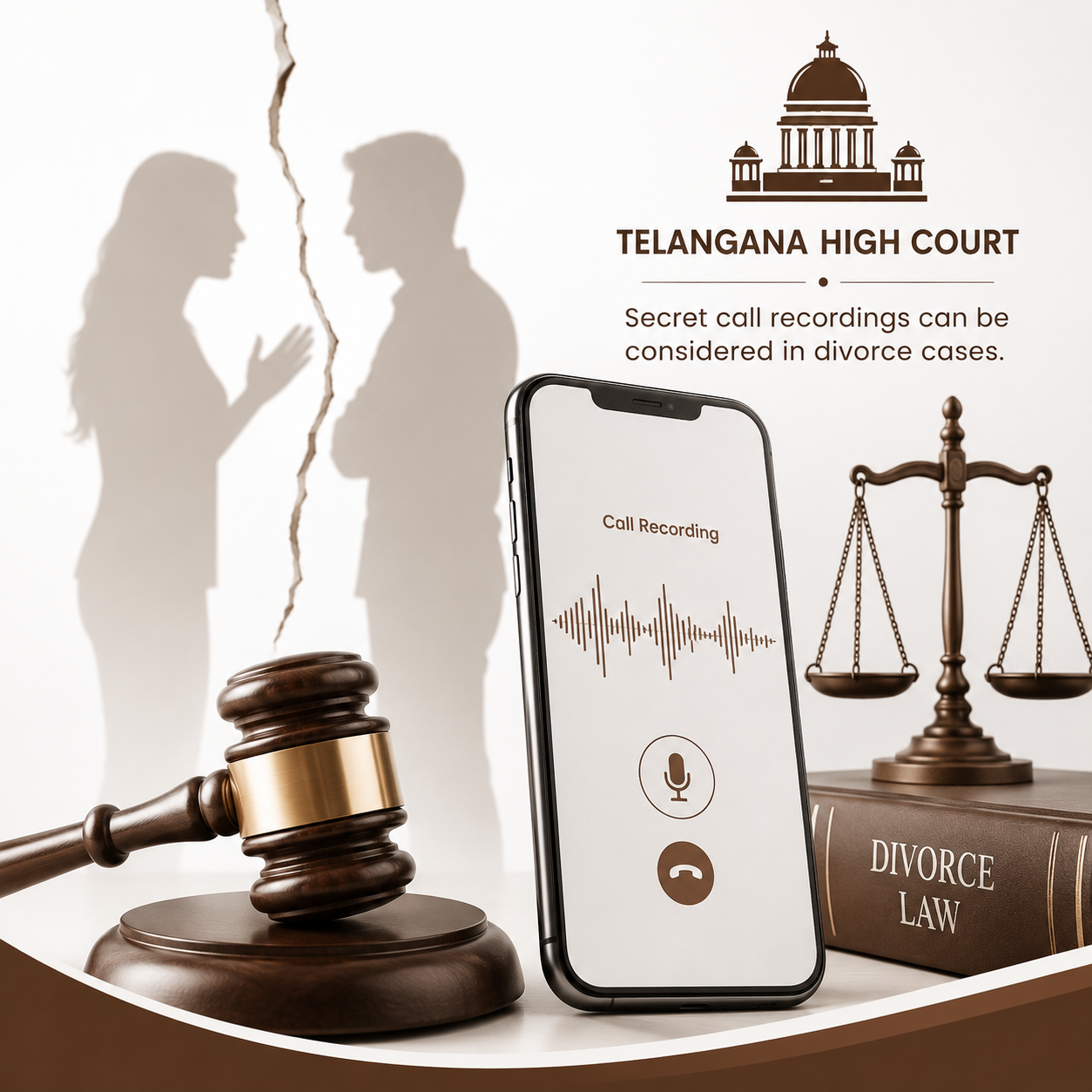
Secret Call Recordings: Telangana HC Divorce Ruling
If you are going through a divorce in Hyderabad and someone has been secretly recording your phone calls, or you have been recording your spouse's, the rules just changed. The Telangana High Court has ruled that secretly recording a spouse's phone conversations without their consent breaches the fundamental right to privacy under Article 21 of the Constitution, and such recordings cannot be used as evidence in matrimonial cases. This is not a small technical update buried in a law journal. It directly affects how evidence is gathered, presented, and thrown out in divorce, cruelty, and maintenance cases across Telangana. Here is what happened, what it means, and what you should do next. What the Telangana High Court Actually SaidThe case involved a husband who wanted to use secretly recorded phone conversations, along with certain financial documents, to prove cruelty by his wife in his divorce petition. The trial court had already refused to accept these recordings as evidence. He challenged that refusal before the High Court.Justice Namavarapu Rajeshwar Rao dismissed both petitions and upheld the trial court's decision. The Court's reasoning had two parts:On privacy: Recording a spouse's calls without their knowledge or consent amounts to a clear breach of the right to privacy guaranteed under Article 21. This applies even within a marriage.On admissibility: Electronic evidence, even if technically authentic, must have a direct and clear connection to the actual issues in dispute. Evidence cannot be let in simply because it exists in digital form. The husband had argued that a forensic lab had verified the authenticity of the recordings, and that he should get the chance to prove their relevance during the final hearing. The Court was not persuaded. The manner in which the evidence was collected mattered just as much as whether it was genuine. Why This Ruling Is a Big DealThis decision puts the Telangana High Court on a collision course with the Supreme Court of India. In July 2025, in Vibhor Garg v. Neha, a Supreme Court bench held the opposite: that secretly recorded spousal conversations do not violate the right to privacy and are admissible under the Evidence Act, because spousal privilege under Section 122 does not apply to disputes between the spouses themselves.So as of today, two very different standards exist side by side. The Supreme Court says such recordings can be used. The Telangana High Court says they cannot. Until a larger bench resolves this conflict, family courts in Telangana are bound to follow the state High Court's view. For anyone currently in litigation in Hyderabad, this is the standard that will actually apply in your case, regardless of what happens elsewhere in the country. What This Means If You Are Going Through a Divorce in HyderabadIf you were planning to use call recordings as evidence: Recordings made without your spouse's consent are unlikely to be accepted by a Telangana family court right now. Relying on them as your main proof of cruelty or misconduct is a risky strategy.If you have been secretly recorded: You have a real legal basis to object to that evidence being admitted, and to argue that it violates your right to privacy.If you are unsure what evidence will actually hold up: This is exactly the moment to get a proper case strategy from a lawyer, rather than relying on WhatsApp chats, call recordings, or screenshots collected in the heat of the moment. Not everything that feels like proof will survive scrutiny in court. On the Section 65B angle: Separately from the privacy issue, electronic evidence like call recordings also needs a valid certificate under Section 65B of the Evidence Act to even be considered. Many recordings fail on this technical ground alone, before privacy is even discussed. Frequently Asked QuestionsIs it illegal to record my spouse's calls in India? It is not a criminal offence by itself, but this ruling confirms that in Telangana, such recordings cannot be used as evidence in matrimonial proceedings if made without consent, because they violate the right to privacy.Does this ruling apply outside Telangana? No. This is a Telangana High Court decision, and it conflicts with a 2025 Supreme Court ruling that took the opposite view. Courts in other states may follow the Supreme Court's position until the conflict is resolved by a larger bench.Can I still use a call recording if my spouse admits to making it? Consent changes the analysis significantly. A recording made with the knowledge or agreement of both parties does not raise the same privacy objection.What if the recording proves domestic violence or abuse? Cases involving safety, threats, or abuse often involve different considerations than a standard cruelty claim. If you are in this situation, do not assume this ruling closes every door. Get specific legal advice on your facts.What evidence can I use instead in a divorce case in Telangana right now? Text messages, emails, medical records, financial statements, witness testimony, and other properly obtained documentation remain valid tools. A lawyer can help you build a case around evidence that will actually survive admissibility challenges. Will this ruling be appealed to the Supreme Court? Given that it directly conflicts with existing Supreme Court precedent, that possibility exists. Until then, it stands as binding law within Telangana. How Fairaigle Legal & Consultancy LLP Can HelpDivorce and matrimonial disputes rarely come down to one clean piece of evidence. They come down to strategy: what to collect, what to avoid, what will actually stand up in front of a judge, and what will get thrown out and waste your time.At Fairaigle Legal & Consultancy LLP, our family law team in Hyderabad tracks rulings like this one closely so your case is built on evidence that holds up, not evidence that gets excluded on day one. We help clients- Review existing evidence, including recordings and digital communication, to assess what is actually usable in a Telangana family court- Build a cruelty, divorce, or maintenance case around admissible, defensible evidence- Respond to a spouse's attempt to introduce improperly obtained recordings against you- Navigate the current conflict between the Telangana High Court and Supreme Court positions with a strategy suited to your specific court and bench- Protect your privacy rights while still building the strongest possible case for your outcomeIf you are dealing with a divorce, separation, or family dispute in Hyderabad and you are unsure whether your evidence will hold up in court, do not guess. Talk to us before you file, or before you respond to a petition filed against you. Reach out to Fairaigle Legal & Consultancy LLP today for a confidential consultation on your case.

RBI Guidelines on Loan Settlement: What Banks Must Offer You
If your loan account has slipped into default and the bank has started calling it an NPA, you are not powerless. The Reserve Bank of India has laid down a clear framework that tells banks exactly how compromise settlements should work, and most borrowers never get to hear about it. This guide breaks down that framework in plain language, so you know what to expect and what you can ask for. What Is an NPA and When Does Your Loan Become OneNPA stands for Non-Performing Asset. In simple terms, it is what a bank calls your loan once you stop paying it on time.A loan account is classified as an NPA when the interest or principal remains overdue for more than 90 days. For cash credit or overdraft accounts, this applies if the account stays out of order continuously for 90 days. For crop loans, the timeline is different: two crop seasons for short-duration crops and one crop season for long-duration crops. Before an account actually turns into an NPA, banks are required to flag early signs of stress. These are called SMA categories, or Special Mention Accounts:SMA-0: overdue up to 30 daysSMA-1: overdue between 31 and 60 daysSMA-2: overdue between 61 and 90 daysOnce the account crosses the 90-day mark without payment, it is formally classified as an NPA. From here, it can be further categorized as Sub-Standard, Doubtful, or Loss, depending on how long it has stayed in default and how much of the underlying security can realistically be recovered. The important thing to understand is this: NPA classification is not a punishment, it is an accounting and risk category. It does not automatically mean the bank will seize your assets tomorrow. It does mean the account now qualifies for resolution options, including a compromise settlement. The RBI Framework for Compromise SettlementIn June 2023, the RBI issued a consolidated Framework for Compromise Settlements and Technical Write-offs, applicable to banks, NBFCs, and other regulated lenders. This framework replaced a patchwork of older circulars and set uniform rules across the lending industry. A compromise settlement, as defined by the RBI, is a negotiated arrangement where the borrower pays back an agreed amount in cash, and in return the lender waives the remaining claim. It is fundamentally different from a technical write-off, where the bank removes the loan from its books for accounting purposes but still retains the legal right to recover the balance later. What Banks Are Required to DoThe framework places specific obligations on lenders, not just borrowers:- A board-approved policy is mandatory. Every regulated entity must have a clearly documented, board-approved policy on compromise settlements. This policy must define timelines, permissible sacrifice levels, and delegation of authority for approving settlements.- Settlement offers must be examined and responded to within a defined timeline. When a borrower submits a written settlement proposal, the bank is expected to evaluate it and communicate acceptance or rejection, typically within 30 to 60 days depending on internal policy.- The realistic repayment capacity of the borrower must be assessed. Banks cannot arbitrarily demand a settlement figure that ignores the borrower's genuine ability to pay. The framework expects a fair, cash-flow-based evaluation.- Settlements involving deferred payment beyond three months are treated as restructuring, not a simple compromise, which brings in additional prudential and reporting requirements for the lender.- Wilful defaulters and fraud-tagged accounts are now eligible too. Earlier, such accounts were often excluded from any settlement route. The 2023 framework allows regulated entities to offer compromise settlements even in these cases, without affecting any ongoing criminal proceedings.- A cooling period applies after settlement. Borrowers who settle wilful default or fraud accounts must typically wait a minimum of 12 months before they can be considered for fresh credit from the same lender, though boards can extend this period.Why This Matters for YouThis framework exists because NPAs are not always a one-sided failure. RBI has itself acknowledged that weak underwriting, poor monitoring, and internal lapses at the bank's end often contribute to accounts turning bad. That is precisely why the regulator insists on a structured, documented, and fair settlement process rather than leaving it to the discretion of a recovery officer.In practice, this means:- You have the right to submit a written settlement proposal and expect a reasoned response.- The bank cannot ignore your genuine financial hardship while calculating the settlement amount.- You are entitled to a settlement process based on documented policy, not verbal pressure or informal negotiation with a single official.- Even flagged wilful defaulter or fraud accounts can explore a settlement route today. Common Mistakes Borrowers Make During SettlementMany borrowers agree to whatever figure the recovery agent first quotes, without checking if it aligns with the bank's own board-approved policy. Others sign settlement letters without getting written confirmation on how the account will be reported to credit bureaus afterward. A few end up paying the settlement amount but never receive a formal No Dues Certificate or closure letter, leaving the account technically unresolved on paper. This is exactly the stage where professional legal guidance changes the outcome. Frequently Asked QuestionsDoes a compromise settlement close my loan completely? Yes, once the agreed amount is paid and the bank issues a settlement letter, the specific claim is closed. However, it is usually reported to credit bureaus as "settled" rather than "closed," which can affect your credit score for a period.Can I negotiate the settlement amount with the bank? Yes. The RBI framework expects banks to assess your real repayment capacity, which means the first figure quoted is rarely final. A well-documented representation can often bring the number down.Will my loan being classified as NPA affect my credit score immediately? Yes, an NPA classification is reported to credit bureaus and does impact your score. However, it does not mean recovery action is instant, and you still have time to explore restructuring or settlement.Can wilful defaulters or fraud-flagged borrowers still settle their loans? Under the 2023 RBI framework, yes. Such borrowers can now be considered for compromise settlement, though a longer cooling period and stricter conditions usually apply.What if the bank refuses to respond to my settlement proposal? Banks are expected to evaluate and respond to written settlement proposals within a defined timeframe under their own board-approved policy. Unreasonable delay or refusal can be challenged, and this is where legal intervention helps.Is a one-time settlement (OTS) the same as a compromise settlement? They are closely related. An OTS is essentially a form of compromise settlement where the entire agreed amount is paid in a single instalment rather than staggered payments.How Fairaigle Legal & Consultancy LLP Can HelpLoan recovery pressure rarely arrives with a rulebook attached. Borrowers are often told verbally that "this is the only offer available" or pushed into signing documents without understanding what they are agreeing to. Fairaigle Legal & Consultancy LLP works directly with borrowers who are facing this exact situation.Our team reviews your loan file, checks whether the bank's NPA classification and settlement process actually complies with RBI's framework, and represents you in direct negotiation with the lender for a fair and realistic settlement figure. If the bank has ignored your proposal, misused recovery pressure, or reported your account incorrectly to credit bureaus, we help you challenge it through the right legal channels. If you are dealing with loan recovery pressure, an unfair settlement offer, or confusion around your NPA status, reach out to Fairaigle Legal & Consultancy LLP today for a confidential consultation. You do not have to navigate this alone, and you do not have to accept the first number a recovery call gives youBook your consultation for expert guidance

Right to Privacy in Adultery Claims: What the SC's Latest Ruling Means for You
IntroductionCan a court force you to hand over your call records and hotel bookings just because your spouse suspects you of cheating? Until recently, this question sat in a legal grey zone. Not anymore.On July 2, 2026, the Supreme Court settled the debate. It ruled that summoning hotel records and call detail records to prove adultery in a divorce case does not violate the right to privacy. The decision affirms an earlier Delhi High Court judgment and closes the door on a defence many spouses relied on to block uncomfortable evidence from reaching the courtroom. If you are going through a divorce, or suspect your partner of infidelity, this ruling changes what you can do, and what can be done to you. Here is what you need to know. The Case That Triggered the RulingThe dispute began with a wife's divorce petition. She alleged that her husband was in a relationship with another woman, that the two had stayed together at a hotel in Jaipur, and that he had fathered a child from the affair. To prove her claim, she asked the family court to summon the hotel's booking records and the call detail records of her husband's phone numbers.The husband objected. He argued that pulling his private communication and travel history violated his fundamental right to privacy. The family court disagreed and ordered the records produced. He then challenged that order before the Delhi High Court, and lost. He carried the fight to the Supreme Court. He lost again. A bench of Justices Manmohan and K. Vinod Chandran dismissed his appeal, finding no reason to interfere with the High Court's reasoning. Why the Courts Ruled Against Privacy as a ShieldThe Delhi High Court's original judgment laid out the reasoning that the Supreme Court has now endorsed, and it is worth understanding in plain terms.Adultery is rarely caught on camera. Direct proof almost never exists, so matrimonial courts have always leaned on circumstantial evidence: hotel stays, travel patterns, phone logs. The High Court held that reservation details, payment records, and identification of guests can establish whether a person shared a room with someone other than their spouse. Call records, similarly, reveal whether the frequency and length of conversations go beyond what is normal between colleagues or friends.The Court also pointed to Section 14 of the Family Courts Act, 1984, which gives family courts wide latitude to accept evidence that would otherwise be inadmissible under the Indian Evidence Act. This provision exists precisely because matrimonial disputes involve intimate, hard-to-prove allegations, and rigid evidence rules would leave genuine claims impossible to establish.On the privacy argument itself, the High Court was direct: the right to privacy, while constitutionally protected, is not absolute. It can be reasonably restricted when a larger interest is at stake. Since the Hindu Marriage Act recognises adultery as a valid ground for divorce, the Court held that allowing a spouse to hide behind privacy to block relevant evidence would defeat the very purpose of that law. The judges were also careful to draw a boundary. The wife was not asking about a stranger. She was seeking records tied to her own husband, based on a specific, reasoned suspicion involving a named individual and a named location. That distinction mattered. It kept the order from becoming a licence for a fishing expedition into someone's personal life. Placing This Ruling in the Bigger Privacy StoryTo understand why this decision matters, it helps to look at two earlier landmark judgments that shaped India's privacy law.Justice K.S. Puttaswamy v. Union of India (2017) is where it all began. A nine-judge bench of the Supreme Court declared the right to privacy a fundamental right under Article 21 of the Constitution. It was a historic moment, but the Court was equally clear that no fundamental right is unconditional. Privacy, like free speech or the right to livelihood, can be restricted when a legitimate state or public interest demands it, provided the restriction is fair, reasonable, and proportionate.Joseph Shine v. Union of India (2018) built on that foundation in the context of marriage itself. The Supreme Court struck down Section 497 of the Indian Penal Code, which had criminalised adultery. The Court held that treating a woman as her husband's property, and punishing only the man involved with her, was unconstitutional and rooted in outdated notions of ownership within marriage. Adultery stopped being a criminal offence. It remained, however, a valid ground for civil divorce. The latest ruling connects these two threads. It confirms that decriminalising adultery did not erase its relevance in matrimonial law, and that privacy, however fundamental, does not override a spouse's right to seek a fair hearing in a divorce case. The Court has drawn a working line: privacy protects you from unwarranted intrusion, not from the consequences of evidence directly relevant to a claim your spouse has a legitimate right to pursue. What This Means If You Are Facing a Similar SituationFor someone filing for divorce on grounds of adultery, this ruling is a significant tool. It confirms that:You can request the court's assistance in summoning hotel records, travel logs, and call detail records where there is a genuine, specific basis for suspicion.Family courts have the authority under Section 14 of the Family Courts Act to accept this kind of evidence even where the Evidence Act would ordinarily be stricter.A privacy objection alone will not stop the court from ordering disclosure, as long as the request is targeted and not a blanket intrusion into someone's personal life.For someone on the receiving end of such an application, the ruling also clarifies your position. Courts will not permit vague, sweeping demands for personal data. The request must be specific, reasoned, and connected to an identifiable allegation. Overreach can still be challenged. Either way, the line between a lawful evidentiary request and an invasive privacy violation is a fine one, and it is not a line most people can navigate alone. How Fairaigle Legal & Consultancy LLP Can HelpMatrimonial disputes involving adultery are rarely just legal matters. They are personal, painful, and often urgent. Getting the evidence question wrong, on either side, can cost you the case or expose you to unnecessary intrusion.At Fairaigle Legal & Consultancy LLP, our family law team stays ahead of every shift in this area of law, including this very ruling. We help you understand exactly where you stand and what your next move should be.If you are considering filing for divorce on grounds of adultery, we can help you build a legally sound application to summon call records, hotel data, and other relevant evidence, drafted precisely enough to meet court standards and avoid rejection.If you are facing an adultery allegation and believe the evidence being sought against you goes beyond what the law permits, we can assess whether the request is genuinely relevant or an unlawful invasion of your privacy, and challenge it where appropriate. If you are unsure where you stand, we can walk you through your rights, your options, and the realistic outcomes before you take any step. Frequently Asked QuestionsDoes the Supreme Court's ruling mean my spouse can access all my personal data during divorce proceedings?No. The ruling applies to specific, relevant records tied to a genuine and reasoned allegation of adultery, such as hotel bookings or call logs connected to a named individual. Courts have made it clear that vague or sweeping requests for someone's personal data are not permitted. The evidence sought must be directly connected to the claim being made.Is adultery still a crime in India after this ruling?No. Adultery was decriminalised in 2018 in the Joseph Shine case, so it is no longer a criminal offence and cannot lead to a jail sentence. It remains, however, a valid ground for civil divorce under personal laws such as the Hindu Marriage Act, which is exactly the context in which this new ruling applies.Can I request call detail records and hotel records on my own, or do I need a court order?You cannot obtain these records directly from telecom providers or hotels on your own. They must be summoned through the family court as part of your divorce proceedings, typically through an application supported by a credible basis for suspicion. A lawyer can help draft this request in a way that meets the court's evidentiary standards.What if I believe my spouse is misusing this ruling to invade my privacy unfairly?You have the right to challenge any request that is overly broad, unconnected to a specific allegation, or effectively a fishing expedition into your personal life. Courts have drawn a clear boundary: only targeted, relevant evidence tied to a genuine claim will be allowed. A family law advocate can assess your situation and object to requests that overstep this line.Does the right to privacy still protect me in a divorce case?Yes, privacy remains a fundamental right, but it is not absolute. Courts can place reasonable restrictions on it when a larger interest, such as a spouse's legitimate right to prove a divorce ground, is at stake. This ruling does not remove your right to privacy; it clarifies where that right ends and where relevant evidence in a matrimonial dispute begins.Can hotel records or call logs alone prove adultery in court?Not by themselves. The Delhi High Court, in the judgment the Supreme Court upheld, was clear that summoning these records only allows them to be placed before the court. Whether they are sufficient to actually prove adultery is a separate question decided later, based on the overall evidence and arguments presented during trial.Does this ruling apply to all religions and marriage laws in India, or only Hindu marriages?The case itself arose under the Hindu Marriage Act, but the underlying principle, that relevant evidence can be summoned through family courts under Section 14 of the Family Courts Act, applies broadly across matrimonial proceedings in India, regardless of the personal law governing the marriage. It is best to get advice specific to your situation, since procedural details can vary.How can Fairaigle Legal & Consultancy LLP help with my adultery-related divorce case? Our family law team can help you file a well-drafted application to summon relevant evidence, defend you against unfair or overreaching evidence requests, and guide you through every stage of your matrimonial dispute with clarity and discretion. Book a confidential consultation to discuss your specific case.You do not have to figure this out on your own, and you should not have to. Talk to a Fairaigle family law expert today. Book your confidential consultation and get clarity on your case before you make your next move.

AI Liability & Copyright: Who Is Responsible?
Someone, somewhere, is finding out right now that the "AI-generated" image on their new website looks a lot like a cartoon character owned by a studio with very good lawyers. Someone else just got a legal notice because an AI tool their company used quietly copied text from a book. And a founder who spent six months building a product around AI-generated content just realized none of it may actually belong to them.This isn't a hypothetical anymore. It's Tuesday.AI tools write, design, code, and create faster than any human team ever could. But when something goes wrong a factual error that costs someone money, an image that looks suspiciously like someone else's copyrighted work, a chatbot that gives bad advice the question everyone eventually asks is the same one: who is actually responsible? The honest answer is that the law is still catching up. But it isn't a blank page either. Courts around the world have already started drawing lines, and the picture that's emerging should worry anyone who assumes "the AI did it" is a legal shield. Why This Question Isn't Going AwayMore than 70 AI copyright lawsuits are currently active or recently resolved across courts in the US and internationally, with total claimed damages estimated well beyond 50 billion dollars. That number alone tells you this isn't a fringe legal debate it's the new normal for any business building on, or around, AI. The biggest confirmed number so far came from Bartz v. Anthropic, where the company agreed to pay 1.5 billion dollars to settle claims tied to roughly 482,000 works, working out to just over 3,000 dollars per book. That case turned on a distinction that matters for everyone: training an AI model on legitimately obtained material may be treated as fair use, but training it or even just storing it using pirated copies is a different story entirely, and courts have made clear there's no shortcut around that.Disney and other major studios are separately pursuing a case against an AI video generator, arguing that when a system can reproduce near-perfect renditions of recognisable characters from a short prompt, the responsibility can't simply be waved away as "the user typed it, not us." That argument that a generative system carrying copyrighted material inside it is fundamentally different from a neutral pipe that just carries traffic is likely to shape how liability gets decided for years to come.So, Who's Actually Liable? It Depends Who's Standing in the RoomThere isn't one villain in these disputes there are usually several parties who could be on the hook, depending on what exactly went wrong.The company that built the AI model can be liable if the harm traces back to how the system was trained for instance, if it was trained on pirated or unlicensed material, or if the model was designed and marketed in a way that all but invited copyright violations.The business or individual deploying the AI tool commercially can be liable for what the tool produces on their behalf, especially if they published, sold, or distributed the output without checking it. Using an AI tool doesn't transfer your legal duty of care to the AI company courts have generally expected the deployer to exercise reasonable diligence.The end user typing the prompts can also carry responsibility, particularly if they deliberately prompted the system to reproduce a specific copyrighted character, brand, or work. And then there's a separate, quieter problem: ownership. In a case that went all the way to the US Supreme Court, the Court declined to overturn lower rulings holding that copyright protection requires human authorship meaning works generated by AI without meaningful human creative input generally cannot be copyrighted at all. That has enormous implications for any business whose content strategy, branding, or product output leans heavily on AI generation. If you can't prove meaningful human creative input, you may not actually own what you think you own.When AI Gets It Wrong, "The Algorithm Made a Mistake" Isn't a DefenseErrors are where this gets personal fast. An AI tool that gives incorrect financial guidance, drafts a contract with a fabricated legal citation, misdiagnoses a business risk, or generates defamatory content about a real person doesn't just create an inconvenience it can create real financial and reputational damage. Liability in these situations tends to follow the same logic as any professional negligence claim: was there a duty of care, was it breached, and did that breach cause quantifiable harm? The fact that an AI system was involved in generating the error doesn't automatically excuse the human or company that relied on it and passed it along. If anything, regulators and courts are increasingly treating "we didn't verify the AI's output" as a failure of due diligence in its own right, not a mitigating factor. What This Means If You've Been AffectedIf you've discovered AI-generated content that copies your original work, if your business has been harmed by an AI tool's factual error, or if you're a creator whose books, art, music, or code may have been used without permission to train a model, you are not without options. These cases are winnable, and the legal landscape while still evolving is increasingly favourable to people who can show clear, documented harm. The challenge is that these disputes sit at the intersection of intellectual property law, contract law, and fast-moving technology, which means generic legal advice often falls short. You need guidance from people who are actually tracking how these cases are unfolding in real time. How Fairaigle Legal & Consultancy LLP Can HelpThis is exactly the kind of complexity Fairaigle Legal & Consultancy LLP was built to handle. The firm works with creators, businesses, and individuals who have been affected by AI-related copyright infringement, wrongful use of their original work, or damages caused by AI-generated errors and misinformation.Whether you're trying to determine if your copyrighted material was used without consent to train a model, need help asserting ownership over AI-assisted work, or have suffered a financial or reputational loss because of an AI tool's mistake, Fairaigle's team can assess your case, explain where you realistically stand, and pursue the right course of action on your behalf from formal notices and settlement negotiations to full litigation support. You don't need to already understand the legal technicalities. You just need to bring what happened to you, and let people who track this space daily tell you what it's actually worth pursuing. Think You Have a Case? Don't Sit on It.Copyright and liability claims involving AI move fast, and evidence can become harder to trace the longer you wait. If you believe your work has been used without permission, or that an AI-generated error has cost you money, clients, or reputation, reach out to Fairaigle Legal & Consultancy LLP for a case review. The sooner you talk to someone who understands this space, the stronger your position will be.

What to Do If Loan Recovery Agents Harass You: A Complete Legal Guide
Missing a loan EMI can feel stressful enough but when it's followed by threatening calls, abusive language, visits to your workplace, or messages sent to your family and neighbours, it crosses a line from recovery into harassment. Many borrowers in India don't realize that loan recovery agents cannot do whatever they want, no matter how much money is owed. There are strict legal boundaries set by the Reserve Bank of India (RBI), the Indian Penal Code, and consumer protection laws and borrowers have real, enforceable rights. This guide breaks down exactly what counts as harassment, what the law says, and the step-by-step action plan you can follow to protect yourself. Understanding Loan Recovery Agent HarassmentLoan recovery agents are legally allowed to remind you about pending dues and encourage repayment. What they are not allowed to do includes:- Calling before 8 AM or after 7 PM- Using abusive, threatening, or humiliating language- Repeated calls intended to intimidate rather than inform- Contacting your employer, colleagues, relatives, or neighbours about your debt- Visiting your home or workplace without prior notice or in a threatening manner- Publicly shaming you posting on social media, sending mass messages, or discussing your loan with third parties- Threatening physical harm, legal action they cannot actually take, or arrest (banks cannot get you arrested for a civil loan default)- Misrepresenting themselves as police, court officials, or government agentsIf any of this sounds familiar, you are not powerless you are dealing with a violation of established regulatory guidelines.What Does the Law Say? RBI Guidelines on Fair PracticesThe RBI's Fair Practices Code requires all banks and NBFCs to ensure their recovery agents behave with courtesy and do not resort to intimidation, harassment, or use of muscle power. Banks are held directly responsible for the conduct of the agents and agencies they hire — outsourcing recovery does not outsource accountability.Indian Penal Code (IPC) / Bharatiya Nyaya Sanhita (BNS) ProtectionsDepending on the nature of harassment, several provisions may apply:- Criminal intimidation — threats of harm to person, reputation, or property- Defamation — public statements damaging your reputation- Criminal trespass — unauthorized entry into your home or workplace- Stalking or harassment provisions where agents repeatedly follow or intimidateConsumer Protection & Banking Ombudsman Framework If harassment stems from a bank or NBFC's outsourced agency, you can escalate the matter to the Banking Ombudsman under RBI's grievance redressal mechanism — a free, legally backed channel specifically designed for such complaints. The SARFAESI Act's LimitsEven where a lender has legal recovery rights under the SARFAESI Act, the process of recovery must still follow due legal procedure. Agents cannot bypass court processes, seize property without notice, or use coercion as a shortcut. Step-by-Step: What to Do If You're Being Harassed1. Document EverythingKeep a detailed log of every call, message, and visit dates, times, what was said, and the agent's name if given. Screenshot messages. Record calls where legally permitted in your state. This evidence is the foundation of any complaint.2. Send a Written Communication to the LenderWrite to the bank or NBFC's grievance/nodal officer, clearly describing the harassment with dates and evidence, and request that all communication happen through acceptable channels only.3. File a Complaint with the Banking OmbudsmanIf the lender doesn't resolve the issue within 30 days, escalate to the RBI Banking Ombudsman a free, time-bound grievance redressal system.4. Approach the Police if Threats EscalateIf you face physical threats, trespass, or intimidation, you can file an FIR under relevant IPC/BNS sections. Harassment is a criminal matter regardless of the civil loan dispute.5. Send a Legal NoticeA formal legal notice from a lawyer often stops harassment immediately, since it puts the lender and agency on record that continued misconduct will invite legal consequences, including compensation claims.6. Consider Filing a Consumer Complaint Mental distress, reputational harm, and unfair trade practices caused by aggressive recovery tactics can form the basis of a consumer complaint seeking compensation.What You Should Never Do- Don't ignore the debt entirely engaging through proper legal channels protects you better than silence- Don't make payments to individual agents in cash without receipts- Don't share sensitive personal or banking information over harassment calls- Don't sign any document presented by an agent without legal review How Fairaigle Legal & Consultancy LLP Helps Victims of Recovery HarassmentAt Fairaigle Legal & Consultancy LLP, we work directly with individuals who are facing aggressive, unlawful, or abusive loan recovery practices. Our approach is built around three priorities: stopping the harassment quickly, protecting your legal rights, and pursuing accountability where warranted.Here's how our team supports clients through the process:- Case Assessment & Documentation Review - We evaluate your situation, review call logs, messages, and correspondence to build a clear evidence trail.- Legal Notices to Lenders & Recovery Agencies - We draft and send formal notices that put banks and NBFCs on legal record, which frequently halts harassment within days.- Banking Ombudsman & RBI Grievance Filing - We handle the paperwork and follow-up needed to escalate your complaint through official RBI channels.- FIR & Criminal Complaint Assistance - Where threats or intimidation cross into criminal conduct, we guide you through filing a police complaint and support the legal process that follows.- Compensation & Consumer Complaint Support - We help victims pursue compensation for mental distress and unfair practices through consumer forums.- Ongoing Legal Representation - From the first notice to final resolution, our team stays engaged so you're never navigating this alone. Our goal is simple: no borrower should have to endure threats, abuse, or public humiliation over a loan default. The law is on your side — we help you use it. Frequently Asked QuestionsCan a recovery agent visit my home at any time? No. Recovery agents are expected to visit only during reasonable hours (generally between 8 AM and 7 PM) and must conduct themselves respectfully, without threats or intimidation.Can loan defaulters be arrested by recovery agents? No. Loan default is a civil matter, not a criminal offence. Recovery agents have no authority to arrest you or threaten arrest only a court, through due legal process, can order such action in specific, limited circumstances.Is it legal for agents to contact my employer or family about my loan? No. Disclosing your loan default to your employer, colleagues, relatives, or neighbours without your consent violates RBI's fair practices guidelines and can amount to defamation.What should I do immediately if I receive threatening calls? Start documenting every call and message immediately, then file a written complaint with the lender's grievance officer, and escalate to the Banking Ombudsman or police if the harassment continues.Can I get compensation for harassment by recovery agents? Yes. Victims can pursue compensation through consumer forums or civil suits for mental distress and unfair trade practices, especially when supported by strong documentation and legal notices.Does having an unpaid loan mean I have no rights? No. Owing money does not strip you of your legal protections. You are entitled to fair, respectful treatment throughout the recovery process, regardless of the amount owed. How quickly can harassment be stopped? In many cases, a formal legal notice alone is enough to stop harassment within days, since it signals that the matter is now being tracked and pursued legally.Facing harassment from loan recovery agents? You don't have to handle it alone. Fairaigle Legal & Consultancy LLP offers confidential consultations to help you understand your rights, document the harassment, and take swift legal action against unlawful recovery practices. Reach out today to protect yourself and hold the responsible parties accountable.Book your consultation today

Earning Wife and Maintenance: Karnataka HC Ruling
There is a quiet but powerful shift happening in Indian matrimonial law and it is long overdue. A recent ruling by the Karnataka High Court has sent a clear message to courts across the country: maintenance is not a gender entitlement. It is a legal remedy rooted in financial need, and when that need does not exist, the claim cannot stand on the mere strength of a woman's marital status. This ruling is not anti-woman. It is pro-justice. And understanding it carefully matters whether you are a husband wrongly burdened with maintenance orders, or a wife genuinely in need of financial support after a difficult marriage. The Case at a Glance: What Actually HappenedThe facts of this case are straightforward, and that is precisely what makes the Court's reasoning so compelling.A couple married in 2024 and lived together for only two months before separating. The wife filed a petition under the Protection of Women from Domestic Violence Act, 2005, seeking monthly maintenance of Rs.1,13,515, along with alternate accommodation and compensation. She also sought interim maintenance while the case was being heard.The Trial Court, by its order dated December 19, 2025, directed the husband to pay Rs.20,000 per month as interim maintenance. On the surface, Rs.20,000 may not sound like an outrageous number. But look at the income comparison at the heart of this case.The husband was employed with Genpact India Private Limited, earning a gross salary of Rs.60,646 per month. The wife, in her own affidavit disclosing assets and liabilities, admitted to earning Rs.1,00,000 per month. Her TDS records, in fact, revealed a monthly income of Rs.1,64,285 nearly two and a half times what her husband earned.The Trial Court had discussed the husband's earnings in considerable detail but had completely ignored the wife's admitted income while passing the maintenance order. The husband challenged this before the Karnataka High Court, and the High Court agreed that such an omission rendered the order wholly unsustainable.The Karnataka High Court, presided over by Dr. Justice Chillakur Sumalatha, set aside the interim maintenance order. The case is cited as R. v. S and Others (Neutral Citation: 2026:KHC:30140). The Core Legal Principle: Maintenance Is About Need, Not GenderThe heart of this ruling lies in a principle that should have always been obvious but has often been obscured by the patriarchal assumptions embedded in how maintenance law has been applied over the decades.Dr. Justice Chillakur Sumalatha held that courts cannot automatically pass a maintenance order merely because a wife files a petition under the Domestic Violence Act, the Hindu Adoption and Maintenance Act, or Section 125 of the Code of Criminal Procedure. The simple act of filing does not entitle a person to maintenance.The Court went further and articulated a standard that courts must apply: maintenance, whether interim or final, is warranted only when it is demonstrated that the wife has no financial sources to maintain herself according to the standard of her husband's lifestyle. Where the wife's own income exceeds that of the husband, and where she has no other dependants or liabilities such as children to care for, the very foundation for awarding maintenance is absent. This is a significant and deliberate shift away from the old assumption that a wife is always, by default, the financially weaker party in a marriage. Why This Ruling Matters: The Evolution of Gender Neutrality in Matrimonial Law Moving Beyond the Stereotyped Dependent WifeFor decades, Indian maintenance law operated on a social reality that was largely accurate for its time the wife was typically the homemaker, financially dependent on her husband, and vulnerable to economic destitution after a marital breakdown. The law rightly protected her. But India has changed. Women are doctors, engineers, senior corporate executives, entrepreneurs, and government officers. Many earn significantly more than their husbands. The social premise that justified automatic maintenance in favour of wives is no longer universal. When the law fails to catch up with this change, it stops being protective and starts being exploitative. The Danger of Maintenance as a WeaponFamily law practitioners across India will candidly tell you that maintenance claims are sometimes used not as a tool of genuine economic protection but as a pressure tactic in matrimonial disputes. When a husband earning Rs.60,000 is directed to pay Rs.20,000 every month to a wife earning over Rs.1,60,000, the maintenance order has nothing to do with need. It has everything to do with leverage. The Karnataka High Court's ruling directly addresses this misuse. By anchoring the right to maintenance firmly in the concept of demonstrated financial need and not in gender the Court has made it significantly harder to weaponise maintenance proceedings. Consistency with the Broader Legal DirectionThis ruling does not emerge in isolation. It is part of a broader trend in Indian higher courts moving towards more nuanced, fact-based approaches to matrimonial disputes. The Supreme Court itself has repeatedly emphasised, in cases relating to Section 125 of the CrPC and its replacement under Section 144 of the BNSS, that maintenance must be calibrated to the actual financial circumstances of both parties. The Karnataka High Court has, in earlier decisions, also held that a wife quitting her job at the husband's request to raise children deserves full consideration and should not be penalised for her inability to earn at the time of separation. These rulings together paint a consistent picture: the law looks at the real situation, not at gender labels. What the Ruling Does Not Say Setting the Record StraightThis ruling has generated significant discussion online, and with that discussion has come some misunderstanding. It is important to be clear about what the Court did not decide.The ruling does not say that wives can never claim maintenance. It does not say that women are no longer protected under the Domestic Violence Act or under Section 125 CrPC. It does not mean that courts will stop awarding maintenance in cases where the wife genuinely needs financial support.What the ruling does say is that income levels matter. A wife who earns substantially more than her husband, has no children to support, and has demonstrated no genuine financial need cannot claim maintenance on the basis that she is a wife. The law does not work that way — and should not. Equally important: the High Court specifically clarified that its observations on the merits would have no bearing on the final disposal of the main case. The wife retains the right to file a fresh interim application if her circumstances change. The door is not permanently shut — it is appropriately calibrated. The Legal Provisions at PlayUnderstanding this ruling requires a brief look at the legal framework it interprets.Section 125 of the Code of Criminal Procedure (now mirrored under Section 144 of the Bharatiya Nagarik Suraksha Sanhita, 2023) entitles a wife who is "unable to maintain herself" to claim maintenance from her husband. The phrase "unable to maintain herself" has always been a limiting condition maintenance was never meant to be unconditional.Section 20 of the Protection of Women from Domestic Violence Act, 2005, permits a Magistrate to direct payment of monetary relief to the aggrieved person. Section 23 provides for interim orders. Again, the Act uses the language of relief it is intended to address a situation of actual harm or need, not to create an automatic financial entitlement. The Karnataka High Court's ruling brings the practical application of these provisions back in line with their literal text. The word "maintenance" itself, etymologically and legally, presupposes a gap a situation where one person cannot maintain themselves and needs another's financial support to do so. How This Affects Husbands Facing Maintenance ClaimsIf you are a husband currently dealing with a maintenance claim where your wife earns a comparable or higher income, this ruling is highly relevant to your case. Here is what it means practically.You have the right to place your wife's income on record as part of your response to any maintenance application. TDS certificates, salary slips, income tax returns, Form 26AS, and affidavits of assets and liabilities are all admissible and relevant. Courts are now clearly expected to engage with this material rather than ignore it.You can challenge interim maintenance orders that have been passed without proper consideration of your wife's income. The High Court's ruling in this case was itself triggered by such a challenge, and it succeeded precisely because the Trial Court had failed to account for the wife's admitted earnings. You should not resign yourself to paying maintenance simply because you believe the system is stacked against you. The law, properly applied, is not. How This Affects Wives Who Genuinely Need MaintenanceIf you are a wife who left a job to care for children, who sacrificed career growth for family responsibilities, or who is genuinely financially dependent on your husband after a marital breakdown, this ruling does not weaken your claim. In fact, the very reasoning the Court employs strengthens your position by contrast.The Court's logic is grounded in economic reality. Where the economic reality shows genuine financial dependence where you truly cannot maintain yourself according to the standard of living you enjoyed during the marriage the entitlement to maintenance remains intact and legally robust. What this ruling asks for is honesty in affidavits and genuine engagement with the facts. Inflated maintenance claims with no factual basis are the ones that are now more likely to fail. The Broader Social Significance: What True Gender Equality Looks Like in LawThere is something important to sit with here: a law that automatically favours women regardless of their financial circumstances is not a gender-equal law. It is a law that treats women as permanently inferior — as though they can never be the financially stronger party in a relationship, as though their economic achievements do not matter in the legal calculus.True gender equality in matrimonial law means that financial need is the criterion — full stop. It means a husband who is genuinely financially weaker than his wife should have the same access to maintenance that the law grants her. Several High Courts across India have in recent years acknowledged this, and the Legal Services Authorities Act and the constitutional guarantee of equality under Article 14 support this interpretation. The Karnataka High Court's ruling is a step toward a legal system that respects women's economic agency and independence, not by denying them protection when they need it, but by not reducing them to the stereotype of permanent dependence when they don't. How Fairaigle Legal and Consultancy LLP Can HelpNavigating matrimonial law whether you are on the receiving end of a maintenance claim that feels unjust, or you are a spouse genuinely seeking financial protection is not something you should do alone. The law is nuanced, the facts are always specific to your situation, and the difference between a well-presented case and a poorly presented one can be tens of thousands of rupees every month.At Fairaigle Legal & Consultancy LLP, we bring clarity, strategy, and compassion to some of the most emotionally and financially challenging situations our clients face.For husbands facing disproportionate maintenance claims, we conduct a thorough analysis of both spouses' financial positions, gather the right documentary evidence, and build a legally sound challenge to maintenance orders that are not grounded in genuine need. We are familiar with the evolving jurisprudence including rulings like this one from the Karnataka High Court and we know how to present it effectively before Trial Courts, High Courts, and in revision proceedings.For wives who genuinely need maintenance and are worried that such rulings will be used against them unfairly, we help establish the real picture: whether that means documenting career sacrifices made for the family, demonstrating the financial gap between your current income and the lifestyle you maintained during the marriage, or building a comprehensive record that no court can ignore.We also advise on the full spectrum of matrimonial disputes divorce proceedings, child custody, property division, domestic violence matters, and settlement negotiations. Our team understands that behind every case is a real person going through one of the hardest chapters of their life, and we take that responsibility seriously. Whether you need an urgent consultation on an interim maintenance order or comprehensive representation throughout your matrimonial proceedings, Fairaigle Legal & Consultancy LLP is here to ensure that the law works fairly for you.FAQsCan a husband claim maintenance from a higher-earning wife?Not automatically. The Karnataka High Court has clearly held that where a wife's income exceeds her husband's, and she has no other dependants or liabilities, there is no foundational basis for awarding maintenance. Each case depends on its facts, and the wife must demonstrate an actual inability to maintain herself to the standard of her husband's lifestyle. What income proof can a husband submit to contest maintenance?A husband can submit the wife's salary slips, TDS certificates, Form 26AS, income tax returns, affidavit of assets and liabilities (which the wife herself files), bank statements, and any other documentary evidence of her income. Courts are now expected to take this material seriously before passing any maintenance order. Does this ruling apply to interim maintenance as well?Yes. The Karnataka High Court set aside an interim maintenance order in this very case. The ruling makes clear that even temporary maintenance orders must be grounded in a genuine consideration of both parties' financial positions. An interim order passed without considering the wife's income is vulnerable to challenge. What if the wife hides her income?Concealment of income in maintenance proceedings is a serious matter. Courts can draw adverse inferences from suppression of financial information. Discovery applications, subpoenas for employment records, and forensic analysis of bank statements are tools available to expose concealed income. Legal counsel can assist in deploying these effectively. Does the Domestic Violence Act still protect women after this ruling?Absolutely. The Domestic Violence Act continues to be a powerful protective statute for women facing domestic violence, including economic abuse. This ruling addresses the specific question of financial maintenance in cases where the wife has substantial independent income. It does not dilute the protections the Act offers against violence, threats, or other forms of abuse. Can a husband claim maintenance from a higher-earning wife?Yes, in principle. Section 24 of the Hindu Marriage Act allows either spouse not just the wife to claim pendente lite maintenance and expenses of proceedings. Several courts have awarded maintenance to husbands in cases where the wife earns significantly more. The Karnataka High Court's reasoning, grounded in economic need rather than gender, supports this approach. What should I do if I have already been ordered to pay maintenance to a financially independent wife?You should consult a family law expert immediately. Orders can be challenged in revision, and if there has been a material change in circumstances or if the original order failed to consider the wife's income, there are legal avenues to seek modification or recall of the order. Is this ruling only applicable in Karnataka?While the Karnataka High Court's decision is directly binding within Karnataka's jurisdiction, well-reasoned High Court judgments are persuasive authority in other High Courts and in lower courts across India. The legal principles articulated here align with what multiple other courts have begun to hold, making it relevant beyond state boundaries.Book your consultation for an Expert Guidance.

Builder Fraud: Best Guidance to File a Case in TRERA for Delayed Possession
You booked your dream home years ago. You paid in full, or close to it. The builder promised possession by a certain date and that date came and went. Then another. Now calls go unanswered, progress is non-existent, and you're left paying rent while your EMIs bleed you dry. If this sounds familiar, you are not alone. Thousands of homebuyers in Telangana are trapped in the same nightmare. The good news? You have a powerful legal remedy: the Real Estate Regulatory Authority (RERA), and specifically, the Telangana Real Estate Regulatory Authority (TSRERA). Here's everything you need to know to fight back. What Counts as Builder Fraud in Delayed Possession?Not every delay is fraud but a pattern of deception absolutely is. Watch for these red flags:- The builder missed the possession date mentioned in your sale agreement by 6 months or more- Construction has visibly stalled with no credible explanation- The project is not registered under TSRERA (which itself is a violation)- The builder is diverting funds from your project to other developments- You're being pressured to accept possession of an incomplete or unsafe unit- The builder is refusing to refund your money despite repeated failures Any of these, individually or together, can form the basis of a strong complaint before TSRERA. Why RERA Is Your Best WeaponBefore RERA, homebuyers had very few options. Consumer courts were slow, civil litigation dragged on for years, and builders knew they could outlast any complaint. RERA changed that entirely.Under the Real Estate (Regulation and Development) Act, 2016, a builder who fails to deliver possession on time must either return the entire amount with interest (currently pegged at the State Bank of India's MCLR + 2%) or pay monthly compensation to the buyer until possession is handed over. TSRERA also has the authority to impose penalties, suspend project registrations, and even recommend imprisonment for repeat offenders. Most importantly, cases before TSRERA are typically resolved within 60 days of filing far faster than any other legal forum.Step-by-Step Guide to Filing a Complaint at TSRERAStep 1: Gather Your Documents FirstBefore you file anything, build your evidence file. You will need:- Sale agreement or allotment letter- All payment receipts and bank statements showing amounts paid- Any correspondence with the builder (emails, WhatsApp messages, letters)- Brochures or advertisements that mentioned the possession date- The project's TSRERA registration number (searchable at tsrera.telangana.gov.in)- Your identity proof and address proof The stronger your documentation, the stronger your case. Save everything even that one email where the builder said "just two more months" eighteen months ago.Step 2: Verify Project Registration on TSRERA PortalVisit tsrera.telangana.gov.in and search for your project. If the builder failed to register the project, that alone is a separate violation you can include in your complaint. A registered project will show the approved plan, completion timeline, and the promoter's details.Step 3: Send a Legal Notice to the BuilderWhile not mandatory before filing at RERA, sending a written demand notice to the builder strengthens your case. Give them 15 to 30 days to respond. If they ignore it or respond with empty promises, that correspondence becomes powerful evidence of bad faith.Step 4: File Your Complaint Online at TSRERA- Personal details of the complainant (you)- Builder/promoter details and project name- Nature of complaint (delayed possession, refund request, or both)- Details of amounts paid and dates- Relief sought compensation, refund, or possession with penaltyUpload scanned copies of all your supporting documents. The filing fee is ₹1,000 for complaints filed by individual homebuyers, payable online.Step 5: Receive Your Case Number and Hearing Date Once filed, TSRERA assigns a unique complaint number and schedules a hearing. You will be notified via email and SMS. The builder is also served notice automatically through the system.Step 6: Appear for Hearings (In Person or Through Advocate) TSRERA hearings happen at their office in Hyderabad. You can appear yourself or engage a legal representative. During the hearing, both sides present their case and documents. TSRERA adjudicating officers are empowered to summon builders, examine records, and direct interim relief where urgently required.Step 7: Enforcement of the OrderIf TSRERA passes an order in your favour and the builder still does not comply, you can apply for enforcement. TSRERA can direct attachment of the builder's properties and accounts to recover the compensation or refund owed to you. What Relief Can You Claim?Depending on your situation, you can ask TSRERA for:- Full refund with interest at MCLR + 2% from the date of each payment- Monthly compensation for every month of delay if you still want the flat- Penalty on the builder for RERA violations- Directions to complete and hand over the project within a fixed timeline In cases of severe fraud, you can also approach the Appellate Tribunal or simultaneously file a criminal complaint under Section 420 IPC for cheating.Common Mistakes Homebuyers MakeWaiting too long is the biggest error. RERA complaints must typically be filed within three years of the cause of action arising. If your possession was due in 2021, do not wait until 2025 to act. Other mistakes include filing without a complete document set, not mentioning the correct relief amount, or accepting builder-offered "goodwill payments" without proper legal documentation that protects your full rights. How Fairaigle Legal & Consultancy LLP Can Help YouNavigating RERA on your own is possible but getting the maximum relief, quickly, requires expertise that comes from handling hundreds of similar cases.Fairaigle Legal & Consultancy LLP is a Hyderabad-based legal firm that specialises in real estate disputes and TSRERA filings. Here is what they bring to your case:Case Assessment: Their team reviews your sale agreement, payment history, and builder's track record to give you an honest evaluation of your case before you spend a single rupee on filing.Document Preparation: They prepare your complaint, calculate the exact interest and compensation you are entitled to, and ensure every document is correctly filed no gaps that a builder's lawyer can exploit.Representation at Hearings: Their advocates appear before TSRERA on your behalf, presenting your case persuasively and responding to the builder's counterarguments with evidence.End-to-End Follow-Up: From filing day to enforcement of the final order, Fairaigle monitors every step, keeping you informed and ensuring the builder cannot delay compliance.Transparent Fee Structure: No hidden charges. You know exactly what you are paying and for what outcome. If you are a homebuyer in Telangana who has been cheated by a builder, reach out to Fairaigle Legal & Consultancy LLP for a free initial consultation. Your case deserves the attention of people who have fought and won against some of Telangana's largest defaulting builders.Frequently Asked QuestionsCan I file a RERA complaint even if the project is not registered? Yes. In fact, an unregistered project is itself a RERA violation, and you can report it along with your complaint. The builder faces penalties for failing to register.What if the builder files for insolvency? You can file a claim with the Insolvency Resolution Professional (IRP) as a financial creditor. RERA and IBC proceedings can run simultaneously in some circumstances. A legal expert can guide you on the best parallel strategy.How long does a TSRERA case take? Most cases receive a first hearing within 30 to 45 days of filing. Final orders typically come within 60 to 90 days, though complex cases may take longer.Can I get a refund if the flat is almost complete? Yes. You are entitled to choose between a refund with interest or possession with compensation for delay. The choice is entirely yours the builder cannot force you to accept possession.Is it expensive to hire a lawyer for RERA? RERA was designed to be affordable for homebuyers. Many legal firms, including Fairaigle, offer case-based fees that are reasonable relative to the amounts at stake. A proper legal filing often results in significantly higher compensation than self-filed complaints. What if the builder offers a settlement after I file? Do not accept any settlement without proper legal review. Builders often approach buyers after a RERA filing with offers that seem generous but waive your rights to interest and full compensation. Get the settlement reviewed before signing anything.Your home is not just a financial investment. It is the place you planned your life around. If a builder has stolen that from you through delay and deception, the law is firmly on your side. Act now because every month you wait is another month the builder profits while you suffer.Click here and Book your consultation today to get guidance from our experts

Why Family Law Mediation Is Often a Better First Step
Before You Call a Courtroom, Read ThisDivorce and family disputes are hard enough on their own. But when people imagine how these situations get resolved, most picture two lawyers squaring off in a courtroom while a judge decides the fate of their home, their children, their finances, and their future.Here is the truth nobody tells you early enough: you do not have to start there.Family law mediation exists, and for many couples and families in conflict, it is not just a good option it is a genuinely better first step. Thousands of families each year are choosing this path and walking away with agreements they actually had a hand in shaping, money still in their pockets, and a relationship with their former partner that did not become a war.This is what that process looks like, and why it might be the right one for you.What Is Family Law Mediation, Really?Mediation is a structured, private process where a neutral third party the mediator helps two people in disagreement work through their issues and arrive at a mutual agreement. The mediator does not decide anything. They guide the conversation, help identify what each person actually needs, and keep things moving forward when emotions run high.In the context of family law, mediation is used for: Divorce and separation agreements Parenting plans and child custody arrangements Division of assets, property, and debt Spousal support and maintenance discussions Post-divorce modifications when circumstances change The mediator is not on anyone's side. They are there to help both people speak, both people be heard, and both people land somewhere workable.The Real Cost of Going Straight to CourtBefore we talk about why mediation works, it helps to understand what litigation actually costs not just in money, but in everything.It Is ExpensiveContested court cases can run into the hundreds of thousands in legal fees depending on how complex the dispute is and how long it drags out. Even relatively straightforward divorces can cost each party several lakhs when lawyers are billing by the hour and filing motion after motion.Mediation, by comparison, is a fraction of that cost. Sessions are usually billed by time, and many couples resolve their primary issues within a handful of sessions.It Takes a Long TimeFamily court dockets are crowded. Cases can stretch on for months or years and during that entire period, you are living in legal limbo. Your finances are frozen. Your parenting plan is temporary. Every decision feels uncertain.Mediation can move at whatever pace you and the other party set. Many couples complete the process in weeks.It Strips Away Your ControlThis is the part that surprises people most. When you go to court, a judge makes the decisions. They do not know your family the way you do. They do not know the nuances of your co-parenting relationship, your financial realities, or what your children actually need. They apply the law and their best judgment to whatever evidence is presented and then you both have to live with whatever they decide.In mediation, you keep control. The agreement that comes out of it is yours, built by both of you.It Poisons the RelationshipEven when people go into litigation with good intentions, the adversarial process has a way of turning everything toxic. Lawyers on each side build cases, which means finding fault, gathering evidence of wrongdoing, and framing the other person as the bad actor. By the time it is over, couples who might have co-parented reasonably often cannot be in the same room.If children are involved, this matters enormously. They spend years watching their parents unable to communicate. Mediation, even when it is difficult, tends to preserve a working relationship between the adults in ways that court battles almost never do.How Mediation Reduces ConflictThere is something almost counterintuitive about sitting in a room with someone you are in dispute with and trying to work things out. It feels like the conflict is already too high for that to be possible.But mediation is specifically designed to manage high-conflict emotion. Here is how:A Safe, Structured SpaceThe mediator sets ground rules from the start. Each person speaks. Each person is heard. Interrupting, threatening, and attacking are off the table. For many couples, this structured space actually allows them to say things they have never managed to say because for once, someone is making sure the other person is actually listening.Focus on Interests, Not PositionsLitigation is built around positions: I want the house. I want full custody. I want that business valued at this number.Mediation shifts the conversation toward underlying interests: I need housing stability for the kids. I need to be meaningfully present in their lives. I need financial security as I rebuild.When people start talking about what they actually need rather than what they are demanding, solutions that satisfy both sides become possible. Sometimes the agreement that emerges looks nothing like what either person walked in demanding and both people are happier for it.Less Hostility Over TimeStudy after study has shown that couples who mediate their separation report lower levels of hostility, better communication, and more satisfaction with the outcome even years later. When you build the agreement yourself rather than having it imposed on you, you are more likely to follow it, and more likely to respect the other person enough to honour it.You Have More Control Than You ThinkOne of the most powerful things about mediation is what it returns to you.When you litigate, you hand your life over to a legal process. When you mediate, you sit at the table. You can say what matters to you. You can ask for something unconventional. You can propose a parenting schedule that actually fits your lives. You can suggest a financial arrangement that a judge would never have thought of but that both of you can actually live with.The agreement that comes out of mediation reflects your family's reality not a generic template applied to your situation by someone who met you for an hour.And because both of you participated in building it, both of you actually understand it. There are no surprises buried in legal language. There is no agreement handed down that one person silently resents. You both said yes to this. You both know why.Is Mediation Right for Every Situation?Mediation is not appropriate in every case. It works best when: Both parties are willing to participate in good faith There is no significant power imbalance or ongoing abuse Both parties have reasonable access to information about shared finances and assets The goal on both sides is resolution, not punishment In situations involving domestic violence, coercion, or one party hiding assets, litigation with strong legal representation may be necessary to protect your interests. A good mediation professional will always screen for these dynamics before the process begins.But for couples who are separating with a genuine desire to do this decently for themselves, for their children, for the life each of them is building next mediation is almost always worth exploring first.What the Research Actually SaysThe evidence behind mediation is not anecdotal. Decades of research in family law has consistently found: Mediated agreements have higher compliance rates than court-ordered ones Parents who mediate report better co-parenting relationships years after separation Children in families that mediated show fewer behavioural and emotional difficulties than those whose parents litigated The cost savings are significant typically 40 to 60 percent lower than contested litigation Resolution happens faster, often within one to three months These are not marginal differences. They are consistent, meaningful outcomes that affect real people's lives.How Fairaigle Legal & Consultancy LLP Can Help You Through ThisNavigating a separation or family dispute is never simple but it does not have to be brutal.At Fairaigle Legal & Consultancy LLP, we work with individuals and families at exactly this crossroads. We understand that the legal system can feel overwhelming, especially when you are already carrying the emotional weight of a relationship ending or a family in transition.Our approach is different. We begin by listening to what happened, to what you need, and to what a good outcome actually looks like for your life and your family.For clients who are candidates for mediation, we help you understand the process, prepare for sessions, and ensure that any agreement you reach is legally sound and genuinely in your interest. We can advise you independently throughout the mediation process so that you enter every session informed and protected without turning the process into a legal battle.For clients where mediation is not the right fit, we provide skilled, compassionate legal representation through every stage of the formal process.Whatever path is right for you, you will not walk it alone. Fairaigle Legal & Consultancy LLP stands alongside you with experience, integrity, and a real commitment to outcomes that work for real people.FAQs Is a mediated agreement legally binding?Yes. Once a mediated agreement is documented and signed — and in many cases, filed with the relevant court — it carries full legal force. Your mediator and legal advisors will ensure it meets all requirements before you sign.Do I still need a lawyer if I choose mediation?You do not need a lawyer present in every mediation session, but it is strongly advisable to have independent legal advice before signing anything. A lawyer can review the agreement to make sure it is fair, complete, and legally enforceable without actively litigating on your behalf.What if we cannot agree on everything in mediation?You do not have to resolve everything to benefit from mediation. Many couples successfully mediate some issues — like parenting arrangements — while referring others, like asset division, to the courts. Partial resolution still saves time, money, and conflict.How long does family mediation take?Most couples complete the core mediation process in two to six sessions, depending on the complexity of the issues. Sessions are typically two to three hours. The entire process often concludes within one to three months.Can mediation work if we are not on speaking terms?Yes. Mediators are trained to work with couples in high conflict. Some mediators even conduct shuttle mediation, where the two parties are in separate rooms and the mediator moves between them. You do not need to be comfortable with each other — you just need to be willing to try.What happens if one person refuses to mediate?Mediation requires the voluntary participation of both parties. If one person refuses, you will likely need to pursue formal legal proceedings. However, a skilled legal advisor can sometimes help open the door to mediation even when one party is initially resistant.Is mediation confidential?Yes. What is said in mediation stays in mediation. This is one of its most significant advantages — it allows both parties to speak openly without fear that their words will be used against them in court later.What does family mediation cost?Costs vary depending on the complexity of the dispute and the number of sessions needed. However, even at the higher end, mediation is almost always significantly less expensive than contested litigation. Many people complete the process having spent a fraction of what a court battle would have cost them.Take the First Step Before the Battle BeginsA separation or family dispute does not have to define you, bankrupt you, or destroy every relationship in its wake.Mediation is not giving up. It is not weakness. It is not pretending the conflict is not real. It is choosing to resolve that conflict in a way that leaves you both with your dignity, your finances, and your ability to move forward.If you are at the beginning of this process or even if you are already in it and wondering if there is a better way we invite you to speak with someone who can help you understand your options clearly.Contact Fairaigle Legal & Consultancy LLP today. Whether mediation is the right path for you or you need full legal representation, we will give you honest guidance, real support, and a plan built around your life not a template.Your next chapter starts with the right first step. Let us help you find it.Fairaigle Legal & Consultancy LLP — Legal guidance with integrity, built for real people navigating real challenges.

Recovery Agents Have No Right to Seize Your Assets — Here Is Exactly What the Law Says
You are sitting at home when the doorbell rings. A group of men in suits identifies themselves as "recovery agents" sent by your bank or NBFC. They are loud, intimidating, and they start pointing at your television, your car, your gold jewellery telling you they "have the right to take it all" if you do not pay up immediately.Here is the truth: they are lying to you. And what they are doing may very well be a criminal offence.If your loan is a credit card dues, a personal loan, or any other unsecured loan recovery agents have absolutely zero legal authority to seize even a single rupee worth of your physical property. Period. Full stop.This blog will walk you through exactly what the law says, what your rights are, and how Fairaigle Legal & Consultancy LLP is standing up for borrowers who have been threatened, harassed, or humiliated by illegal recovery tactics.Understanding the Two Types of Loans - A Quick PrimerBefore we get into the legal battle lines, it is important to understand why this distinction matters so much in the first place.What Is a Secured Loan?A secured loan is one where you pledge a specific asset called collateral as a guarantee against repayment. Common examples include:◠Home Loans — where your property is mortgaged◠Car Loans — where the vehicle itself is hypothecated to the lender◠Gold Loans — where your gold ornaments are physically held by the lender◠Loan Against Property (LAP) — secured against a registered asset In case of default on a secured loan, the lender has a defined legal process to recover the collateral primarily governed by the SARFAESI Act, 2002. Even then, strict procedural safeguards apply.What Is an Unsecured Loan?An unsecured loan is extended purely on the basis of your creditworthiness your income, CIBIL score, and repayment history. No asset is pledged, no collateral is offered. The most common types are:◠Credit Card Outstanding Dues◠Personal Loans◠Buy Now, Pay Later (BNPL) Products◠Consumer Durable Loans without hypothecation◠Education Loans (without third-party security in many cases) The fundamental legal reality: because no collateral was pledged at the time of the loan agreement, the lender acquires NO legal ownership rights over any of your assets. A recovery agent working for such a lender, therefore, carries zero authority to touch, seize, or threaten to seize anything you own.The Law Is Crystal Clear Physical Seizure for Unsecured Loans Is IllegalIndia has a robust legal framework protecting borrowers from predatory recovery tactics. Here are the key pillars:The SARFAESI Act, 2002 What It Does AND Does Not CoverThe Securitisation and Reconstruction of Financial Assets and Enforcement of Security Interest Act (SARFAESI) grants banks powers to seize and sell secured assets in case of NPA accounts. However, this Act explicitly applies only to secured loans where a security interest has been created. It has absolutely no application to credit card dues or personal loans.RBI Fair Practices Code & Recovery Agent GuidelinesThe Reserve Bank of India (RBI) has issued comprehensive guidelines on the conduct of recovery agents, which all banks and NBFCs are legally bound to follow. Key provisions state that recovery agents:◠Must NOT visit borrowers before 8:00 AM or after 7:00 PM◠Must carry and show an authorisation letter from the lender◠Must NEVER use intimidation, threats, or abusive language◠Must NEVER threaten seizure of assets for unsecured loans◠Must NEVER contact or harass family members, neighbours, or employers without consent◠Cannot make calls repeatedly with the intent to harass Violation of these guidelines is not merely a regulatory slap on the wrist it can lead to cancellation of the bank's recovery agency agreement and criminal liability for the agents involved.Indian Penal Code ProtectionsMultiple sections of the IPC protect you from illegal recovery harassment:◠Section 383 / 384 - Extortion: Threatening to cause harm unless you pay◠Section 441 / 448 - Criminal Trespass / House Trespass: Entering your home without permission under threat◠Section 503 / 506 - Criminal Intimidation: Threatening injury to you or your property◠Section 379 - Theft: If an agent physically removes your belonging without legal authority◠Section 34 - Common Intention: If multiple agents act together in the aboveConsumer Protection Act, 2019Harassment, intimidation, and misrepresentation by recovery agents also constitute "unfair trade practices" and "deficiency in service" under the Consumer Protection Act, 2019. Borrowers can file complaints before the District Consumer Commission and seek compensation for mental harassment, defamation, and physical harm.What Recovery Agents CAN and CANNOT Do The Complete Breakdown What They CAN Do (Legally)What They CANNOT Do (Illegal)Send written communication / noticesSeize any physical asset for unsecured loansMake polite phone calls during business hours (8am–7pm)Visit your home before 8 AM or after 7 PMInform you of outstanding dues and payment optionsUse abusive, threatening, or obscene languageNegotiate repayment schedules or settlementsContact your family members, neighbours, or employer to shame youInitiate legal proceedings through courtsRemove or threaten to remove your TV, car, jewellery, or any assetFile civil suits for money recovery in courtsClaim powers under SARFAESI for a personal loan or credit cardReport default to credit bureaus (CIBIL, Experian)Make repeated calls at odd hours to harass or intimidate Real Scenarios Recognising Illegal Recovery BehaviourSometimes harassment does not look obvious. Here are scenarios borrowers across India face daily, and why each is illegal:Scenario 1: The Midnight CallerA recovery agent calls you at 11 PM screaming that you have to pay tomorrow or "they will come and take everything." This violates RBI's time restriction guidelines and constitutes criminal intimidation under IPC Section 503.Scenario 2: The Workplace EmbarrassmentAn agent shows up at your office and loudly informs your colleagues and boss about your loan default. This is a violation of your right to privacy, constitutes defamation, and can be actioned under the Consumer Protection Act as well as the IPC.Scenario 3: The False Legal ThreatAn agent hands you a "notice" that looks official and states the bank will send police to arrest you tomorrow if you do not pay. Loan default is a civil matter, NOT a criminal offence. No police can arrest you for non-payment of a personal loan. This fake notice constitutes fraud and extortion.Scenario 4: The Physical Seizure AttemptTwo agents enter your home and begin photographing or inventorying your furniture and electronics, saying they will "take these if you don't settle today." This is criminal trespass and criminal intimidation and if they actually remove anything, it is theft under Section 379 IPC.Scenario 5: Family HarassmentAgents call your parents, spouse, or siblings repeatedly, threatening them with legal action and demanding they pay your loan. Harassment of third parties who are not guarantors is strictly prohibited under RBI guidelines and can constitute criminal intimidation.Your Step-by-Step Action Plan When Recovery Agents Cross the LineIf you or a family member has been subjected to illegal recovery tactics, here is exactly what you should do - right now:Step 1 - Document EverythingStart collecting and preserving evidence immediately. This includes saving threatening SMS messages and WhatsApp texts, recording phone calls (legal to record for personal protection in most Indian states), noting down dates, times, and names of agents, and taking photographs or video of any property they threaten to seize.Step 2 - Send a Written Complaint to the BankWrite a formal complaint letter to the bank's Grievance Redressal Officer (GRO). Every bank is required by RBI regulations to have one. Clearly state what happened, when it happened, and demand that harassment cease immediately. Send this by registered post and email with read-receipt so there is a paper trail.Step 3 - File a Complaint with the RBI Banking OmbudsmanIf the bank does not resolve your complaint within 30 days, you can escalate to the RBI's Integrated Ombudsman Scheme (IOS) at cms.rbi.org.in. This is a free, speedy mechanism that can direct banks to compensate you for harassment.Step 4 - Lodge an FIR / Police ComplaintIf agents have threatened you physically, entered your home without permission, or removed your belongings, file an FIR immediately at your local police station. Cite the relevant IPC sections listed in Section 2 of this article. Request a copy of the FIR - it is your legal right.Step 5 - Approach Consumer CourtFile a consumer complaint against the bank and the recovery agency for mental harassment, defamation, and deficiency in service. You can claim compensation for mental agony, actual losses, and litigation costs.Step 6 - Consult a Legal ExpertThis is where professional legal guidance makes all the difference. Navigating multiple forums, preserving evidence correctly, and building a case that actually wins requires expertise. This is precisely what Fairaigle Legal & Consultancy LLP does for borrowers like you.How Fairaigle Legal & Consultancy LLP Is Fighting for Harassed BorrowersFairaigle Legal & Consultancy LLP is one of India's dedicated legal firms standing at the intersection of consumer rights and financial law. With a team of experienced attorneys, the firm has become a trusted ally for borrowers who have been bullied, threatened, and exploited by unlawful recovery practices.Who Does Fairaigle Help?◠Borrowers threatened with illegal asset seizure for unsecured loans◠Individuals harassed by recovery agents at their home or workplace◠Victims of midnight calls, abusive language, and psychological intimidation◠People handed fraudulent legal notices designed to panic and coerce◠Borrowers whose family members have been threatened or embarrassed◠Anyone who has had property unlawfully removed by recovery agentsWhat Fairaigle Does for YouThe firm's multi-pronged approach means your case is handled from every angle simultaneously, not just one forum:◠Immediate Legal Notice to the Bank & Recovery Agency :- A strongly worded legal notice citing specific RBI guidelines and IPC provisions is served on the bank and agency within 48 hours of engagement, which in many cases immediately stops the harassment.◠RBI Ombudsman Complaint Filing :- Fairaigle's team prepares and files technically sound complaints with the RBI Integrated Ombudsman Scheme, maximising the chances of a favourable direction and monetary compensation.◠Consumer Court Representation :- For cases involving defamation, mental distress, or actual financial harm, the firm files well-drafted consumer complaints and represents you at all hearings.◠Criminal Complaint Support :- If agents have committed cognisable offences under the IPC, Fairaigle guides you through the FIR process, assists in drafting your complaint, and liaises with police authorities on your behalf.◠Negotiated Settlements on Your Terms :- Where appropriate, the firm also negotiates settlement agreements with lenders from a position of legal strength, not desperation :- ensuring you are not coerced into agreements you cannot sustain.◠24/7 Legal Support During Active Harassment :- When harassment is ongoing, the firm provides immediate telephonic legal guidance so you know exactly what to say, what to document, and what not to do in real time.What Makes Fairaigle Different?"We do not just give advice we fight alongside our clients. Every borrower who walks through our door has already been through enough stress. Our job is to turn the tables legally and ensure the institutions that crossed the line are held accountable." — Fairaigle Legal & Consultancy LLP The firm combines deep knowledge of RBI regulations, consumer protection law, and criminal law to build cases that courts and regulators take seriously. Beyond legal skill, Fairaigle is known for its empathetic, client-first approach treating every case not as a file number but as a real human being's fight for dignity.Frequently Asked QuestionsCan a recovery agent physically take my TV or phone if I default on a credit card?Absolutely not. Credit cards are unsecured loans. No physical asset was pledged as collateral. A recovery agent has zero legal authority to seize any of your physical possessions. If they attempt to do so, you should call the police immediately and file an FIR for criminal trespass and attempted theft.I received a call saying police will arrest me tomorrow for non-payment. Should I be worried?No. Loan default is a civil dispute, not a criminal offence. Police cannot arrest you for failing to repay a personal loan or credit card dues. This is a classic scare tactic used to coerce payment. Document the call and report it to your bank's grievance cell and the RBI Ombudsman immediately.A recovery agent showed up at my office and told my boss about my loan. What can I do?This is a serious violation. The RBI guidelines expressly prohibit agents from contacting your employer to embarrass you. You can file a complaint with the bank's GRO, approach the RBI Ombudsman, file a consumer complaint for defamation and mental distress, and even pursue a criminal complaint for harassment. Fairaigle can assist you with all of these steps.Are there specific hours during which recovery agents can contact me?Yes. RBI guidelines clearly state that recovery agents can only contact borrowers between 8:00 AM and 7:00 PM. Any contact outside these hours is a regulatory violation, and the evidence of such contact strengthens your complaint against the bank.What if the agent carries an official-looking notice claiming court authority?Do not panic. Verify everything before taking action. A legitimate court summons comes through official channels and is served by a court process server, not a bank's recovery agent. Ask for the case number, court name, and judge's name mentioned in the notice and independently verify it through a lawyer. Fairaigle offers a notice-verification service specifically for such situations.My personal loan was taken three years ago. Can I still complain about harassment that happened last month?Yes. The harassment itself is the trigger for the complaint, not the date of the loan. RBI Ombudsman complaints can typically be filed within one year of the cause of action (the harassment incident). Consumer court complaints also have their own limitation periods. Contact Fairaigle immediately to assess your specific timeline.The bank says they have no responsibility since they outsourced recovery to an agency. Is that true?Completely false. Under RBI guidelines, banks are fully liable for the conduct of their outsourced recovery agents. A bank cannot wash its hands of illegal behaviour by pointing to a third-party agency. The bank that issued your loan bears primary responsibility for the misconduct of every agent it deploys.I agreed to a payment under pressure when they threatened me. Can I challenge that agreement?Potentially yes. An agreement signed under duress intimidation or coercion may not be valid under the Indian Contract Act, 1872, which states that consent obtained by coercion is voidable. Consult with Fairaigle to evaluate the specific circumstances of your situation.Does filing a complaint against the bank affect my CIBIL score further?Filing a legal complaint or consumer grievance does not by itself affect your CIBIL score. Your credit score is affected by payment history, outstanding dues, and credit utilisation none of which are altered simply by your asserting your legal rights. In fact, a successfully resolved complaint sometimes results in updated credit bureau reporting.How do I get in touch with Fairaigle Legal & Consultancy LLP?You can reach Fairaigle Legal & Consultancy LLP through their official website and contact channels. The firm offers an initial consultation where a qualified attorney reviews your situation, explains your legal options, and recommends the most effective course of action. Given the time-sensitive nature of harassment cases, early engagement is always advisable.Final Word: Your Dignity Is Non-NegotiableTaking out a loan and struggling to repay it does not make you a criminal. It makes you a human being going through a difficult financial situation. The law of India recognises this and has built comprehensive protections precisely for moments like these.Recovery agents who bully, threaten, harass, and deceive borrowers are not just breaking RBI guidelines they are committing crimes. And the banks that deploy them are legally responsible for every act they commit.You have the right to be treated with dignity. You have the right to know the law. And you have the right to fight back. Fairaigle Legal & Consultancy LLP is here to make sure that right is more than just words on paper. If you are being harassed by recovery agents for an unsecured loan, do not wait. Document the evidence, stop all further payments made under duress, and contact Fairaigle Legal & Consultancy LLP today. The law is on your side let the right team put it to work for you.Book your consultation with an Expert

Consumer Courts Act Tough: Lessons from Airtel & Railways
If you have ever paid for a service and received something far less in return, you already know the feeling. The recharge that did not work as promised. The train seat you booked weeks in advance, occupied by someone else when you finally boarded. For years, most people simply absorbed these losses, assuming a fight against a telecom giant or a government department was not worth the trouble. That assumption is changing fast. Consumer courts across India are handing down rulings that put the burden back where it belongs: on the service provider, not the customer. Two recent cases, one against Bharti Airtel and one against the Railways, show exactly how this shift is playing out, and why ordinary consumers now have real leverage. The Airtel Case: Charged for 5G, Stuck on a Weak SignalA consumer in Himachal Pradesh recharged his Airtel number expecting 5G connectivity. Instead, he was left struggling with a poor, often non-functional signal. When he raised the issue, Airtel's defense was that his handset, a Redmi Note 9 Pro Max, was not 5G-compatible in the first place. The District Consumer Disputes Redressal Commission in Shimla was not convinced. The bench noted that Airtel had never actually carried out a physical inspection of the customer's handset to verify its claim that the device was incompatible with 5G. More importantly, the Commission raised a sharper question: if Airtel genuinely believed the phone could not support 5G, why did it accept payment for a 5G plan at all? The Commission stated that once the company knew the customer's handset was not compatible with 5G internet services, it should not have permitted him to recharge for a 5G plan in the first place. The order directed Airtel to refund the recharge amount and pay Rs 5,000 in compensation to the affected customer. This is not a minor technicality. It establishes a principle that telecom companies cannot collect money for a service they have reason to believe the customer cannot use. The burden of verification sits with the company, not the consumer fumbling through customer care calls. The Railways Case: Confirmed Tickets, Empty Promises The second case is, in some ways, even more troubling because it involves something every train traveler fears: arriving at your seat only to find a stranger sitting in it. Four passengers traveling on the LTT Patna Express from Vindhyachal to Ara had confirmed reservations in coach B4. When they reached their seats, they found them occupied by individuals who identified themselves as railway employees and refused to move. The passengers sought help from on-duty railway staff, but no resolution came. They ended up traveling the entire journey standing, despite holding valid, confirmed tickets. The Bhojpur District Consumer Disputes Redressal Commission did not mince words. It held that the passengers suffered mental, physical, and economic harassment because of the Railways' failure to provide their allotted berths, and that this amounted to a clear deficiency of service. The Commission directed North Central Railway and the Ministry of Railways to refund the original ticket amount with eight percent annual interest, pay Rs. 20,000 in compensation, and cover Rs. 15,000 in litigation costs, all within 60 days, failing which the amount would attract ten percent annual interest. What makes this ruling significant is that it rejects the idea that overcrowding or staff misconduct is simply an unavoidable part of train travel in India. The Commission treated it for what it was: a failure of service that the Railways must answer for financially. Why These Rulings Matter Beyond the Individual Cases Both rulings share a common thread. They reject the idea that large organizations, whether private telecom companies or government-run railways, can treat consumer harm as a cost of doing business. A few takeaways stand out:Deficiency of service has teeth. Courts are willing to award compensation that goes beyond a simple refund, recognizing the mental and physical toll of being shortchanged.The burden of proof is shifting. In the Airtel case, the company's failure to verify its own claims worked against it. Service providers can no longer make assumptions and expect consumers to disprove them.Government entities are not exempt. The Railways ruling shows that public sector bodies face the same scrutiny as private companies when service falls short. Compensation is becoming more realistic. Rs 20,000 for a single journey gone wrong, or a full refund plus damages for a faulty recharge, signals that commissions are taking consumer hardship seriously rather than offering token relief.What This Means If You Have Faced Something SimilarMaybe you have been billed for a plan or service that never delivered as promised. Maybe you have dealt with an airline, an e-commerce platform, an insurance company, or yes, the Railways, failing to honor what you paid for. These rulings are proof that filing a complaint is not a hopeless exercise. Consumer commissions are actively examining the conduct of large organizations and are willing to rule against them when the evidence supports it. The challenge, of course, is knowing how to build that case. Which commission has jurisdiction. What documentation strengthens your claim. How to frame the deficiency of service in a way that holds up. This is where most people get stuck, not because their grievance lacks merit, but because the process feels unfamiliar and intimidating. How Fairaigle Legal & Consultancy LLP Can HelpThis is exactly the gap Fairaigle Legal & Consultancy LLP is built to close. If you have been overcharged, denied a service you paid for, or left to deal with the fallout of someone else's negligence, whether it is a telecom provider, the Railways, an airline, or any other service, our team can help you turn that frustration into a properly documented, legally sound complaint. Here is what working with Fairaigle Legal & Consultancy LLP looks like in practice:Case evaluation: We assess your situation honestly, including whether you have a strong claim for deficiency of service and what compensation you might reasonably pursue.Documentation support: We help you gather and organize the evidence that consumer commissions actually look for, recharge receipts, ticket confirmations, correspondence with customer care, and more.Drafting and filing: Our team prepares your complaint with the correct legal language and files it with the appropriate District, State, or National Consumer Disputes Redressal Commission.Representation: We represent your interests throughout the process, so you are not navigating hearings and procedural requirements alone. Follow-through on orders: Winning a ruling is only half the job. We also assist in ensuring that compensation orders are actually enforced and paid out.Consumer law exists to protect people exactly like you, but it only works when someone takes the first step. If a service provider has let you down, do not assume it is simply the cost of doing business in India. The Shimla and Bhojpur rulings prove otherwise, and Fairaigle Legal & Consultancy LLP is here to help you pursue the outcome you deserve.Frequently Asked QuestionsCan I file a consumer complaint against a telecom company for charging me for a service I could not use? Yes. As the Airtel ruling shows, if a company collects payment for a service like 5G while having reason to know you cannot access it, that can be treated as a deficiency of service, entitling you to a refund and compensationWhat can I do if my confirmed train seat is occupied by someone else? Report it immediately to the on-duty Travelling Ticket Examiner (TTE) and document the incident, including names, coach and seat numbers, and the time. If the Railways fails to resolve it, you can file a complaint with the relevant District Consumer Disputes Redressal Commission, as seen in the Bhojpur case.How much compensation can I realistically expect from a consumer court? It varies by case, but recent rulings show meaningful amounts: Rs 5,000 in the Airtel matter and Rs 20,000 plus litigation costs and interest in the Railways case. Compensation depends on the extent of harassment, financial loss, and documented evidence.Is there a time limit for filing a consumer complaint in India? Generally, a consumer complaint must be filed within two years from the date the cause of action arose. Delays beyond this can affect admissibility, so it helps to act promptly.Do I need a lawyer to file a complaint with a consumer commission? It is not mandatory, but legal guidance significantly improves your chances of a favorable outcome. Consumer commissions follow specific procedural and documentation requirements, and professional support, like that offered by Fairaigle Legal & Consultancy LLP, helps avoid common filing errors.Can I file a complaint against a government body like Indian Railways?Yes. Government entities are not exempt from consumer protection law. The Bhojpur ruling against North Central Railway and the Ministry of Railways confirms that public sector bodies are held to the same standard of accountability as private companies.What evidence should I keep to support a consumer complaint? Recharge or booking receipts, ticket confirmations, screenshots of app or website issues, written or recorded communication with customer care, and any official complaint numbers. The more documented your timeline, the stronger your case.Book your consultation today click here

Cyber Law and Justice: How India Protects Victims in the Digital Age
It usually starts with something small. A text message claiming your bank account is about to be blocked. A call from someone posing as a customs or police official asking you to "verify" your Aadhaar number. A friend request from a profile that looks exactly like someone you already know. By the time most people realise something is wrong, money has already left their account, a private photo has already been shared, or a stranger already has access to information that was never meant to leave their phone.This is what cybercrime looks like in India today, less like a dramatic hacking scene and more like an ordinary afternoon interrupted by one bad decision made under pressure. It is also happening at a scale most people don't fully grasp. The country's national cybercrime reporting portal received well over a million and a half complaints in a single recent year, and that volume has kept climbing since. Behind every one of those numbers is a person who had to figure out, often for the first time in their life, what their legal rights actually are once a crime moves from the physical world into the digital one.That is where cyber law comes in, and more importantly, where access to real justice becomes the deciding factor between a case that quietly goes nowhere and one that ends in recovery, accountability, or both.What Cyber Law Actually CoversCyber law is the body of rules governing everything we do online, from sending an email to running an e-commerce business to reporting someone harassing you on social media. It isn't one single statute but a layered framework, built primarily around the Information Technology Act, 2000, and now supported by newer criminal codes, evidence rules, and a dedicated data protection law.In practical terms, this framework does three things for an ordinary citizen. It defines what counts as a cybercrime. It creates the police and judicial machinery to investigate and prosecute it. And it gives victims a legal basis to demand both punishment for the offender and, wherever possible, compensation for what they lost.The Legal Framework Behind Cyber Justice in IndiaThe Information Technology Act, 2000The IT Act remains the backbone of cyber law in India. It was the country's first law to give legal recognition to electronic records and digital signatures, and its 2008 amendment expanded it considerably to address the kinds of crimes people encounter every day now.A handful of sections do most of the work. Section 43 lets a victim claim compensation when someone gains unauthorised access to a computer system or damages it. Section 66 criminalises hacking and dishonest or fraudulent access to a computer resource. Section 66C deals specifically with identity theft, covering the misuse of someone's password, Aadhaar details, or digital signature. Section 66D addresses cheating by personation, the legal term for what happens when a scammer pretends to be your bank, your employer, or even a relative online. Section 66E criminalises capturing or sharing images of a person's private body parts without consent, a provision frequently invoked in image-based abuse cases. Section 66F deals with cyber terrorism, while Sections 67, 67A, and 67B criminalise publishing obscene material, sexually explicit content, and material involving children, respectively.These aren't abstract legal phrases. They are the exact provisions a police officer cites when registering a complaint about a fraudulent UPI transaction, a leaked private photo, or a fake job offer that turned out to be a scam.Bharatiya Nyaya Sanhita and the New Criminal CodesSince July 2024, India's criminal justice system has run on three new codes that replaced the colonial-era Indian Penal Code, Code of Criminal Procedure, and Indian Evidence Act. Two of these matter most to cybercrime victims.The Bharatiya Nyaya Sanhita, 2023, carries forward and updates offences that used to sit in the IPC, things like cheating, criminal intimidation, stalking, defamation, and obscenity, many of which apply just as much to a WhatsApp message or a fake Instagram profile as they once did to purely physical conduct. These provisions usually work alongside the IT Act rather than instead of it, which is why a single cybercrime complaint often cites sections from both laws at once.The Bharatiya Sakshya Adhiniyam, 2023, has quietly become one of the most important laws for cyber justice, even though most people have never heard of it. It governs how electronic evidence, screenshots, call records, emails, chat logs, gets admitted in court. Under Section 63, which replaced the older Section 65B of the Evidence Act, a certificate identifying the device and authenticity of the electronic record is required before that evidence can be relied on. This single requirement has decided the outcome of a great many cybercrime cases, because evidence that looks completely convincing on a phone screen can still be thrown out of court if it wasn't collected and certified correctly.The Digital Personal Data Protection Act, 2023This is India's first dedicated data privacy law, and it is currently moving through a phased rollout worth knowing about. Its rules were notified in November 2025, the Data Protection Board was set up almost immediately afterward, registration requirements for consent managers are due to take effect around November 2026, and full enforcement, including penalties that can run into hundreds of crores for serious violations, kicks in from May 2027. For an individual victim, this law matters most when personal data has been leaked, sold, or misused by a company or platform that failed to protect it.CERT-In and Cybersecurity Reporting NormsThe Indian Computer Emergency Response Team, or CERT-In, requires organisations to report cybersecurity incidents within six hours of detecting them. This rule exists so that large-scale breaches, banking data leaks, healthcare record thefts, get flagged quickly enough for authorities and the public to respond before the damage spreads further.The Cybercrimes Indians Actually EncounterStrip away the legal terminology, and most cybercrime in India falls into a handful of recognisable patterns.Financial fraud sits at the top of the list by a wide margin: fake UPI payment requests, OTP scams, fraudulent loan apps, cryptocurrency investment schemes, and calls from people posing as bank or government officials. Phishing and identity theft come next, where attackers trick people into handing over passwords or use stolen personal details to open accounts or take loans in someone else's name.Cyberstalking and online harassment are disturbingly common, particularly against women, and increasingly involve persistent monitoring, threats, or repeated unwanted contact across multiple platforms at once. Closely related is image-based abuse, the non-consensual sharing of private photos or videos, sometimes combined with blackmail in what's commonly called sextortion. The rise of AI-generated deepfakes has added a newer and more troubling layer here, since victims can now be targeted with fabricated images or videos that never actually existed.Social media impersonation and online defamation round out the picture, along with data breaches and hacking incidents that compromise personal or business information on a larger scale.How the Justice System RespondsReporting MechanismsThe first real point of contact for most victims is the National Cyber Crime Reporting Portal at cybercrime.gov.in, alongside the 1930 helpline run by the Ministry of Home Affairs. The 1930 number is built specifically for financial fraud and is directly linked to major banks and payment platforms, which means a fast call can sometimes get stolen funds frozen before they disappear into a chain of mule accounts. Speed matters enormously here, since fraudsters typically move money within minutes of receiving it.Filing a complaint online doesn't replace visiting a local cybercrime police station, especially in serious cases where an account freeze or urgent investigation is needed. The portal routes complaints to the relevant state cybercrime cell, but a victim often still needs someone tracking the file, following up with the bank, and making sure the complaint doesn't quietly stall somewhere in the system.Investigation and Digital ForensicsOnce a complaint is filed, investigators rely on digital forensics, tracing IP addresses, recovering deleted data, analysing call records, matching device metadata, to build a case. This is specialised work, and it's also where many cases either succeed or fall apart, depending on how carefully the evidence was preserved right from the start.The Real Challenges Victims FaceIt would be misleading to call this system smooth or fast. Jurisdiction is a constant headache, since the person who defrauded someone in Hyderabad may be operating from another state or another country entirely. Anonymity tools make tracing offenders difficult. Many police stations are still building the technical capacity to handle digital evidence properly, and court backlogs mean cases can take years to resolve. On top of all this, a significant number of victims never report the crime at all, either because they don't know how, assume nothing will come of it, or feel embarrassed about having been deceived in the first place.None of this makes justice unreachable. It means the path to justice usually moves faster and further when a victim has someone experienced guiding them through it from day one.What to Do If You Become a VictimThe first hours after discovering a cybercrime matter more than most people realise. A few steps make a measurable difference. Stop all further transactions or communication with the suspected fraudster immediately, and don't delete anything, screenshots, messages, emails, and call logs are all evidence. Call the 1930 helpline right away if money is involved, since banks can sometimes freeze a transaction within a narrow window. File a complaint on cybercrime.gov.in or at your nearest cybercrime cell, and keep the acknowledgment number you're given. Inform your bank directly and ask for written confirmation of your fraud report, separate from the police complaint. And consult a lawyer who understands both the technical and legal sides of cyber cases, particularly if the matter involves harassment, blackmail, leaked images, or a financial loss the bank is reluctant to reverse.Why Legal Support Changes the OutcomeA police complaint is the starting point, not the finish line. What happens after filing often determines whether a victim sees real movement or watches their case sit untouched for months. A lawyer experienced in cyber matters knows how to draft a complaint that cites the correct sections from the start, how to push for a proper digital evidence certificate so it survives scrutiny in court, how to coordinate with a bank's nodal officer when money needs to be traced, and how to pursue a civil claim for compensation alongside the criminal complaint when that's the right route.This is also where many victims find the emotional weight of the experience easier to carry. Cybercrime rarely feels like an isolated incident to the person living through it. It feels like a violation, of trust, of privacy, of a basic sense of safety, and having someone competent and steady on your side changes how the entire process feels, not just how it eventually ends.How Fairaigle Legal & Consultancy LLP Supports Victims of CybercrimeFairaigle Legal & Consultancy LLP is a Hyderabad-based litigation, forensic, and investigative firm that works with individuals navigating exactly this kind of situation. The firm was founded by Advocate Anindita Pal, who brings an unusual combination of backgrounds to cyber-related cases: legal training, an MBA, and a postgraduate qualification in Forensic Science and Criminology. That forensic grounding matters specifically in cybercrime work, because so much of whether a case succeeds depends on how carefully digital evidence is identified, preserved, and presented in line with the certification requirements under the Bharatiya Sakshya Adhiniyam.In practice, this means the firm can help a victim from the very first conversation, reviewing what evidence already exists and what still needs to be secured, drafting a complaint that correctly invokes the relevant IT Act and BNS provisions, and following up with the cybercrime cell or a bank's nodal officer rather than leaving the victim to chase the file alone. Where a matter calls for litigation, whether that means pursuing a criminal complaint through to conviction or filing a civil claim for compensation under Section 43 of the IT Act, the firm's litigation background allows the case to move into court without losing the forensic detail it was built on.Fairaigle describes its own approach as compassionate and client-centred, and that framing fits cybercrime work particularly well. Victims of financial fraud, image-based abuse, or online harassment are usually dealing with shock, embarrassment, or fear alongside the legal problem itself, and a firm that treats the person, not just the case file, tends to get better outcomes simply because the victim stays engaged with the process instead of giving up partway through.If you are based in Hyderabad, or anywhere in India, and believe you've been the victim of a cybercrime, financial fraud, identity theft, online harassment, stalking, defamation, or a data breach, reaching out to a firm with this kind of forensic and litigation background early can make a real difference in how quickly evidence gets secured and how seriously your complaint is treated.Frequently Asked QuestionsWhat should I do in the first hour after discovering I've been scammed online?Stop any further payment or communication with the fraudster, preserve every screenshot and message, and call the 1930 cybercrime helpline immediately if money was involved. Speed matters most in financial fraud cases, since stolen funds move through multiple accounts within minutes.Is there a time limit for reporting a cybercrime in India?There's no strict deadline that bars you from filing a complaint, but delays reduce your chances of recovering money or tracing the offender, since digital trails and bank transaction windows narrow quickly. Reporting as soon as possible is always advisable.Can I actually get my money back after a UPI or bank fraud?Recovery is possible, particularly if you report through the 1930 helpline or your bank within the first few hours, since funds can sometimes be frozen before withdrawal or conversion. It becomes harder, though not impossible, the longer you wait.Do I need a lawyer to file a cybercrime complaint, or can I do it myself?You can file the initial complaint yourself on cybercrime.gov.in or at a police station. A lawyer becomes valuable once the case stalls, when you need to pursue compensation, when sensitive content like private images is involved, or when identifying the offender requires legal pressure on intermediaries or banks.What is the punishment for online harassment or cyberstalking in India?Cyberstalking and harassment are addressed through provisions of the Bharatiya Nyaya Sanhita alongside Section 66 and related sections of the IT Act, with penalties that can include imprisonment and fines depending on the severity and repetition of the conduct.Is sharing someone's private photos without consent a crime?Yes. Capturing or distributing intimate images without consent is a punishable offence under Section 66E of the IT Act, which deals with violation of bodily privacy, and where sexually explicit material is involved, Section 67A applies as well. These cases can be reported confidentially.What happens after I file a complaint on the National Cyber Crime Reporting Portal?Your complaint gets routed to the relevant state or district cybercrime cell for investigation. You receive an acknowledgment number to track its status, but in financial fraud cases, following up directly with the investigating officer and your bank's nodal officer tends to speed things along considerably.How long does a cybercrime case usually take to resolve in court?This varies widely depending on how complex the evidence is, how quickly the offender is traced, and court backlogs in the relevant jurisdiction. Cases with strong, properly certified digital evidence and active legal follow-up generally move faster than those left without consistent attention.Does the new data protection law help me if a company leaked my personal data?The Digital Personal Data Protection Act, 2023, gives you the right to know how your data was used and to seek redress through the Data Protection Board once the law is fully in force. Until its substantive provisions take complete effect in 2027, most data-leak complaints are still pursued through the IT Act and existing grievance mechanisms.Can a cybercrime committed by someone in another state or country still be prosecuted?Yes, though it takes longer. The IT Act and the new criminal codes allow Indian authorities to pursue offenders regardless of where they're located if the victim or the impact of the crime is in India, though cross-border cases require coordination between jurisdictions and can extend timelines significantly.A Final WordCyber law in India has matured considerably over the past few years, but laws on paper only become justice when someone actually uses them, correctly, persistently, and on time. If you've been targeted by a scam, harassed online, had your images misused, or lost money to fraud, the system does have a path forward for you. Taking the first step quickly, preserving your evidence, reporting promptly, and getting the right legal guidance early, is usually what separates a case that gets resolved from one that quietly fades away.Click here to book your consultation with our experts

Family Law Cases in India: How Courts Have Balanced Justice and Misuse
Walk into any family court in India on a weekday morning and you will see two very different stories playing out in the same corridor. In one courtroom, a woman is finally getting a protection order after years of being told to "adjust." In the next, an elderly couple in their seventies is fighting to get their names struck off a cruelty case filed by a daughter-in-law they met perhaps a handful of times. Both scenes are real. Both happen every single day. And both explain why Indian courts, especially the Supreme Court, have spent the last decade trying to walk a very fine line: protect genuine victims of matrimonial cruelty without letting the law become a tool of personal vendetta. This isn't an abstract legal debate. It shows up in dowry harassment complaints under Section 498A of the old Indian Penal Code (now Sections 85 and 86 of the Bharatiya Nyaya Sanhita), in domestic violence petitions under the Protection of Women from Domestic Violence Act, 2005, and in maintenance disputes under Section 125 of the CrPC and the Hindu Marriage Act. Each of these laws was written with a clear, protective purpose. Each has also, at some point, been stretched, exaggerated, or weaponised. The story of family law in India over the last fifteen years is really the story of courts learning to tell the two apart.Why These Laws Were Made So Strict in the First PlaceIt helps to remember why Parliament gave these provisions teeth in the first place. Dowry deaths and matrimonial cruelty were, and in many pockets still are, a serious and under-reported problem. Section 498A was inserted into the IPC in 1983 specifically because ordinary cruelty and assault provisions were not capturing the slow, sustained mental and economic abuse that many married women faced inside their own homes, often tied to dowry demands. The Dowry Prohibition Act and, later, the Protection of Women from Domestic Violence Act, 2005, were built on the same logic: a woman should not have to wait for a bruise to show up before the law takes her seriously.Because lawmakers wanted these provisions to have real bite, they made the cruelty offence cognizable and non-bailable, meaning police could register a case and arrest without first seeking a magistrate's permission. That design choice protected genuine victims from procedural delay. It also, almost inevitably, created room for misuse, because an arrest could now be triggered on the strength of a complaint alone, before any judicial scrutiny of its truth.When Protection Turns Into Pressure: The Misuse ProblemOver time, judges across the country started noticing a pattern. Complaints filed during the heat of a marital breakdown would name not just the husband, but his parents, siblings, married sisters living abroad, and sometimes distant relatives who had barely been part of the couple's daily life. The Supreme Court itself remarked, in the case that quashed proceedings against an elderly couple, their five daughters, and even a family tailor, that it was unfortunate to see criminal machinery used so broadly against people with no specific role in the alleged cruelty.The numbers tell a similar story. RTI data drawn from five district courts in Delhi, covering cruelty trials between 2021 and 2024, showed that out of nearly 9,950 such trials, only around 23 ended in conviction, a conviction rate of roughly 0.2 percent, while close to half were quashed by higher courts and several hundred more resulted in acquittal. That kind of gap between complaints filed and guilt actually established is exactly what pushed the judiciary to start asking harder questions about specificity, evidence, and intent before letting a matrimonial dispute turn into a multi-year criminal trial for an entire family.The Judicial Course Correction: A Decade of CalibrationPreeti Gupta vs. State of Jharkhand (2010): The First WarningLong before the Supreme Court built formal guidelines, it flagged the problem in Preeti Gupta v. State of Jharkhand, cautioning that relatives living in different cities or even different countries were routinely named in complaints with no real allegation against them individually. The Court urged trial courts to read FIRs with a critical eye rather than treat every named accused as equally culpable.Arnesh Kumar vs. State of Bihar (2014): No More Automatic ArrestsThis is probably the single most cited judgment in this entire space. The Supreme Court held that police could not arrest a person merely because a Section 498A complaint had been filed. Officers were directed to apply the checklist under Section 41 of the CrPC, satisfy themselves that arrest was genuinely necessary, and record reasons for that decision. Magistrates, in turn, were told to scrutinise those reasons before authorising further detention. The judgment didn't dilute the offence itself; it simply restored the idea that arrest is a serious step that needs justification, not a reflexive response to a single complaint.Rajesh Sharma (2017) and Social Action Forum for Manav Adhikar (2018): Trial, Error, and a Step BackIn 2017, the Supreme Court went further in Rajesh Sharma v. State of Uttar Pradesh, directing every district to set up a Family Welfare Committee that would screen 498A complaints before any arrest could follow. It was a well-intentioned attempt to add a buffer against hasty criminal action. But within a year, in Social Action Forum for Manav Adhikar v. Union of India, a three-judge bench led by then Chief Justice Dipak Misra reconsidered the idea. The Court held that creating an entirely new screening body outside the framework of the CrPC overstepped what judicial interpretation could legitimately do, and struck down the Family Welfare Committee direction. At the same time, it retained the more procedural safeguards, such as guidance on arrest, investigation, and the possibility of quashing cases that settle, showing that the Court was willing to correct its own overreach while keeping the underlying safeguards intact.Rajnesh vs. Neha (2020): Balance on the Money Side of Family DisputesMisuse in family law isn't only about criminal complaints; it shows up just as often in maintenance disputes, where one side inflates needs and the other conceals income. In Rajnesh v. Neha, the Supreme Court laid down a uniform, mandatory format for an "Affidavit of Disclosure of Assets and Liabilities" to be filed by both spouses in every maintenance proceeding across the country, along with timelines for filing and clear criteria for deciding the amount. This is a quieter judgment than the criminal-law cases, but arguably just as important, because it tackled misuse from both directions at once: exaggerated claims on one side, hidden income on the other.Kahkashan Kausar vs. State of Bihar (2022): Naming Relatives Is Not EnoughBy 2022, the Supreme Court had built a clear principle: vague, general, "omnibus" allegations against a husband's relatives, without any specific incident attributed to them individually, amount to an abuse of the legal process. In Kahkashan Kausar v. State of Bihar, the Court quashed proceedings against in-laws where the complaint simply listed names without describing what each person had actually done. This case is now a standard reference point whenever a family member with no concrete role is dragged into a matrimonial criminal case.2024 - 2026: The BNS Era and a Fresh Wave of ScrutinyFrom 1 July 2024, Section 498A IPC was carried forward, almost word for word, as Sections 85 and 86 of the Bharatiya Nyaya Sanhita, 2023, with the cruelty offence and its definition now split across two provisions instead of one. The substance didn't change, and neither did the judicial caution around it. Through 2025, the Supreme Court continued to quash cases built on generic allegations, including in Dara Lakshmi Narayana v. State of Telangana and Ghanshyam Soni v. State (NCT of Delhi), where it set aside a decades-old FIR against an elderly couple and several family members for lack of specific evidence. In Rajesh Chaddha v. State of Uttar Pradesh, the Court acquitted a man after roughly two decades of litigation, finding the original conviction had rested on vague testimony rather than concrete proof.At the same time, the Court was equally clear that none of this meant the law itself was flawed. In Janshruti (People's Voice) v. Union of India, the Supreme Court rejected a plea to declare Section 498A unconstitutional, holding that occasional misuse has to be addressed case by case through judicial scrutiny, not by scrapping a provision that genuinely protects women. And in mid-2025, the Court endorsed Allahabad High Court guidelines introducing a short cooling-off period and a structured referral mechanism before coercive action is taken in fresh complaints, an attempt to build the safeguard that the original Family Welfare Committee idea had reached for, but within a framework the law actually permits.Justice, Not Dilution: How Courts Draw the LineWhat runs through every one of these judgments is a single, consistent idea: the problem courts are solving for isn't the existence of these protective laws, it's the lack of specificity and verification before they're used to deprive someone of liberty or reputation. When a complaint contains clear, dated, specific allegations backed by some corroborating material, courts have shown no hesitation in allowing trials to proceed and convictions to stand. When a complaint reads like a list of grievances copy-pasted onto every family member's name, courts have increasingly stepped in early, often through quashing petitions, rather than making an accused wait years for an acquittal that, as the Supreme Court itself has noted, rarely undoes the social and financial damage of a prolonged criminal trial.This is also why the broader story of Indian family law isn't only about narrowing protections. The same judiciary that has cracked down on omnibus dowry complaints has, in other moments, expanded protection for women, striking down instant triple talaq as unconstitutional in Shayara Bano v. Union of India and decriminalising adultery in Joseph Shine v. Union of India on the ground that the old provision treated a married woman as her husband's property. Read together, these cases show a judiciary that is trying to get the substance of family justice right on both ends, neither soft on genuine cruelty nor blind to the human cost of a wrongly filed case.What This Means for Families TodayFor someone going through a marital breakdown right now, this evolving case law has very practical consequences. A complainant who wants a 498A or domestic violence case to hold up needs to document specific incidents, dates, and the individual role of each person named, rather than a general account of an unhappy marriage. Someone facing a complaint that genuinely doesn't involve them needs to move quickly, through anticipatory bail or a quashing petition, armed with the line of cases described above. Anyone in a maintenance dispute should expect to file, and to insist the other side files, the disclosure affidavit that Rajnesh v. Neha now makes mandatory, because vague claims about income or need no longer carry weight on their own. And increasingly, courts themselves are nudging families toward mediation before litigation, recognising that a settled dispute resolves the underlying conflict in a way a decade-long trial rarely does.How Fairaigle Legal & Consultancy LLP Can HelpCases like these rarely come down to a single clean question of right and wrong. They come down to evidence, sequence of events, and how convincingly a story can be told and supported on paper. That's where having the right legal partner matters more than most people realise until they're already in the middle of a dispute.Fairaigle Legal & Consultancy LLP, based in Hyderabad and led by Advocate Anindita Pal, works on exactly this kind of case from both sides of the table. The firm's approach to matrimonial and family disputes leans heavily on mediation and conflict resolution first, in line with where Indian courts themselves are pushing family law, while keeping litigation ready as the next step when a settlement genuinely isn't possible.A few things make their approach particularly relevant to the cases discussed in this article. For someone who has genuinely faced cruelty or domestic violence, the firm helps build a complaint that is specific, well-documented, and capable of standing up to the kind of scrutiny courts now apply, rather than a generalised account that risks being read as omnibus or vague. For someone wrongly implicated, especially a relative with no real role in the dispute, the firm works on early relief through anticipatory bail and quashing petitions, drawing on the same line of Supreme Court reasoning covered above. And because Advocate Pal also holds a master's degree in forensic science and criminology alongside her litigation background, the firm brings a fact-and-evidence-first lens to matrimonial disputes, which matters enormously in cases that ultimately turn on whether an allegation can actually be substantiated.Beyond cruelty and domestic violence matters, the team also handles maintenance disputes, divorce proceedings, child custody, and the disclosure and documentation work that cases like Rajnesh v. Neha now require, alongside the firm's broader litigation, arbitration, and business consultancy practice.FAQsIs Section 498A still in force, or has it been removed? It hasn't been removed. From 1 July 2024, it continues as Sections 85 and 86 of the Bharatiya Nyaya Sanhita, with the same punishment range and the same definition of cruelty. Cases filed before that date are still prosecuted under the old IPC section; new complaints are registered under the BNS provisions.Can my entire family be arrested just because my spouse filed a 498A or domestic violence complaint? No, not automatically. Following Arnesh Kumar v. State of Bihar and later judgments like Kahkashan Kausar v. State of Bihar, police are required to assess the necessity of arrest, and courts have repeatedly quashed cases where relatives were named without any specific allegation against them individually.What is the "cooling-off period" people are talking about in recent 498A cases? It refers to guidelines, developed by the Allahabad High Court and endorsed by the Supreme Court in 2025, that build in a short waiting period and a structured screening step before coercive police action follows a fresh cruelty complaint, aimed at separating genuine cases from impulsive ones filed in the heat of a dispute.If a 498A or dowry case is found false, what happens to the person who filed it? There's no automatic punishment built into the cruelty provision itself, but courts can, in appropriate cases, direct action for perjury or malicious prosecution, and a quashed or acquitted case can be used as a basis for a separate civil or criminal complaint, including for defamation, depending on the facts.How is maintenance amount actually decided now? Since Rajnesh v. Neha (2020), both spouses must file a standard "Affidavit of Disclosure of Assets and Liabilities," and courts are expected to fix interim and final maintenance based on that documented financial picture rather than on unverified claims from either side.Does the new criminal code (BNS) make it harder or easier to file a cruelty case? Procedurally, it's largely the same. The BNS renamed and renumbered the offence but kept the substance, the punishment, and the safeguards built up through years of Supreme Court rulings intact.Is mediation compulsory before going to court in a family dispute? Not universally mandatory in every case, but courts increasingly refer matrimonial disputes to mediation centres or family counsellors as a first step, and many High Courts and the Supreme Court have actively encouraged settlement before a full trial, especially where children are involved.Can a husband or his family get a false case quashed before trial even begins? Yes. Under Section 482 of the old CrPC, now Section 528 of the Bharatiya Nagarik Suraksha Sanhita, High Courts have the power to quash an FIR or chargesheet at an early stage if the allegations, even taken at face value, don't disclose a specific, credible case, exactly the relief granted in several of the 2025 Supreme Court rulings discussed above.Talk to Someone Before the Next Step If you're dealing with a family law matter right now, whether you're trying to document a genuine grievance properly or trying to clear your name from a case that doesn't reflect your actual role, the early decisions you make tend to matter the most. Reach out to Fairaigle Legal & Consultancy LLP through fairaigle.in or write in at fairaiglelegal@gmail.com to set up a consultation and understand where you actually stand before deciding your next move.click here to Book your consultation now

Best Litigation Law Services in Bangalore: Everything You Need to Know
Bangalore — India's Silicon Valley — is not only a hub of technology and innovation but also a rapidly growing centre for legal disputes across civil, commercial, and criminal domains. As the city expands, so does the demand for skilled litigation lawyers who can navigate the complexities of India's judicial system. Whether you are an individual, a startup, or a large corporation, understanding general litigation law services in Bangalore is the first step toward protecting your rights. What Is General Litigation?General litigation refers to the legal process of resolving disputes through the court system. It encompasses a broad spectrum of cases — from contractual disagreements and property disputes to employment conflicts, injunctions, and recovery suits. In Bangalore, litigation proceedings are primarily handled by the City Civil Court, the Karnataka High Court, District Courts, Consumer Forums, Labour Tribunals, and various other specialised tribunals. A general litigation lawyer represents clients at all stages — drafting pleadings, filing suits, appearing at hearings, managing evidence, and arguing before judges — until a final judgment or settlement is reached. Why Litigation Services Are in High Demand in BangaloreThe city's booming real estate sector, thriving startup ecosystem, dense population, and multi-jurisdictional business activity generate a constant stream of legal disputes. Common triggers include:Property and title disputes in rapidly developing areas like Whitefield, Sarjapur, and DevanahalliCommercial contract breaches between vendors, clients, and business partnersEmployment and labour disputes arising from wrongful termination or unpaid duesFamily law matters including divorce, maintenance, and inheritance conflictsBanking and recovery suits filed by financial institutionsConsumer complaints against builders, e-commerce platforms, and service providersHow Fairaigle Legal & Consultancy Helps Victims in BangaloreWhen victims find themselves entangled in a legal dispute often overwhelmed, unaware of their rights, and unsure of the next step Fairaigle Legal & Consultancy steps in as a trusted partner for justice.Fairaigle Legal & Consultancy is a Bangalore-based legal firm with a dedicated focus on general litigation, offering end-to-end legal support to individuals and businesses who have been wronged. Here is how they make a real difference:Free Initial Case AssessmentFairaigle offers a no-obligation first consultation where victims can present their situation and get a clear, honest opinion on the merits of their case — without any upfront cost.Victim-First ApproachUnlike transactional legal firms, Fairaigle prioritises the victim's story. Their team listens carefully, understands the emotional and financial impact of the dispute, and crafts a litigation strategy centered around the client's best interests.Expert Representation Across All CourtsFrom the City Civil Court and Consumer Commission to the Karnataka High Court and Labour Tribunals, Fairaigle's experienced advocates represent victims at every judicial level with confidence and clarity.Property & Real Estate Dispute SupportMany victims in Bangalore face builder fraud, illegal encroachments, or title disputes. Fairaigle specialises in recovering property rights, filing injunctions, and pursuing compensation for affected homebuyers and landowners.Fast-Track Remedies & Interim ReliefTime matters in litigation. Fairaigle proactively files for interim injunctions, stay orders, and urgent hearings to ensure victims are protected while their case is being resolved.Transparent Fees & Legal Aid GuidanceFairaigle maintains complete transparency in billing and also helps eligible victims connect with free legal aid services under KSLSA and DLSA, ensuring that financial constraints never become a barrier to justice.Settlement & ADR Support Not every dispute needs to go to trial. Fairaigle's team is skilled in mediation and arbitration, helping victims achieve faster, less stressful resolutions while still securing fair outcomes.FAQs How do I find a reliable litigation lawyer in Bangalore? Look for a Bar Council-registered advocate with experience in your type of dispute. Firms like Fairaigle Legal & Consultancy offer free initial consultations and specialised litigation support across Bangalore's courts.What is the typical cost of litigation services in Bangalore? Fees range from ₹1,000–₹3,000 per hearing for junior advocates to ₹10,000–₹50,000+ for senior lawyers. Fairaigle offers transparent pricing and fixed-fee options for straightforward cases.How long does a litigation case take to resolve in Bangalore? Consumer forums may resolve cases in 6–18 months; civil suits can take 2–10 years. Interim remedies like injunctions can protect your interests in the interim.Can disputes be resolved without going to court? Yes — through mediation, arbitration, or conciliation. Fairaigle's team is experienced in ADR and helps clients settle disputes faster without the stress of prolonged court battles.What documents do I need before consulting a litigation lawyer? Bring contracts, correspondence (emails/WhatsApp), identity proof, payment records, property documents, and any court notices received. The more organised you are, the faster your lawyer can act.What is the difference between a civil suit and a criminal complaint? A civil suit seeks compensation or remedy (money, property). A criminal complaint seeks punishment for offences like fraud or assault. Some cases — like cheque bouncing — involve both.Which courts handle litigation cases in Bangalore?City Civil & Sessions Court — civil and criminal mattersKarnataka High Court — appeals and writsConsumer Commission — buyer/consumer complaintsLabour Court — employment disputesDRT — banking and loan recoveryNCLT Bangalore — insolvency casesCan I get an interim injunction to protect my rights immediately? Yes. Courts can grant urgent injunctions under Order 39 CPC to stop harmful actions, freeze assets, or preserve property. Fairaigle regularly files such applications on behalf of victims needing immediate relief.Are there free legal aid services available in Bangalore? Yes. The Karnataka State Legal Services Authority (KSLSA) provides free aid to economically weaker sections, women, and SC/ST communities. Fairaigle also assists eligible clients in accessing these services. Final ThoughtsNavigating the legal landscape in Bangalore can feel overwhelming — but you do not have to face it alone. With the right litigation partner like Fairaigle Legal & Consultancy, you can approach any dispute with clarity, confidence, and a team that genuinely fights for your rights.Whether you are a homebuyer cheated by a builder, an employee wrongfully terminated, or a business facing a contract breach — act early, document everything, and reach out to a trusted advocate without delay.At Fairaigle Legal & Consultancy, we believe that everyone deserves a fair chance to defend their rights. No matter their background or financial position, every individual should have access to justice—because justice is a right, not a privilege. Fairaigle Legal & Consultancy | Bangalore — Your fight is our mission.

Corporate Law Services in Hyderabad: Protecting Businesses with Expert Legal Guidance
Why Every Business Needs Legal ProtectionHyderabad has emerged as one of India's fastest-growing business hubs, attracting startups, SMEs, multinational corporations, and investors. As businesses expand, legal compliance and corporate governance become critical for long-term success. Corporate law helps businesses operate legally, manage risks, resolve disputes, and maintain compliance with regulatory requirements.Whether you are starting a new company, entering into business contracts, raising investments, or handling shareholder disputes, professional legal guidance can prevent costly mistakes and protect your organization's interests.At Fairaigle, our experienced legal team assists businesses and individuals in navigating complex corporate legal matters with practical and result-oriented solutions.What is Corporate Law?Corporate law governs the formation, operation, management, and dissolution of companies. It covers various legal aspects that affect businesses, including:Company Registration and IncorporationCorporate Governance ComplianceShareholder AgreementsMergers and AcquisitionsContract Drafting and ReviewIntellectual Property ProtectionEmployment and Labor Law ComplianceRegulatory ComplianceBusiness Dispute ResolutionCorporate LitigationA strong legal foundation ensures that businesses operate efficiently while minimizing legal risks.Common Corporate Legal Issues Faced by Businesses in Hyderabad1. Shareholder and Partnership DisputesDisagreements among business partners or shareholders can disrupt operations and lead to litigation. Properly drafted agreements can help prevent conflicts.2. Contract BreachesPoorly drafted contracts often result in disputes regarding payment obligations, service delivery, confidentiality, and non-compete clauses.3. Regulatory Non-ComplianceCompanies must comply with regulations issued by government authorities. Non-compliance may result in penalties, legal action, and reputational damage.4. Employment-Related IssuesEmployee grievances, wrongful termination claims, workplace policies, and labor law compliance require careful legal management.5. Intellectual Property ProtectionBusinesses frequently face trademark infringement, copyright violations, and misuse of proprietary information.6. Corporate Fraud and Financial MisconductInternal fraud, misrepresentation, financial irregularities, and breach of fiduciary duties can significantly impact business operations.How Fairaigle Helps Businesses and VictimsAt Fairaigle, we understand that corporate disputes can affect both businesses and individuals. Our legal professionals provide strategic advice and practical legal solutions tailored to each case.Our Corporate Legal Services Include:- Company Formation and Registration Assistance- Corporate Compliance Management- Contract Drafting, Review, and Negotiation- Shareholder and Partnership Dispute Resolution- Corporate Litigation Support- Intellectual Property Protection- Employment Law Advisory- Due Diligence and Risk Assessment- Legal Notice Drafting and RepresentationSupporting Victims of Corporate MisconductVictims of corporate fraud, contract violations, shareholder oppression, and financial misconduct often struggle to understand their legal rights.The Fairaigle team helps by:Evaluating legal claimsGathering supporting evidenceProviding strategic legal adviceDrafting legal noticesAssisting in negotiations and settlementsRepresenting clients before appropriate legal forumsOur objective is to help clients pursue lawful remedies while protecting their financial and business interests.Expert Corporate Lawyers' Advice for BusinessesMaintain Proper Documentation : Every business transaction should be supported by legally valid agreements and records.Conduct Regular Compliance Audits : Periodic legal audits help identify compliance gaps before they become serious issues.Review Contracts Carefully : Never sign contracts without understanding the legal obligations and risks involved.Protect Intellectual Property : Register trademarks, copyrights, and other intellectual property assets at the earliest stage.Resolve Disputes Early : Timely legal intervention often prevents expensive litigation and business disruptions.Seek Legal Advice Before Major Decisions : Whether acquiring a company, raising investment, or restructuring operations, legal guidance can prevent future complications.Why Choose Fairaigle for Corporate Law Services in Hyderabad?Businesses choose Fairaigle because of our:Experienced Legal ProfessionalsClient-Centric ApproachStrategic Legal SolutionsTransparent CommunicationFocus on Compliance and Risk ManagementEfficient Dispute Resolution SupportOur team works closely with clients to understand their business objectives and deliver practical legal solutions that support growth and compliance.ConclusionCorporate law plays a vital role in protecting businesses, investors, employees, and stakeholders. In Hyderabad's rapidly evolving business environment, obtaining professional legal guidance is essential for compliance, risk management, and sustainable growth.Whether you are a startup founder, business owner, investor, or someone affected by corporate misconduct, Fairaigle's legal team is committed to helping you understand your rights and navigate complex corporate legal challenges effectively.Frequently Asked Questions (FAQs)1. What does a corporate lawyer do?A corporate lawyer advises businesses on legal matters such as contracts, compliance, disputes, mergers, acquisitions, and corporate governance.2. Why is corporate law important for startups?Corporate law helps startups establish proper legal structures, protect intellectual property, comply with regulations, and avoid future disputes.3. When should a business consult a corporate lawyer?Businesses should consult a corporate lawyer before signing contracts, raising investments, hiring employees, restructuring operations, or dealing with disputes.4. Can corporate lawyers help resolve shareholder disputes?Yes. Corporate lawyers assist in negotiation, mediation, arbitration, and litigation involving shareholder and partnership disputes.5. How can businesses avoid corporate litigation?Businesses can reduce litigation risks through proper contracts, regulatory compliance, legal audits, and early dispute resolution.6. What should I do if my company is a victim of corporate fraud?Seek legal assistance immediately. Preserve documents, communications, financial records, and other evidence that may support your claim.7. Does Fairaigle provide corporate legal consultation in Hyderabad?Yes. Fairaigle assists businesses and individuals with a wide range of corporate legal matters, compliance requirements, and dispute resolution services.Book your consultation now with Fairaigle

Safe Land Purchase in Hyderabad: Document Check Guide
IntroductionBuying land is one of the biggest investments you'll ever make. Whether you're purchasing a plot to build your dream home or as an investment, one mistake in document verification can lead to years of legal trouble.With Hyderabad's booming real estate market, property fraud, disputed ownership, and unauthorized layouts are still common. Before paying even a small advance, make sure you've completed these essential legal checks.Why Property Verification MattersMany buyers trust verbal promises from sellers or developers. Unfortunately, issues such as fake ownership claims, hidden loans, disputed titles, and unapproved layouts can turn a dream investment into a nightmare.A few days spent verifying documents can save you lakhs of rupees and years of litigation.Essential Documents to Verify1. Sale Deed & Ownership HistoryThe Sale Deed is the primary proof of ownership.Check:Whether the seller is the actual owner.Ownership history for at least 30 years.Matching survey numbers and property boundaries.No missing links in the ownership chain.Red Flag: Seller cannot provide registered ownership documents.2. Encumbrance Certificate (EC)The EC reveals whether the property has:Existing loansLegal disputesCourt attachmentsMortgagesAlways obtain an EC covering at least 13-30 years.Red Flag: Active mortgage or unexplained gaps in records.3. Property Tax & Khata RecordsVerify:Property tax payments are up to date.Khata/Patta is in the seller's name.Municipal records match property details.Unpaid taxes may become your liability after purchase.4. Land Use ClassificationNot every plot advertised as "residential" is legally residential.Check whether the land is:ResidentialAgriculturalCommercialGovernment-reserved landVerify through HMDA and local revenue records.Red Flag: Agricultural land being marketed as residential without proper conversion.5. HMDA/DTCP & RERA ApprovalsFor plotted developments:Confirm HMDA or DTCP approval.Verify RERA registration where applicable.Check that your plot appears in the approved layout plan.Red Flag: "Approval under process" is never a valid substitute for approval.6. Physical Survey & Boundary VerificationDocuments alone aren't enough.Hire a licensed surveyor to confirm:Exact plot dimensionsBoundary markingsNo encroachmentsSurvey number matches recordsRed Flag: Seller discourages a physical survey.7. Power of Attorney (POA) VerificationIf someone is selling on behalf of the owner:Ensure the POA is registered.Confirm it remains valid.Verify that it hasn't been revoked.Red Flag: Owner cannot be contacted or verified.Smart Verification ProcessFollow this simple sequence:Collect all property documents.Verify ownership history.Obtain Encumbrance Certificate.Check land use classification.Verify HMDA/DTCP approvals.Conduct a physical survey.Review tax and municipal records.Obtain a legal opinion from a property lawyer.Common Mistakes Buyers Make- Trusting verbal assurances- Paying large advances before verification- Ignoring agricultural land conversion status- Skipping site visits- Buying solely based on Power of Attorney documentsWhy Professional Legal Verification Is Worth ItA qualified property lawyer can:Conduct complete title verification.Identify hidden legal risks.Review approvals and government records.Provide a written legal opinion.Protect your investment before registration.The cost of legal verification is minimal compared to the financial loss caused by a disputed property.How Fairaigle Can Help YouAt Fairaigle, we understand that purchasing property involves significant financial and legal commitments. Our legal professionals assist buyers, investors, and businesses with comprehensive property due diligence and legal verification services.Fairaigle Services Include:✔ Property document verification✔ Title search and ownership verification✔ Encumbrance and litigation checks✔ Property dispute consultation✔ Legal notices and representation✔ Real estate and land transaction advisory✔ Corporate and individual legal servicesOur goal is simple: help clients make legally secure decisions and avoid future disputes before they arise.Whether you're buying a residential plot, commercial land, or investment property, Fairaigle provides expert legal guidance at every stage of the transaction.Frequently Asked Questions (FAQs)Is it safe to buy land in Hyderabad without legal verification?No. Even approved-looking properties may have ownership disputes, hidden loans, or regulatory issues.How can I check if a plot is HMDA approved?You can verify approval details through HMDA records or consult a legal professional for independent verification.What is an Encumbrance Certificate?An Encumbrance Certificate confirms whether a property has financial liabilities, mortgages, or legal claims.Can I buy agricultural land and build a house immediately?Not always. Agricultural land may require conversion approval before residential construction is permitted.How much does property legal verification cost?Legal verification costs vary depending on the property's complexity, but it is a small investment compared to potential legal risks.When should I hire a property lawyer?Before paying a significant advance amount or signing any sale agreement.What is the biggest red flag when buying land?Missing ownership documents, unapproved layouts, or sellers unwilling to provide records for verification.Final ThoughtsProperty verification is not just paperwork it's your protection against fraud, financial loss, and future litigation. Take the time to verify every document, inspect the property physically, and seek professional legal advice before making a purchase.A safe investment starts with informed decisions, and proper legal due diligence is the first step toward protecting your future.Book your consultation nowemail on: fairaiglelegal@gmail.com

AI Laws in India: What Businesses Must Know
IntroductionArtificial Intelligence is transforming how businesses operate, but India's legal framework is evolving just as quickly. Many organizations still assume AI regulation is years away. In reality, data protection requirements, AI governance principles, and sector-specific compliance obligations are already shaping how companies build, deploy, and use AI systems.This guide explains the most important AI-related laws and regulations in India and outlines practical steps businesses should take to remain compliant.India's AI Regulatory LandscapeUnlike the European Union, India does not currently have a single comprehensive AI Act. Instead, AI governance is governed through a combination of existing laws, new privacy regulations, government guidelines, and sector-specific rules.The key components include:1. MeitY AI Governance Guidelines (2025)Released by the Ministry of Electronics and Information Technology (MeitY) in November 2025, these guidelines establish India's framework for responsible AI development and deployment. Although advisory in nature, they are increasingly influencing regulatory expectations, procurement standards, and industry practices.2. Digital Personal Data Protection Act (DPDPA), 2023India's first comprehensive data privacy law is being implemented in phases through 2027. It directly impacts AI systems that collect, process, analyze, or train on personal data.3. Information Technology Act & Intermediary RulesThe IT Act and Intermediary Guidelines impose obligations on digital platforms regarding AI-generated content, deepfakes, user protection, and grievance redressal mechanisms.4. Emerging Copyright FrameworkIndia is actively exploring AI-specific copyright regulations, particularly concerning the use of copyrighted material for AI training and commercialization.The important takeaway is simple: businesses must comply with multiple overlapping regulations rather than a single AI law.The Seven Principles of Responsible AIThe MeitY AI Governance Guidelines are built around seven foundational principles that organizations are encouraged to adopt:Safety and ReliabilityAI systems should operate accurately and safely, especially in critical sectors such as healthcare, banking, and infrastructure.Equity and InclusionOrganizations must ensure AI systems do not create unfair discrimination based on caste, religion, gender, disability, language, or other protected characteristics.Privacy and SecurityPersonal data must be handled in accordance with privacy laws, with appropriate safeguards and security controls.TransparencyBusinesses should be able to explain how AI systems make decisions, particularly when those decisions affect individuals.AccountabilityA human or organization must remain accountable for outcomes produced by AI systems.Protection and RedressalUsers should have access to grievance mechanisms if they are negatively impacted by AI-driven decisions.SustainabilityOrganizations should consider environmental impacts such as energy consumption and resource usage associated with AI operations.Although these principles are not currently mandatory, regulators, investors, and enterprise customers increasingly expect businesses to align with them.The DPDPA and Its Impact on AIThe Digital Personal Data Protection Act (DPDPA) is currently the most important AI-related law in India.Consent Is CentralUnlike some international privacy frameworks, the DPDPA places significant emphasis on user consent. Organizations must obtain clear, informed, and specific consent before processing personal data.For AI systems, this creates important compliance considerations. Data collected for one purpose cannot automatically be repurposed for AI model training or analytics without appropriate legal authorization.AI Training Data ChallengesMany AI applications rely on large datasets containing personal information. Businesses must ensure:Data is collected lawfully.Processing aligns with the stated purpose.Users can withdraw consent.Data usage is properly documented.Organizations are increasingly adopting privacy-enhancing technologies such as federated learning, anonymization, and differential privacy to reduce compliance risks.Data Breach ObligationsThe DPDPA requires organizations to notify affected individuals and the Data Protection Board in the event of certain personal data breaches within prescribed timelines.Significant Data FiduciariesBusinesses processing large volumes of personal or sensitive data may be classified as Significant Data Fiduciaries (SDFs). Additional responsibilities can include:Data Protection Impact Assessments (DPIAs)Independent auditsEnhanced governance controlsRisk assessments for automated systemsAI-Generated Content and Deepfake ComplianceBusinesses creating or distributing AI-generated content must pay close attention to obligations under the IT Act and related government advisories.Synthetic Content LabellingOrganizations should implement clear disclosure mechanisms when AI-generated content is shared publicly. Transparency helps reduce misinformation risks and improves user trust.Deepfake PreventionPlatforms are expected to implement reasonable measures to detect, monitor, and address deepfakes and manipulated media. Failure to do so can result in legal, regulatory, and reputational consequences.Copyright ConsiderationsIndia is currently evaluating frameworks that may require compensation mechanisms when copyrighted material is used for AI training. Businesses developing generative AI solutions should closely monitor future developments in this area.Sector-Specific AI RegulationsAI compliance requirements vary depending on industry.Financial ServicesRegulators such as RBI, SEBI, and IRDAI oversee AI applications in lending, fraud detection, algorithmic trading, risk assessment, and insurance underwriting.HealthcareAI-powered diagnostics, clinical decision support tools, and patient management systems may require regulatory approval and compliance with healthcare standards.TelecommunicationsTelecom operators using AI for customer profiling, network optimization, or automated decision-making must comply with telecom-specific regulations.Legal ServicesLaw firms and compliance providers using AI tools must maintain human oversight, professional accountability, and client confidentiality.EducationEducational institutions and EdTech platforms using AI for assessment, personalization, or monitoring must ensure responsible handling of student data.Mobility and LogisticsAI-driven transportation, route optimization, and autonomous technologies are increasingly subject to regulatory scrutiny.Key Penalties Businesses Should UnderstandIndia's privacy framework introduces substantial penalties for non-compliance.Organizations may face significant financial penalties for:Failure to implement adequate security safeguardsFailure to notify authorities of data breachesViolations involving children's dataNon-compliance with obligations applicable to Significant Data FiduciariesGeneral violations of DPDPA requirementsAdditionally, platforms that fail to comply with intermediary obligations may lose legal protections under the IT Act, exposing them to greater liability.For most businesses, the reputational damage and operational disruption resulting from regulatory action can be even more costly than the penalties themselves.How Fairaigle Legal & Consultancy Helps Businesses Stay CompliantAt Fairaigle Legal & Consultancy, we believe compliance should support growth rather than slow it down. By combining legal expertise with modern AI tools, we help organizations navigate India's evolving AI regulations efficiently and effectively.Our services include:AI Compliance AuditsAssessment of AI systems, data flows, consent practices, and governance frameworks against current regulatory requirements.Policy DraftingPreparation of privacy policies, AI usage disclosures, consent notices, and compliance documentation tailored to your business.Regulatory MonitoringContinuous tracking of developments from MeitY, RBI, SEBI, and other regulators to keep clients informed of new obligations.DPIAs and Risk AssessmentsComprehensive Data Protection Impact Assessments and AI risk evaluations for organizations handling large-scale personal data.Industry-Specific Legal AdviceSpecialized guidance for fintech, healthtech, edtech, logistics, and other regulated sectors.Ongoing Compliance SupportRetainer-based services that ensure your compliance program evolves alongside changing regulations.An 8-Step AI Compliance ChecklistBusinesses can strengthen their AI governance by following these practical steps:- Identify all AI systems and document associated data flows.- Review and strengthen consent mechanisms.- Assess whether your organization may qualify as a Significant Data Fiduciary.- Implement clear disclosure practices for AI-generated content.- Designate responsible personnel for privacy and AI governance.- Establish a documented breach response process.- Align internal policies with the seven AI governance principles.- Monitor regulatory developments regularly.ConclusionIndia's AI regulatory environment is no longer a future concern—it is a present business reality. Organizations that proactively build transparency, privacy protection, accountability, and governance into their AI systems will be better positioned to earn customer trust, attract investment, secure enterprise contracts, and avoid costly compliance failures.Rather than viewing regulation as a barrier, forward-thinking businesses are treating compliance as a competitive advantage.At Fairaigle Legal & Consultancy, we help businesses confidently navigate AI governance, data privacy, and regulatory compliance through practical legal solutions supported by modern technology. As India's AI ecosystem continues to evolve, staying compliant today can become your strongest advantage tomorrow.Frequently Asked Questions (FAQs)1. Does India have a dedicated AI law like the European Union's AI Act?No. India currently does not have a standalone AI Act similar to the EU AI Act. Instead, AI is governed through a combination of regulations, including the Digital Personal Data Protection Act (DPDPA), IT Act, Intermediary Guidelines, MeitY's AI Governance Guidelines, and sector-specific rules issued by regulators such as RBI, SEBI, and IRDAI.2. Can businesses use customer data to train AI models in India?Businesses must be extremely careful when using customer data for AI training. Under the DPDPA, personal data can generally only be used for the purpose for which consent was originally obtained. If AI training falls outside that purpose, organizations may need additional consent or alternative lawful mechanisms to remain compliant.3. Are AI-generated images, videos, and voice recordings legal in India?Yes, AI-generated content is generally legal. However, businesses must ensure that such content is not misleading, defamatory, fraudulent, or in violation of privacy and copyright laws. Organizations should also implement clear disclosure and labeling practices for synthetic content to reduce legal risks and maintain transparency.4. What are the biggest AI compliance risks for businesses in India?The most significant risks include unauthorized use of personal data, inadequate consent mechanisms, data breaches, biased or discriminatory AI decisions, lack of transparency in automated decision-making, and failure to comply with sector-specific regulations. These issues can result in financial penalties, reputational damage, and regulatory scrutiny.5. How can startups prepare for future AI regulations in India?Startups should begin by documenting their AI systems, reviewing data collection practices, strengthening consent frameworks, implementing AI governance policies, conducting risk assessments, and maintaining transparency about how AI is used. Early compliance efforts are often far less expensive than making corrections after regulations become stricter.6. How can Fairaigle Legal & Consultancy help businesses with AI compliance?Fairaigle Legal & Consultancy helps businesses identify AI-related legal risks, conduct compliance audits, prepare privacy and AI governance documentation, perform Data Protection Impact Assessments (DPIAs), monitor regulatory developments, and build practical compliance frameworks tailored to their industry. Our goal is to help organizations innovate confidently while staying aligned with India's evolving AI laws.

Trusted Legal Experts for 10K+ Cases : Civil Law in Bangalore
How to Choose the Right Civil Lawyer in Bangalore?Civil disputes can be life-altering. Choosing the right advocate makes all the difference between a prolonged ordeal and a clear resolution. Domain ExperienceLook for an advocate with demonstrable experience in civil courts — City Civil Court, District Courts, and the High Court of Karnataka. Experience translates into procedural precision and strategic advantage.Area of SpecialisationCivil law is broad. Property disputes, injunction matters, money recovery, and succession cases each demand specific expertise. A specialised civil lawyer tailors legal strategy to the unique nature of your dispute.Transparent CommunicationThe best civil advocates explain your situation honestly realistic timelines, probable outcomes, and fee structures without ambiguity. At Fairaigle, transparency is a core value, not just a promise.Proven Track RecordA consistent record of successful civil case outcomes reflects strategic skill, court-room proficiency, and deep legal knowledge. Always verify client testimonials and case histories before retaining a lawyer.Civil Litigation Services We Offer in BangaloreOur civil advocates handle the full spectrum of civil litigation before City Civil Courts, District Courts, and the Karnataka High Court.Property & Possession MattersProperty and possession disputes are among the most common and complex civil legal issues faced by individuals, families, and businesses. Whether the dispute involves ownership rights, boundary conflicts, inheritance claims, unlawful occupation, tenancy issues, or recovery of possession, timely legal intervention is crucial to protect your interests. Our experienced civil lawyers provide comprehensive legal support in resolving property-related matters through negotiation, mediation, and court proceedings when necessary. We assist clients in safeguarding their ownership rights, recovering possession of property, obtaining injunctions against illegal interference, and addressing disputes involving title, partition, mortgages, and land acquisition. With a strategic and client-focused approach, we work to ensure that your property rights are protected and your legal objectives are achieved efficiently and effectively.Contract, Money & Commercial DisputesBusiness and financial disputes can significantly impact your personal and commercial interests. Our legal team provides effective representation in a wide range of contract, money, and commercial matters, including Specific Performance of Contracts, Money Recovery Suits, Cheque Bounce Cases under Section 138 of the Negotiable Instruments Act, Commercial Disputes, Insolvency and NCLT Matters, Debt Recovery Tribunal (DRT) proceedings, Dissolution of Partnership Firms, Interpleader Suits, Execution Petitions, Final Decree Proceedings, and Suits for Cancellation of Decrees and Documents. We focus on protecting your rights, recovering dues, enforcing contractual obligations, and achieving practical legal solutions through strategic litigation and dispute resolution.Family, Succession & Personal MattersFamily and personal legal matters often involve sensitive relationships, emotional challenges, and important legal rights. Our experienced civil lawyers provide compassionate and effective legal assistance in Guardians and Wards Cases, Adoption Suits, Probate Proceedings, Succession Certificates, Review and Revision Petitions, Waqf Matters, Arbitration and Mediation Proceedings, Defamation Suits, and Public Interest Litigations (PILs). Whether you are seeking to protect family interests, establish succession rights, resolve personal disputes, or pursue alternative dispute resolution, we offer strategic legal guidance tailored to your unique circumstances. Our goal is to help clients navigate complex legal issues with confidence while protecting their rights, interests, and future.Tribunal & Regulatory ForumsNavigating tribunal and regulatory proceedings requires specialized legal knowledge and a thorough understanding of procedural requirements. Our legal team represents clients before various tribunals, quasi-judicial authorities, and regulatory forums, providing effective advocacy and strategic guidance at every stage. We handle Consumer Disputes before Consumer Courts in Karnataka, Motor Accident Claim Cases under the Motor Vehicles Act, proceedings before Tahsildar Courts, the offices of the Deputy Commissioner and Assistant Commissioner, and matters before the Karnataka Appellate Tribunal. We also assist clients with the filing of Caveats to safeguard their legal interests and prevent ex parte orders. With a client-focused approach, we strive to protect your rights, resolve disputes efficiently, and achieve favorable outcomes across a wide range of regulatory and tribunal matters.Document Drafting & Non-Litigation ServicesBeyond courtrooms, our civil lawyers in Bangalore assist with legally sound document drafting and advisory services to secure your rights before disputes arise. We assist individuals, families, businesses, and organizations in preparing legally valid and enforceable documents, including Sale Deeds, Sale Agreements, Release Deeds, Gift Deeds (Hiba), Mortgage Deeds, Wills and Testaments, Partition Deeds, Joint Development Agreements, General and Special Powers of Attorney, Exchange Deeds, Memorandums of Understanding (MOUs), Rental and Lease Agreements, Partnership Deeds, Affidavits, Deeds of Rectification, Adoption Deeds, Deeds of Encumbrance, and Association Bye-Laws and Articles. Our legal team ensures that every document is carefully drafted, reviewed, and customized to meet legal requirements, minimize risks, and protect your interests with clarity and precision.Why Choose Fairaigle for Civil Cases in Bangalore?Fairaigle Legal & Consultancy LLP is built on the belief that every client deserves empathetic, expert, and transparent legal representation.Deep Legal ExpertiseOur founding partner holds advanced qualifications including BALLB, TLPWE – IIM Calcutta, and MACLFS – NALSAR, with 12+ years of litigation experience across civil, writ, and debt recovery matters.Transparent CommunicationWe believe in honest conversations. From the first consultation, we give you a realistic picture of your case without jargon, without false promises.Tailored Case StrategyNo two civil disputes are alike. We craft bespoke legal strategies for every client, factoring in evidence strength, court timelines, and your personal goals.Compassionate ApproachCivil disputes often carry deep personal stakes. Our team approaches every case with empathy, discretion, and genuine commitment to your wellbeing not just your verdict.Multi-Court RepresentationWe represent clients before City Civil Courts, District Courts, the Karnataka High Court, RERA, DRT, NCLT, and consumer forums ensuring comprehensive coverage.Ethical Legal PracticeWe uphold strict professional ethics. Integrity, confidentiality, and respect for the law are non-negotiable in every case we handle.How We Handle Your Civil Case in BangaloreA structured, client-focused process that keeps you informed and in control at every stage.Initial Consultation & Case Assessment. We begin with a detailed consultation to understand your dispute, goals, and documentation. We assess the strengths and limitations of your case and outline the most practical path forward.Legal Evaluation & Strategy FormulationOur advocates examine all relevant documents and precedents. We identify the legal remedies available to you and recommend the most efficient course of action litigation, mediation, or settlement.Document Drafting & PreparationWe prepare legally sound plaints, written statements, affidavits, caveats, and supporting documents — crafted precisely to meet court standards and strengthen your position.Court Representation & AdvocacyOur civil lawyers appear on your behalf at all hearings, present compelling legal arguments, ensure timely filings, and vigorously represent your interests before the court.Compliance, Execution & Follow-UpOnce a decree is passed, we handle execution petitions, ensure orders are enforced, file appeals where necessary, and guide you through post-judgement compliance until the matter is fully resolved.Frequently Asked Questions on Civil Lawyers in BangaloreHow do I choose the best civil lawyer in Bangalore for my case?Look for an advocate with relevant civil court experience, a track record of successful outcomes, specialisation in the area of your dispute (property, contracts, family property), and a reputation for honest communication. An initial consultation like the one Fairaigle offers helps you assess compatibility before committing.What documents do I need to file a civil case in Bangalore?The documents required depend on the dispute type. Generally, you will need identity proof, property documents or title deeds, agreements or contracts, prior legal notices exchanged, evidence supporting your claim, and court fee challans. Our advocates will guide you through the specific requirements for your case.How much do civil lawyers in Bangalore charge?Legal fees vary based on case complexity, court level, and number of hearings. Straightforward document matters are priced differently from contested property litigation in the High Court. At Fairaigle, we share a clear fee structure during the first consultation so there are no surprises.Can a civil lawyer in Bangalore help with property disputes?Absolutely. Civil lawyers regularly handle title disputes, illegal possession, inheritance conflicts, partition of ancestral property, builder-buyer disputes, and RERA complaints. Our advocates are experienced in Karnataka property law and can represent you before civil courts and Karnataka RERA.How long does it take to resolve a civil case in Bangalore?Case duration depends on the complexity of the dispute, evidence involved, court caseload, and whether the matter is contested. Simple matters may conclude in months; complex property or commercial disputes can take longer. Early legal action and proper documentation significantly improve efficiency.Does Fairaigle offer online legal consultations?Yes. Fairaigle Legal & Consultancy LLP offers phone and video consultations for clients who are unable to visit our Bangalore office. You can also reach us via our website contact form or WhatsApp.Book Your Consultation with Our Civil Lawyers TodayServing clients across Bangalore, Karnataka, and nationwide. Compassionate legal support that delivers results.

Property Dispute Law in Bangalore, Karnataka: Best Guidance to Protect Your Rights
Property disputes can turn your most valuable asset into your biggest source of stress. Whether it's a boundary disagreement with a neighbor, a title fraud, or a family inheritance conflict the right advocate by your side makes all the difference.Understanding Property Disputes in BangaloreBangalore, the capital of Karnataka, is one of India's fastest-growing cities. With rapid urban development and soaring real estate values, property disputes have become increasingly common across areas like Whitefield, Hebbal, Jayanagar, Sarjapur Road, and Electronic City. When land and money collide, conflicts are inevitable.Karnataka follows the Karnataka Land Revenue Act, the Transfer of Property Act, and various state-specific regulations that govern property ownership, sale, and inheritance. Navigating this legal landscape without an experienced civil advocate in Bangalore is risky and often costly.Common Types of Property DisputesNot all property disputes look alike. Here are the most frequent issues our clients bring to us in Bangalore:Title & Ownership : Conflicting ownership claims, fraudulent sale deeds, and unclear title chains.Boundary Disputes: Encroachment by neighbors or disputes over survey demarcations. Partition & Inheritance: Family disputes over ancestral property, wills, and Hindu Succession Act rights.Landlord–Tenant: Wrongful eviction, rent defaults, and lease agreement violations.Builder Disputes: Delayed possession, RERA violations, and defective construction issues.Benami Transactions: Property held in another's name and Benami Act violations.Why Hiring the Best Lawyer or Advocate MattersMany people attempt to handle property matters on their own, hoping to save money. In reality, this almost always leads to greater expense and worse outcomes. A skilled property dispute lawyer in Bangalore brings three things you cannot replicate alone: legal knowledge, procedural experience, and strategic negotiation.The best advocates in Karnataka don't just know the law they know the local courts, the documentation practices at the BDA (Bruhat Bengaluru Mahanagara Palike), and how Karnataka-specific rules apply to your case. That local expertise is invaluable.Legal Procedures in Karnataka Property CasesProperty cases in Bangalore typically proceed through Civil Courts, the High Court of Karnataka, or quasi-judicial bodies like the Karnataka Appellate Tribunal and RERA Karnataka. Depending on the nature of your dispute, your advocate may pursue:Civil suits for declaration of title, injunction, or partition. Criminal complaints where fraud, forgery, or cheating under the IPC is involved. RERA proceedings for disputes against builders and developers. Mediation and negotiation as a faster, cost-effective first step before litigation.Your legal advisor for property disputes will map the best route based on your goals whether that's a quick resolution or a full court victory.Documents Required for Property Dispute CasesGathering the right documents early strengthens your legal position significantly. Your civil advocate in Bangalore will typically require:Sale deed, gift deed, or will establishing your claimSurvey and site plan (from the Survey Settlement and Land Records department)Khata certificate and tax-paid receipts from BBMP or Gram PanchayatEncumbrance certificate (EC) from the Sub-Registrar's officeIdentity documents and Aadhaar / PAN of all partiesCorrespondence, agreements, notices related to the disputePhotographs or video evidence of encroachment or property conditionHow an Experienced Advocate Can Protect Your RightsA seasoned property litigation lawyer in Bangalore does far more than file court papers. They conduct a thorough title due diligence, identify weak points in the opposing claim, draft precise legal notices, negotiate settlements when beneficial, and argue your case before the court with authority.Real estate legal help in Karnataka also extends to preventive advice ensuring your documents are airtight before you buy, sell, or inherit property, so disputes never arise in the first place.Tips to Choose the Best Lawyer in BangaloreSpecialization matters: Choose an advocate who focuses specifically on property and civil law, not a generalist.Check court experience: Your lawyer should have a proven track record in Karnataka's civil courts and tribunals.Clear communication: The best advocates explain complex laws in simple terms and keep you updated regularly.Transparent fees: A trustworthy legal advisor discusses fees openly no hidden charges or vague billing.Why Legal Guidance Matters in Property LitigationThe longer a property dispute goes unaddressed, the more complicated it becomes. Adverse possession laws in India can grant squatters legal rights after 12 years. Fraudulent registrations can be set aside, but only within limitation periods. Every delay works against you.Property litigation services in Bangalore also encompass helping you obtain stay orders to prevent illegal construction or sale of disputed property critical protective measures your advocate can pursue on an urgent basis. Acting early with the right legal advisor is always the smarter choice.Frequently Asked QuestionsHow long does a property dispute case take in Bangalore?It varies widely. Simple disputes resolved through mediation may conclude in a few months. Full civil litigation in Karnataka courts can take 2 to 7 years depending on complexity, court load, and whether parties appeal. An experienced advocate helps streamline the process and often secures faster resolutions through negotiated settlements.What is the first step when I suspect a property fraud in Bangalore?Contact a civil advocate immediately. Your lawyer will help you obtain an encumbrance certificate, verify the title chain, and if fraud is confirmed, file a criminal complaint under the IPC and seek an injunction from the civil court to freeze any further transactions on the property.Can a property dispute be settled out of court in Karnataka?Yes, and this is often the preferred path. Mediation, arbitration, and Lok Adalats are all available mechanisms in Karnataka. Many property disputes especially family partition matters are resolved faster and with less expense through negotiated settlements guided by a skilled legal advisor.What How can RERA help in builder disputes in Karnataka?RERA Karnataka provides homebuyers with a fast-track forum to address grievances against builders including delayed possession, quality defects, and misleading advertising. Complaints are typically resolved within 60 days. A property dispute lawyer familiar with RERA filings can substantially improve your chances of a favorable order and compensation.Facing a property dispute in Bangalore, Karnataka? Get expert legal advice before the issue escalates. Speak with an experienced advocate today and safeguard your property, documents, and legal rights with confidence. email us: fairaiglelegal@gmail.com ,"Consult the best Advocate in Bangalore"

Civil Law in Hyderabad, Telangana – Complete Guide to Civil Legal Remedies in India
Civil law is the foundation of justice that protects the rights of individuals, families, and businesses. In a rapidly growing city like Hyderabad, civil disputes related to property, contracts, family matters, and money recovery are common. This ready-to-use blog explains civil law in India with a special focus on Hyderabad and Telangana, making it ideal for law firm websites and SEO purposes.What Is Civil Law in India?Civil law governs non-criminal disputes where one party seeks enforcement of rights, compensation, or specific performance rather than punishment. In Telangana, civil cases are adjudicated before City Civil Courts, District Courts, and the Hon’ble High Court for the State of Telangana at Hyderabad.Civil law plays a vital role in maintaining legal certainty, fairness, and dispute resolution across India.Types of Civil Law Cases Handled in Hyderabad1. Property & Real Estate Disputes Title disputes and ownership claims Partition and inheritance suits Injunction and possession matters Builder–buyer and land disputes 2. Contract & Commercial Disputes Breach of contract Recovery of money Specific performance of agreements 3. Family & Personal Law Matters Divorce and maintenance Succession and inheritance disputes Property disputes among family members 4. Civil Compensation & Consumer Claims Deficiency of services Negligence and damages Civil Case Procedure in TelanganaThe civil litigation process in Hyderabad typically includes: Issuance of a Legal Notice Filing of Plaint before the competent civil court Submission of Written Statement by the defendant Recording of Evidence and Cross-Examination Final Arguments and Judgment Execution Proceedings to enforce the decree Each stage requires accurate drafting, procedural compliance, and strategic advocacy.Why Civil Law Is Important for Hyderabad ResidentsCivil law protects: Property and land rights in Telangana Contractual and commercial interests Family and succession rights Business and investment security Timely legal action helps prevent financial losses, prolonged litigation, and irreversible legal complications.Role of a Civil Lawyer in HyderabadA qualified civil lawyer in Hyderabad assists clients by: Providing legal opinions and case assessment Drafting legal notices, plaints, and pleadings Representing clients before City Civil Courts, District Courts, and the Telangana High Court Handling settlements, mediation, and alternative dispute resolution Professional legal guidance ensures effective enforcement of civil rights and remedies.Conclusion Civil law ensures justice, stability, and protection of rights in society. For individuals and businesses in Hyderabad, Telangana, and across India, expert civil legal support is essential for resolving disputes efficiently and lawfully. Whether it is a property issue, contractual dispute, or family matter, a skilled civil lawyer in Hyderabad can help safeguard your legal interests.

Criminal Law in Hyderabad, Telangana: Expert Legal Guidance to Protect Your Rights
IntroductionCriminal law plays a critical role in maintaining law and order in society. In a fast-growing legal and commercial hub like Hyderabad, criminal cases require swift, strategic, and professional legal handling. Whether you are facing criminal charges or seeking to file a complaint, understanding criminal law in Telangana and consulting an experienced criminal lawyer in Hyderabad is essential to protect your rights and reputation.Understanding Criminal Law in TelanganaCriminal law in Telangana deals with offences that affect individuals and society at large. These cases are prosecuted by the State and handled before Magistrate Courts, Sessions Courts, and the Hon’ble High Court.Major laws governing criminal cases include: Indian Penal Code (IPC) Code of Criminal Procedure (CrPC) Indian Evidence Act A qualified criminal advocate in Hyderabad ensures proper legal procedure is followed from investigation to trial.Types of Criminal Cases Handled in HyderabadA professional criminal law practice in Hyderabad typically handles: Theft, robbery, and property-related offences Cheating, fraud, and financial crimes Assault and criminal intimidation cases Domestic violence and matrimonial criminal cases Cybercrime and online fraud cases White-collar crimes and business-related offences Anticipatory bail and regular bail matters Criminal appeals and revisions Experienced criminal lawyers in Hyderabad provide end-to-end legal services, from police station representation to courtroom advocacy.Why Hire a Criminal Lawyer in Hyderabad?Criminal cases can have serious consequences, including imprisonment, fines, and long-term impact on personal and professional life. Hiring an experienced criminal lawyer in Hyderabad, Telangana helps you: Safeguard your constitutional and legal rights Handle police inquiries and investigations legally File or defend FIRs effectively Obtain bail at the earliest stage Build a strong defense strategy before trial courts and High Court Early legal consultation in Hyderabad can significantly improve case outcomes.Rights of an Accused Person Under Criminal LawUnder Indian criminal law, every accused person has the right to: Legal representation by a criminal advocate Protection against illegal arrest and detention Right to remain silent Right to a fair and speedy trial Right to apply for bail as per law A trusted criminal defense lawyer in Hyderabad ensures these rights are strictly enforced.Criminal Law Services for Individuals & Businesses in TelanganaCriminal proceedings are not limited to individuals. Startups, companies, and professionals in Hyderabad often require criminal legal services for compliance-related or financial disputes. Legal support helps minimize risk, ensure regulatory compliance, and protect business interests.ConclusionCriminal law demands precision, experience, and timely legal action. Whether you are an accused, complainant, or business entity, consulting a skilled criminal lawyer in Hyderabad, Telangana is the first step toward justice. Professional legal guidance ensures clarity, confidence, and effective representation at every stage of a criminal case. For reliable criminal law legal services in Hyderabad, seek expert advice and strong courtroom representation today.
No legal articles found matching your selected Category and Location filters.
