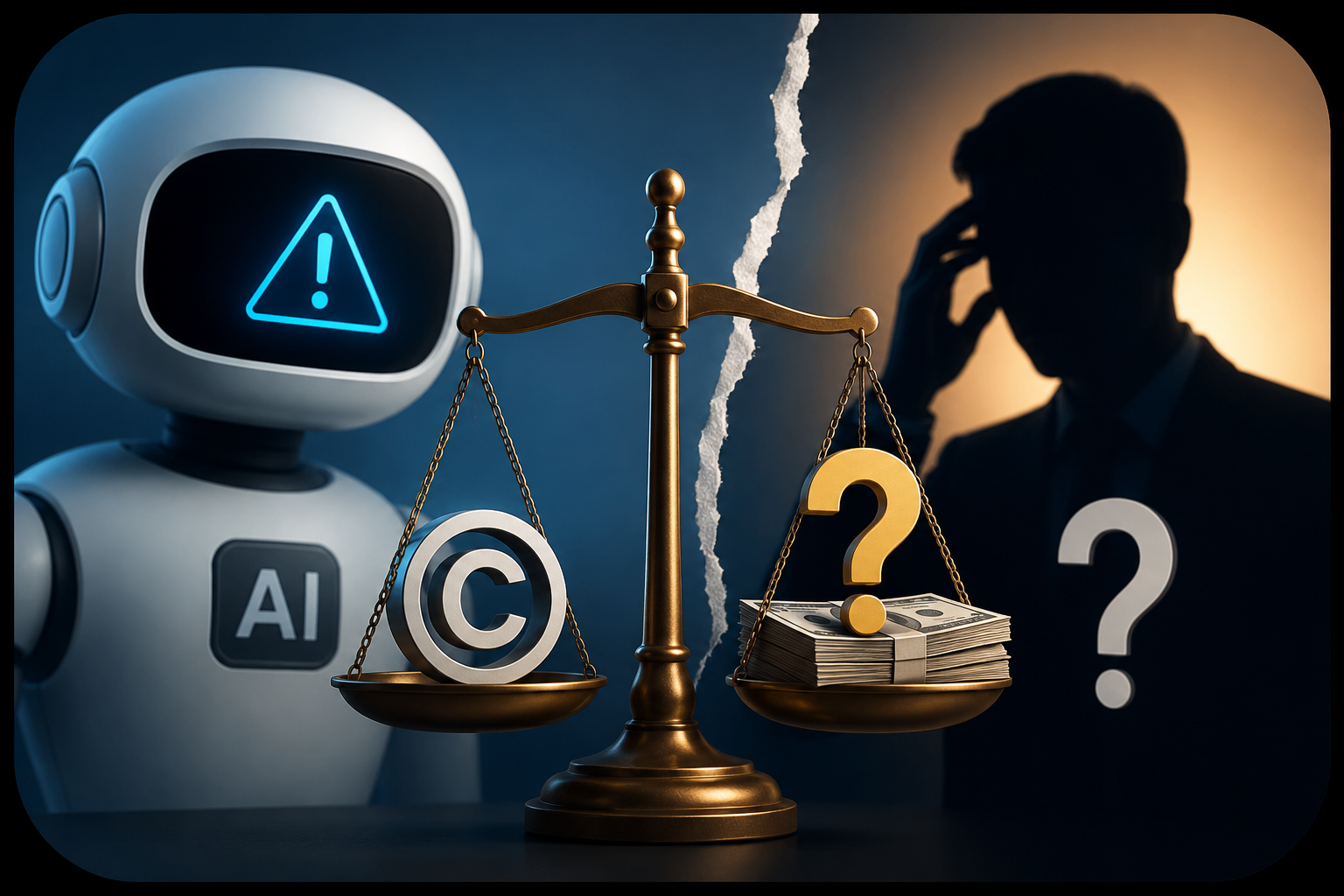
Someone, somewhere, is finding out right now that the "AI-generated" image on their new website looks a lot like a cartoon character owned by a studio with very good lawyers. Someone else just got a legal notice because an AI tool their company used quietly copied text from a book. And a founder who spent six months building a product around AI-generated content just realized none of it may actually belong to them.
This isn't a hypothetical anymore. It's Tuesday.
AI tools write, design, code, and create faster than any human team ever could. But when something goes wrong a factual error that costs someone money, an image that looks suspiciously like someone else's copyrighted work, a chatbot that gives bad advice the question everyone eventually asks is the same one: who is actually responsible?
The honest answer is that the law is still catching up. But it isn't a blank page either. Courts around the world have already started drawing lines, and the picture that's emerging should worry anyone who assumes "the AI did it" is a legal shield.
Why This Question Isn't Going Away
More than 70 AI copyright lawsuits are currently active or recently resolved across courts in the US and internationally, with total claimed damages estimated well beyond 50 billion dollars. That number alone tells you this isn't a fringe legal debate it's the new normal for any business building on, or around, AI.
The biggest confirmed number so far came from Bartz v. Anthropic, where the company agreed to pay 1.5 billion dollars to settle claims tied to roughly 482,000 works, working out to just over 3,000 dollars per book. That case turned on a distinction that matters for everyone: training an AI model on legitimately obtained material may be treated as fair use, but training it or even just storing it using pirated copies is a different story entirely, and courts have made clear there's no shortcut around that.
Disney and other major studios are separately pursuing a case against an AI video generator, arguing that when a system can reproduce near-perfect renditions of recognisable characters from a short prompt, the responsibility can't simply be waved away as "the user typed it, not us." That argument that a generative system carrying copyrighted material inside it is fundamentally different from a neutral pipe that just carries traffic is likely to shape how liability gets decided for years to come.
So, Who's Actually Liable? It Depends Who's Standing in the Room
There isn't one villain in these disputes there are usually several parties who could be on the hook, depending on what exactly went wrong.
The company that built the AI model can be liable if the harm traces back to how the system was trained for instance, if it was trained on pirated or unlicensed material, or if the model was designed and marketed in a way that all but invited copyright violations.
The business or individual deploying the AI tool commercially can be liable for what the tool produces on their behalf, especially if they published, sold, or distributed the output without checking it. Using an AI tool doesn't transfer your legal duty of care to the AI company courts have generally expected the deployer to exercise reasonable diligence.
The end user typing the prompts can also carry responsibility, particularly if they deliberately prompted the system to reproduce a specific copyrighted character, brand, or work.
And then there's a separate, quieter problem: ownership. In a case that went all the way to the US Supreme Court, the Court declined to overturn lower rulings holding that copyright protection requires human authorship meaning works generated by AI without meaningful human creative input generally cannot be copyrighted at all. That has enormous implications for any business whose content strategy, branding, or product output leans heavily on AI generation. If you can't prove meaningful human creative input, you may not actually own what you think you own.
When AI Gets It Wrong, "The Algorithm Made a Mistake" Isn't a Defense
Errors are where this gets personal fast. An AI tool that gives incorrect financial guidance, drafts a contract with a fabricated legal citation, misdiagnoses a business risk, or generates defamatory content about a real person doesn't just create an inconvenience it can create real financial and reputational damage.
Liability in these situations tends to follow the same logic as any professional negligence claim: was there a duty of care, was it breached, and did that breach cause quantifiable harm? The fact that an AI system was involved in generating the error doesn't automatically excuse the human or company that relied on it and passed it along. If anything, regulators and courts are increasingly treating "we didn't verify the AI's output" as a failure of due diligence in its own right, not a mitigating factor.
What This Means If You've Been Affected
If you've discovered AI-generated content that copies your original work, if your business has been harmed by an AI tool's factual error, or if you're a creator whose books, art, music, or code may have been used without permission to train a model, you are not without options. These cases are winnable, and the legal landscape while still evolving is increasingly favourable to people who can show clear, documented harm.
The challenge is that these disputes sit at the intersection of intellectual property law, contract law, and fast-moving technology, which means generic legal advice often falls short. You need guidance from people who are actually tracking how these cases are unfolding in real time.
How Fairaigle Legal & Consultancy LLP Can Help
This is exactly the kind of complexity Fairaigle Legal & Consultancy LLP was built to handle. The firm works with creators, businesses, and individuals who have been affected by AI-related copyright infringement, wrongful use of their original work, or damages caused by AI-generated errors and misinformation.
Whether you're trying to determine if your copyrighted material was used without consent to train a model, need help asserting ownership over AI-assisted work, or have suffered a financial or reputational loss because of an AI tool's mistake, Fairaigle's team can assess your case, explain where you realistically stand, and pursue the right course of action on your behalf from formal notices and settlement negotiations to full litigation support.
You don't need to already understand the legal technicalities. You just need to bring what happened to you, and let people who track this space daily tell you what it's actually worth pursuing.
Think You Have a Case? Don't Sit on It.
Copyright and liability claims involving AI move fast, and evidence can become harder to trace the longer you wait. If you believe your work has been used without permission, or that an AI-generated error has cost you money, clients, or reputation, reach out to Fairaigle Legal & Consultancy LLP for a case review. The sooner you talk to someone who understands this space, the stronger your position will be.
