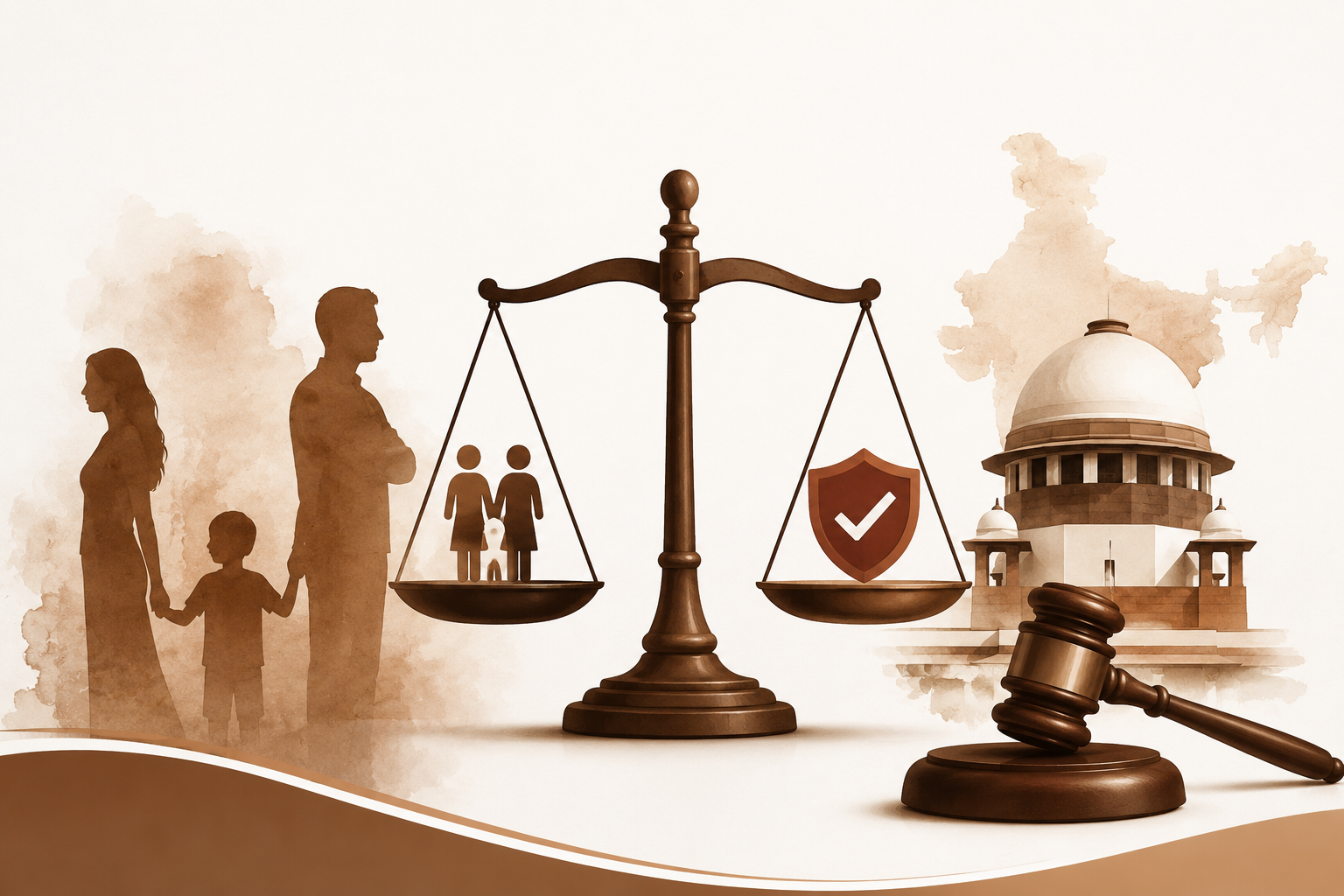
Family Law Cases in India: How Courts Have Balanced Justice and Misuse
Walk into any family court in India on a weekday morning and you will see two very different stories playing out in the same corridor. In one courtroom, a woman is finally getting a protection order after years of being told to "adjust." In the next, an elderly couple in their seventies is fighting to get their names struck off a cruelty case filed by a daughter-in-law they met perhaps a handful of times. Both scenes are real. Both happen every single day. And both explain why Indian courts, especially the Supreme Court, have spent the last decade trying to walk a very fine line: protect genuine victims of matrimonial cruelty without letting the law become a tool of personal vendetta.
This isn't an abstract legal debate. It shows up in dowry harassment complaints under Section 498A of the old Indian Penal Code (now Sections 85 and 86 of the Bharatiya Nyaya Sanhita), in domestic violence petitions under the Protection of Women from Domestic Violence Act, 2005, and in maintenance disputes under Section 125 of the CrPC and the Hindu Marriage Act. Each of these laws was written with a clear, protective purpose. Each has also, at some point, been stretched, exaggerated, or weaponised. The story of family law in India over the last fifteen years is really the story of courts learning to tell the two apart.
Why These Laws Were Made So Strict in the First Place
It helps to remember why Parliament gave these provisions teeth in the first place. Dowry deaths and matrimonial cruelty were, and in many pockets still are, a serious and under-reported problem. Section 498A was inserted into the IPC in 1983 specifically because ordinary cruelty and assault provisions were not capturing the slow, sustained mental and economic abuse that many married women faced inside their own homes, often tied to dowry demands. The Dowry Prohibition Act and, later, the Protection of Women from Domestic Violence Act, 2005, were built on the same logic: a woman should not have to wait for a bruise to show up before the law takes her seriously.
Because lawmakers wanted these provisions to have real bite, they made the cruelty offence cognizable and non-bailable, meaning police could register a case and arrest without first seeking a magistrate's permission. That design choice protected genuine victims from procedural delay. It also, almost inevitably, created room for misuse, because an arrest could now be triggered on the strength of a complaint alone, before any judicial scrutiny of its truth.
When Protection Turns Into Pressure: The Misuse Problem
Over time, judges across the country started noticing a pattern. Complaints filed during the heat of a marital breakdown would name not just the husband, but his parents, siblings, married sisters living abroad, and sometimes distant relatives who had barely been part of the couple's daily life. The Supreme Court itself remarked, in the case that quashed proceedings against an elderly couple, their five daughters, and even a family tailor, that it was unfortunate to see criminal machinery used so broadly against people with no specific role in the alleged cruelty.
The numbers tell a similar story. RTI data drawn from five district courts in Delhi, covering cruelty trials between 2021 and 2024, showed that out of nearly 9,950 such trials, only around 23 ended in conviction, a conviction rate of roughly 0.2 percent, while close to half were quashed by higher courts and several hundred more resulted in acquittal. That kind of gap between complaints filed and guilt actually established is exactly what pushed the judiciary to start asking harder questions about specificity, evidence, and intent before letting a matrimonial dispute turn into a multi-year criminal trial for an entire family.
The Judicial Course Correction: A Decade of Calibration
Preeti Gupta vs. State of Jharkhand (2010): The First Warning
Long before the Supreme Court built formal guidelines, it flagged the problem in Preeti Gupta v. State of Jharkhand, cautioning that relatives living in different cities or even different countries were routinely named in complaints with no real allegation against them individually. The Court urged trial courts to read FIRs with a critical eye rather than treat every named accused as equally culpable.
Arnesh Kumar vs. State of Bihar (2014): No More Automatic Arrests
This is probably the single most cited judgment in this entire space. The Supreme Court held that police could not arrest a person merely because a Section 498A complaint had been filed. Officers were directed to apply the checklist under Section 41 of the CrPC, satisfy themselves that arrest was genuinely necessary, and record reasons for that decision. Magistrates, in turn, were told to scrutinise those reasons before authorising further detention. The judgment didn't dilute the offence itself; it simply restored the idea that arrest is a serious step that needs justification, not a reflexive response to a single complaint.
Rajesh Sharma (2017) and Social Action Forum for Manav Adhikar (2018): Trial, Error, and a Step Back
In 2017, the Supreme Court went further in Rajesh Sharma v. State of Uttar Pradesh, directing every district to set up a Family Welfare Committee that would screen 498A complaints before any arrest could follow. It was a well-intentioned attempt to add a buffer against hasty criminal action. But within a year, in Social Action Forum for Manav Adhikar v. Union of India, a three-judge bench led by then Chief Justice Dipak Misra reconsidered the idea. The Court held that creating an entirely new screening body outside the framework of the CrPC overstepped what judicial interpretation could legitimately do, and struck down the Family Welfare Committee direction. At the same time, it retained the more procedural safeguards, such as guidance on arrest, investigation, and the possibility of quashing cases that settle, showing that the Court was willing to correct its own overreach while keeping the underlying safeguards intact.
Rajnesh vs. Neha (2020): Balance on the Money Side of Family Disputes
Misuse in family law isn't only about criminal complaints; it shows up just as often in maintenance disputes, where one side inflates needs and the other conceals income. In Rajnesh v. Neha, the Supreme Court laid down a uniform, mandatory format for an "Affidavit of Disclosure of Assets and Liabilities" to be filed by both spouses in every maintenance proceeding across the country, along with timelines for filing and clear criteria for deciding the amount. This is a quieter judgment than the criminal-law cases, but arguably just as important, because it tackled misuse from both directions at once: exaggerated claims on one side, hidden income on the other.
Kahkashan Kausar vs. State of Bihar (2022): Naming Relatives Is Not Enough
By 2022, the Supreme Court had built a clear principle: vague, general, "omnibus" allegations against a husband's relatives, without any specific incident attributed to them individually, amount to an abuse of the legal process. In Kahkashan Kausar v. State of Bihar, the Court quashed proceedings against in-laws where the complaint simply listed names without describing what each person had actually done. This case is now a standard reference point whenever a family member with no concrete role is dragged into a matrimonial criminal case.
2024 - 2026: The BNS Era and a Fresh Wave of Scrutiny
From 1 July 2024, Section 498A IPC was carried forward, almost word for word, as Sections 85 and 86 of the Bharatiya Nyaya Sanhita, 2023, with the cruelty offence and its definition now split across two provisions instead of one. The substance didn't change, and neither did the judicial caution around it. Through 2025, the Supreme Court continued to quash cases built on generic allegations, including in Dara Lakshmi Narayana v. State of Telangana and Ghanshyam Soni v. State (NCT of Delhi), where it set aside a decades-old FIR against an elderly couple and several family members for lack of specific evidence. In Rajesh Chaddha v. State of Uttar Pradesh, the Court acquitted a man after roughly two decades of litigation, finding the original conviction had rested on vague testimony rather than concrete proof.
At the same time, the Court was equally clear that none of this meant the law itself was flawed. In Janshruti (People's Voice) v. Union of India, the Supreme Court rejected a plea to declare Section 498A unconstitutional, holding that occasional misuse has to be addressed case by case through judicial scrutiny, not by scrapping a provision that genuinely protects women. And in mid-2025, the Court endorsed Allahabad High Court guidelines introducing a short cooling-off period and a structured referral mechanism before coercive action is taken in fresh complaints, an attempt to build the safeguard that the original Family Welfare Committee idea had reached for, but within a framework the law actually permits.
Justice, Not Dilution: How Courts Draw the Line
What runs through every one of these judgments is a single, consistent idea: the problem courts are solving for isn't the existence of these protective laws, it's the lack of specificity and verification before they're used to deprive someone of liberty or reputation. When a complaint contains clear, dated, specific allegations backed by some corroborating material, courts have shown no hesitation in allowing trials to proceed and convictions to stand. When a complaint reads like a list of grievances copy-pasted onto every family member's name, courts have increasingly stepped in early, often through quashing petitions, rather than making an accused wait years for an acquittal that, as the Supreme Court itself has noted, rarely undoes the social and financial damage of a prolonged criminal trial.
This is also why the broader story of Indian family law isn't only about narrowing protections. The same judiciary that has cracked down on omnibus dowry complaints has, in other moments, expanded protection for women, striking down instant triple talaq as unconstitutional in Shayara Bano v. Union of India and decriminalising adultery in Joseph Shine v. Union of India on the ground that the old provision treated a married woman as her husband's property. Read together, these cases show a judiciary that is trying to get the substance of family justice right on both ends, neither soft on genuine cruelty nor blind to the human cost of a wrongly filed case.
What This Means for Families Today
For someone going through a marital breakdown right now, this evolving case law has very practical consequences. A complainant who wants a 498A or domestic violence case to hold up needs to document specific incidents, dates, and the individual role of each person named, rather than a general account of an unhappy marriage. Someone facing a complaint that genuinely doesn't involve them needs to move quickly, through anticipatory bail or a quashing petition, armed with the line of cases described above. Anyone in a maintenance dispute should expect to file, and to insist the other side files, the disclosure affidavit that Rajnesh v. Neha now makes mandatory, because vague claims about income or need no longer carry weight on their own. And increasingly, courts themselves are nudging families toward mediation before litigation, recognising that a settled dispute resolves the underlying conflict in a way a decade-long trial rarely does.
How Fairaigle Legal & Consultancy LLP Can Help
Cases like these rarely come down to a single clean question of right and wrong. They come down to evidence, sequence of events, and how convincingly a story can be told and supported on paper. That's where having the right legal partner matters more than most people realise until they're already in the middle of a dispute.
Fairaigle Legal & Consultancy LLP, based in Hyderabad and led by Advocate Anindita Pal, works on exactly this kind of case from both sides of the table. The firm's approach to matrimonial and family disputes leans heavily on mediation and conflict resolution first, in line with where Indian courts themselves are pushing family law, while keeping litigation ready as the next step when a settlement genuinely isn't possible.
A few things make their approach particularly relevant to the cases discussed in this article. For someone who has genuinely faced cruelty or domestic violence, the firm helps build a complaint that is specific, well-documented, and capable of standing up to the kind of scrutiny courts now apply, rather than a generalised account that risks being read as omnibus or vague. For someone wrongly implicated, especially a relative with no real role in the dispute, the firm works on early relief through anticipatory bail and quashing petitions, drawing on the same line of Supreme Court reasoning covered above. And because Advocate Pal also holds a master's degree in forensic science and criminology alongside her litigation background, the firm brings a fact-and-evidence-first lens to matrimonial disputes, which matters enormously in cases that ultimately turn on whether an allegation can actually be substantiated.
Beyond cruelty and domestic violence matters, the team also handles maintenance disputes, divorce proceedings, child custody, and the disclosure and documentation work that cases like Rajnesh v. Neha now require, alongside the firm's broader litigation, arbitration, and business consultancy practice.
FAQs
Is Section 498A still in force, or has it been removed?
It hasn't been removed. From 1 July 2024, it continues as Sections 85 and 86 of the Bharatiya Nyaya Sanhita, with the same punishment range and the same definition of cruelty. Cases filed before that date are still prosecuted under the old IPC section; new complaints are registered under the BNS provisions.
Can my entire family be arrested just because my spouse filed a 498A or domestic violence complaint?
No, not automatically. Following Arnesh Kumar v. State of Bihar and later judgments like Kahkashan Kausar v. State of Bihar, police are required to assess the necessity of arrest, and courts have repeatedly quashed cases where relatives were named without any specific allegation against them individually.
What is the "cooling-off period" people are talking about in recent 498A cases?
It refers to guidelines, developed by the Allahabad High Court and endorsed by the Supreme Court in 2025, that build in a short waiting period and a structured screening step before coercive police action follows a fresh cruelty complaint, aimed at separating genuine cases from impulsive ones filed in the heat of a dispute.
If a 498A or dowry case is found false, what happens to the person who filed it?
There's no automatic punishment built into the cruelty provision itself, but courts can, in appropriate cases, direct action for perjury or malicious prosecution, and a quashed or acquitted case can be used as a basis for a separate civil or criminal complaint, including for defamation, depending on the facts.
How is maintenance amount actually decided now?
Since Rajnesh v. Neha (2020), both spouses must file a standard "Affidavit of Disclosure of Assets and Liabilities," and courts are expected to fix interim and final maintenance based on that documented financial picture rather than on unverified claims from either side.
Does the new criminal code (BNS) make it harder or easier to file a cruelty case?
Procedurally, it's largely the same. The BNS renamed and renumbered the offence but kept the substance, the punishment, and the safeguards built up through years of Supreme Court rulings intact.
Is mediation compulsory before going to court in a family dispute?
Not universally mandatory in every case, but courts increasingly refer matrimonial disputes to mediation centres or family counsellors as a first step, and many High Courts and the Supreme Court have actively encouraged settlement before a full trial, especially where children are involved.
Can a husband or his family get a false case quashed before trial even begins?
Yes. Under Section 482 of the old CrPC, now Section 528 of the Bharatiya Nagarik Suraksha Sanhita, High Courts have the power to quash an FIR or chargesheet at an early stage if the allegations, even taken at face value, don't disclose a specific, credible case, exactly the relief granted in several of the 2025 Supreme Court rulings discussed above.
Talk to Someone Before the Next Step
If you're dealing with a family law matter right now, whether you're trying to document a genuine grievance properly or trying to clear your name from a case that doesn't reflect your actual role, the early decisions you make tend to matter the most. Reach out to Fairaigle Legal & Consultancy LLP through fairaigle.in or write in at fairaiglelegal@gmail.com to set up a consultation and understand where you actually stand before deciding your next move.