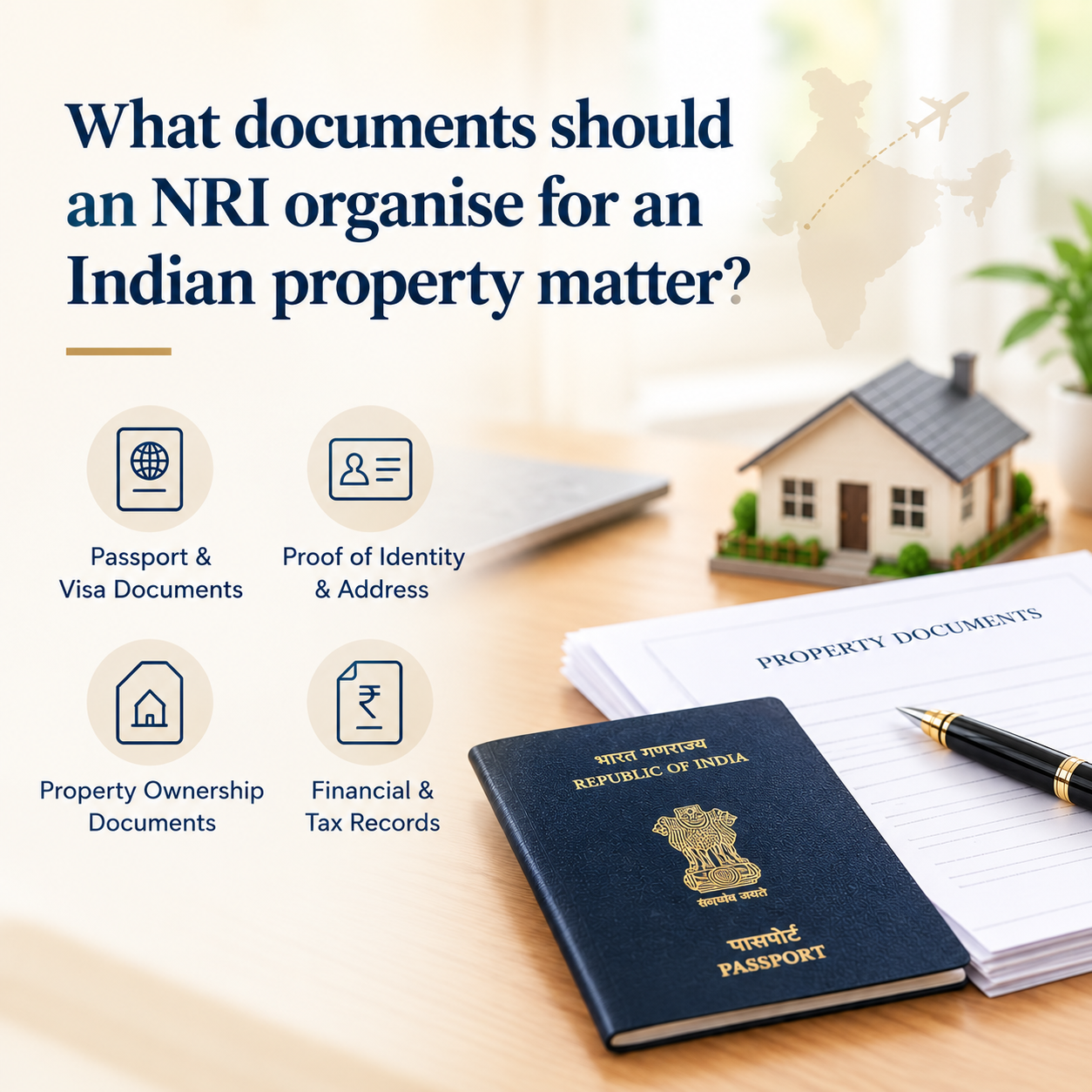
You’re in Dubai, London, or Toronto. Your family home in India is still in your name. Then a call comes: a tenant has stopped paying, a relative wants to “just sign a few papers,” or a buyer wants to close in two weeks. Without the right documents, you’re stuck, and fast.
This guide is for NRIs and their families dealing with Indian property. It explains in plain words what to organise, what has changed recently, and what to avoid.
Your Core Document Checklist
Keep these in one folder, scanned and stored in the cloud, with originals somewhere safe.
- Title deed or sale deed: Proof that the property is legally yours.
- Encumbrance certificate: Shows whether the property has loans or legal claims on it. Get one covering 30 years.
- Property tax receipts and utility bills: Proof of ownership and no pending dues.
- Khata, patta, or mutation records: Your name must be in local revenue records, not just on paper.
- Passport, visa, and OCI/PIO card: Proof of your NRI status.
- PAN card and Indian bank account: Needed for almost every transaction. Use an NRO or NRE account.
- Approved building plan and occupancy certificate: Skip these and a future buyer’s lawyer will flag it.
- Will or succession papers: Essential if the property came to you through inheritance.
Power of Attorney: Powerful and Risky
Most NRIs can’t fly back for every signing, so a Power of Attorney (PoA) is common. Do it carefully.
- Sign it before a notary or the Indian embassy abroad. If your country is part of the Hague Apostille Convention, get it apostilled instead. The MEA website explains how.
- Bring it to India and pay stamp duty and registration within the time allowed. Rules differ by state.
- Name one trusted person, and list exactly what they can do. Avoid “do everything” language.
- Revoke it in writing when the job is done.
New Law Updates: What Changed for NRIs
Capital gains tax on property. Since the July 2024 Budget, long-term capital gains on property are taxed at 12.5%, and the old indexation benefit is gone. The Finance Act 2024 allows resident individuals the choice between the old and new method for property bought before 23 July 2024, but NRIs generally don’t get that choice. Check your own case with a chartered accountant.
TDS on sale. When an NRI sells property, the buyer must deduct tax at source, and it can apply to the entire sale price, not just your profit. If your actual gain is small, apply for a lower deduction certificate from the tax department before the sale.
The new Income Tax Act. India’s new Income Tax Act, 2025 replaced the 1961 Act from 1 April 2026, so section numbers you see on older websites may be outdated. Always check the current rules on the official Income Tax portal.
Repatriation. NRIs can send sale proceeds abroad, up to USD 1 million per financial year, with Form 15CA and 15CB and proof that taxes were paid. Check the RBI website for the latest limits.
Case Law Breakdown: Why Registered Papers Matter
Suraj Lamp & Industries v. State of Haryana (Supreme Court of India)
The situation: Many property deals were happening through a “GPA sale.” The seller handed over a Power of Attorney, an agreement to sell, and a Will, and the buyer treated that as full ownership. No registered sale deed was made.
What the Court said: These arrangements do not transfer ownership. Under the Transfer of Property Act, the sale of immovable property above the legal value needs a registered sale deed. A PoA only lets someone act for you. It does not hand over your property.
What it means for you: If you’re buying, insist on a registered sale deed. If you’re selling, never let anyone treat your PoA as a transfer of title. Courts still rely on this ruling, and you can read Supreme Court judgments on the official Supreme Court of India website.
FAQ's
Can an NRI buy property in India?
Yes. NRIs and OCIs can buy residential and commercial property without special RBI approval. Agricultural land, plantations, and farmhouses are not allowed.
Do I need to be present for registration?
No. A properly drafted and registered PoA lets someone sign for you.
Can my NRI status block an inherited property?
No. NRIs can inherit property in India. You will need succession papers, and tax and repatriation rules still apply when you sell.
What happens if my relatives occupy my property?
Move early. Send a legal notice and collect proof of ownership. Delay can make removal harder.
People Also Ask
How do I check if a property title is clean?
Ask a local property lawyer to check the title deed history, the encumbrance certificate, and court records for disputes.
Is a Will valid if I made it abroad?
Yes, if it’s properly signed and witnessed. Registering it in India makes it easier to prove later.
Can I rent out my property from abroad?
Yes. Use a written rent agreement, and remember that rental income is taxable in India.
Do I have to file income tax in India?
If you earn income in India, such as rent or capital gains, usually yes.
Quick Action Plan
- Gather and scan every title and tax document this month.
- Update your name in local revenue records.
- Execute a limited PoA only if you really need one.
- Speak to a property lawyer and a chartered accountant before any sale.
- Keep all tax payment proofs for repatriation.
Don’t Wait for the Dispute
Most NRI property fights begin with missing paperwork, not bad intent. Spend a weekend sorting your documents now, and you save months, even years, of stress later.
Need personalised guidance? Speak to a qualified property lawyer in the state where your property sits. Laws and stamp duties vary by state.
